

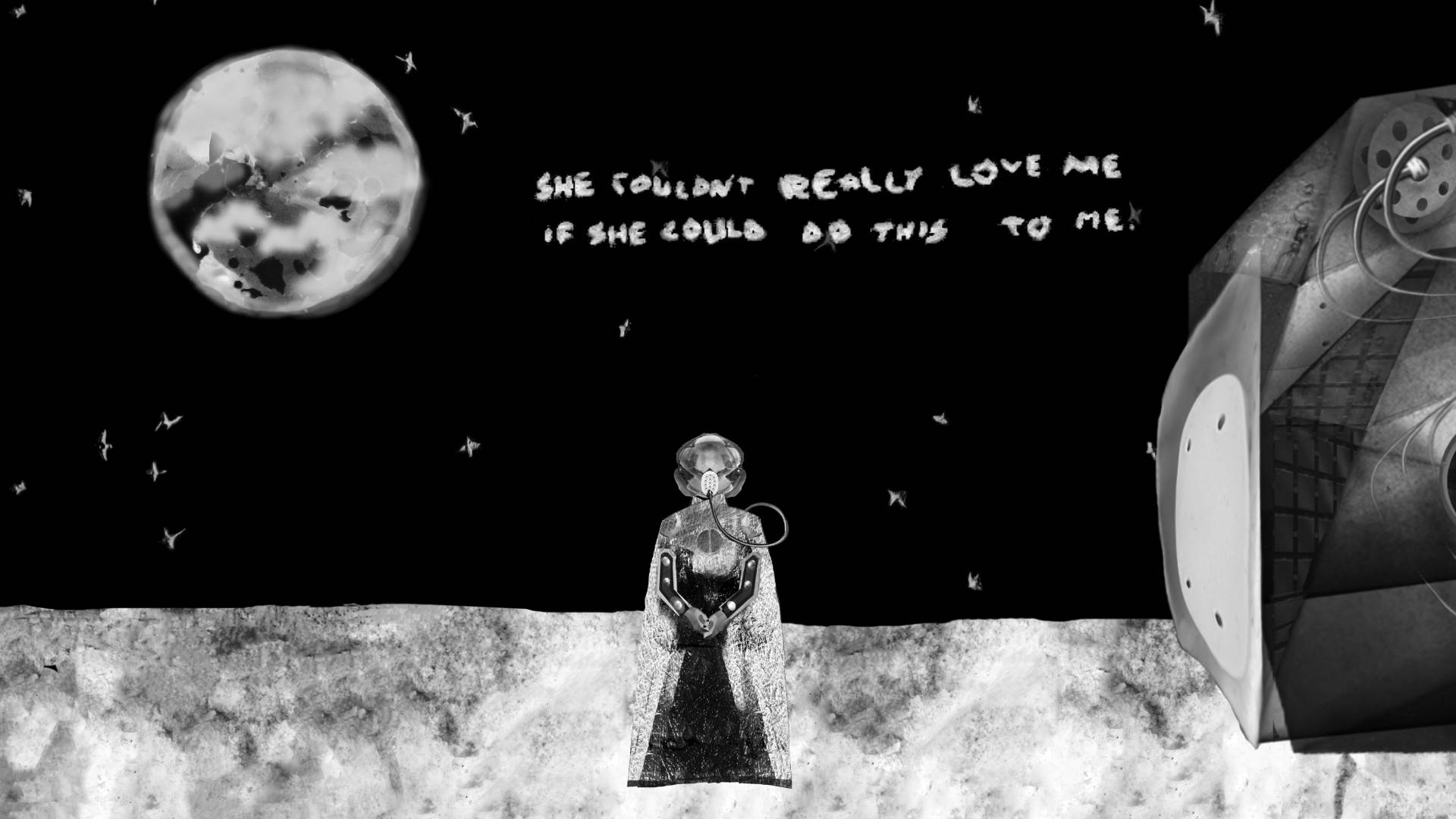
Featured image: Ritual of the Moon screenshot.
Are games just games?
It is hard to ask the question without evoking the charged politics of 2014 “GamerGate” and to fall into that classic culture war, the seemingly endless tug of war between “games are just games” and “games are a medium that implicitly teaches culture, which can be bad/good/ideological/propaganda.”
Much ink has been spilled on the violent ideologies of video games: first-person shooters, as a genre, “normalize and furnish” fantasies. Role-playing games, as a genre, assuage work anxieties. Sandbox games are likewise a colonialist fantasy of a land without Native peoples. Some go so far as to state that all video games have a capitalist, violent background because of their history as part of “empire.”
However, it doesn’t seem like “the discourse” has truly shifted the landscape of the games that we play. Many popular games are still violent, shooting games which “furnish violent, masculine fantasies of American empire”: Counterstrike, Fortnite, Valorant, Call of Duty. Sandbox games like Minecraft and Roblox still dominate the charts. And people are playing video games more than ever.
So what is the point of saying all of these things?
In sociologist Musa Al-Gharbi’s latest book, he asks the same question. He argues that the social justice discourse which dominates elite institutions and corporations, though purportedly performed in favor of social justice, is actually employed in service of advancing symbolic capitalists’ social position. It’s a way to legitimize privilege on moral terms. This is because this language is primarily spoken by elites, taught to elites in school, and used as a way to dismiss those of lower class status. For example, the people who are the least likely to know the terms “cultural appropriation” or “microaggressions” are the people for whom the discourse is “for”: minorities, people of lower classes. This essay is very much inspired by his argument that “video games have never been woke”: that focusing on diversity and representation in video games “miss the actual impacts these companies and their products have on society, which are often far out of step with their progressive rhetoric.” Namely, exclusive hiring practices, outsourcing labor, exploitative practices, and, uh, hoarding money and power.
Following his footsteps, I argue that game studies are also part of this trend. By “discovering” an embedded “bad” political ideology in games, game critics leverage fancy words to make themselves seem fancy and smart. Along these lines, popular games – which appeal to the “average” consumer – are morally bad, while less popular games – which appeal to our highly refined tastes – are morally good. The purpose of this critique is to create a new frontier of differentiation: we don’t play immoral games, but they do. I know the immorality of these games, but they don’t.
Through this lens, “progressive” thinking on games might be much less progressive than we think. Game critique has never been woke.
Minecraft and Colonialism
For example, take this YouTube video: Minecraft, Sandboxes, and Colonialism, published by Dan Olson, with (as of 6/3/2026) 1.1 million views. The video excavates out a problem from a particular piece of media which has only a very slight and convoluted relationship to that problem. It is evident from the qualified analysis itself, that the analysis is qualified. Dan says,
It’s a particularly interesting case study in the way that game systems create metaphor, and that even if you didn’t intend for your mechanics to incentivize kidnapping, you still sort of created a game where the player is kind of encouraged to do a kidnapping. This interaction doesn’t just mimic kidnapping, but more specifically the brutal relocation policies of colonialism.
Emphasis on “sort of” and “kind of” and “mimic.” The villager-boat interaction merely looks like the “brutal relocation policies of colonialism,” and that is where the similarity ends. (I suspect no victim of real life, honest-to-God, violent, brutal colonialism was interviewed in the making of this video.) This argument is (and acknowledges itself to be) a stretch.
It is not meant to condemn the people playing the game (Dan himself has spent countless hours playing Minecraft), nor does it suggest that we stop playing the game altogether. It’s a harmless think-piece that makes you go, hmmm, that’s interesting and continue on with your life. Perhaps you will think more deeply about what your games mean and the ideas that you can extrapolate from the games themselves. The overall message seems me to be solid: “your values and interests are authentic, but they were not formed in a vacuum.”
I admit, though, that when I watched the video, I was highly triggered. I spent a lot of time formulating theses about how to rebuke the argument that Minecraft is “about” colonialism. In fact I have pages and pages of analysis, backed up by John Guillory and Musa Al-Gharbi and whatnot. The truth is my arguments aren’t very interesting, and they simply rehearse what people in the comments have already vigorously debated.
What’s more interesting to talk about is what the video seems to be “for.” Who is watching the video? (From what it looks like in the comments section, very few people who aren’t already pre-convinced.) If the audience is people who already kind of believe what he’s saying, then why make it? Could it be a signal of his own “right-thinking,” his affiliation with the correct group? Or a public confession, akin to self-flagellation, for his “doing a colonialism”? Or just… sheer intellectual curiosity? All of the above, none of the above; at the end of the day, it’s a relatively harmless video. It was not designed to foment anger, to be an iron on the culture wars, even if I was provoked.
The thing that upset me the most was the fact that this video was assigned to me in a class about video games, and thus, the video became a proverbial log on the fire for the bland identity-based liberalism that pervades classes at Stanford. That, instead of asking perhaps more interesting, targeted questions about privilege and class (equally provoked by media), we are asking whether Minecraft depicts colonialism. That is to say, it feels useless, considering the fact that the very act of playing video games actively contributes to extractive colonialism because you’re using chips which had to be mined from the Congo, etc. etc. etc. and so on and so forth.
On the other hand, what I disagree with are the arguments which condemn all of a particular genre for “embodying” a particular value set. In the video, he cites this sentence from the article Colonized Play: “In an era where physical space has been thoroughly explored, virtual spaces harken back to the romance of the colonial frontier—as new regions to discover and conquer. Such conquest is not just psychosymbolic, but also sensitive to the legacies of colonialism and underdevelopment.”
In particular, I am turned off by the words “psychosymbolic,” “sensitive,” “underdevelopment.” I dislike the Chat-like juxtaposition (although I’m sure it was written pre-Chat): “it’s not just [one word], but also [a string of much fancier words said in a convoluted way].” The sentence is wishy-washy and vague and alienating. It sounds good, but it really doesn’t have much to say. What does psychosymbolic mean? What does it mean to be “sensitive” to legacies? Does this even matter in terms of real politics (how people behave in the world)? Under this framework, what do we say about a colonized person playing Minecraft? Does that mean that Minecraft is no longer colonialist, that instead it’s a reparative, constructive way to free the colonized people from the material constraints of the world? Or that the colonized person is reenacting their own colonization?
Rather, due to the amount of agency we have in sandbox games (especially Minecraft), sandbox games are probably the least likely to change our minds – thereby being the least political games. It doesn’t force you to explore, kill people, or kidnap villagers. Its tutorial tells you to build a crafting bench, and that’s about it. You can play it in a totally destructive, “colonialist” way by building breeders or farms, or you can play it in a constructive, non-colonialist way by regrowing all the trees you cut. Unlike other forms of media, you choose what happens – which means the game is most likely to reaffirm your beliefs, not change them.
We should also consider how important subliminal messaging really is: might we be overvaluing the impact of Minecraft (the medium) on ideology? What’s more important is probably the people you encounter in Minecraft in servers or your friends and family. I just think that these social interactions far outweigh the underlying political messaging of games. Representation is important, but like, not that important. If we really care about colonialism in Minecraft, we should care about it in real life, too.
Dan isn’t the only one to make this kind of argument for Minecraft and its relation to colonialism. For example, I found this article featured on JSTOR Daily, which argues that Minecraft “can and should be considered a foundational digital text of settler colonialism.” Admittedly, this article has 15 citations, so it’s probably not the foundational digital text for understanding how Minecraft is about colonialism, either. There’s a lot of overreading when he writes about the creatures in Minecraft: “The construction of these humanoids reflects specific moments in the fictions of colonialism; zombies and skeletons engage the cannibalistic and phantom-like characterizations of Indigenous people in the Americas, Africa, and Australia, and the mythology of monstrosity constructed as part-and-parcel of early European projects of domination.” While this might be true, it really is uncertain how popular depictions of zombies and skeletons affect the disproportionate poverty on contemporary Native reservations. It seems like literally anything could be “part-and-parcel of early European projects of domination” as long as you say “engage” and “reflect”; this is a post-materialist politics, one that takes popular culture to be the primary (and only) battlefield. The point of saying this seems to just be saying it: drawing a loose association between two very different things and thus being able to take the moral high ground.
Games are particularly susceptible to being the subject of anxieties about pop culture because they teach via play. Unlike other dominant forms of media, like streaming, TV, or books, games allow you to act. These actions can then be interpreted in a political way, even as it is underdetermined how the actions you perform in video games really affect how you behave in real life. It is easy to believe and assume that when players reenact violent fantasies, that transmits to them the idea that “violence is good”; it is easy to assume that when players reenact colonialist fantasies, that likewise transmits the idea that “colonialism is good.” But this overvalues the import of a sandbox game like Minecraft on real colonialism today, which doesn’t look like Minecraft colonialism at all. And it seems like the only purpose of the rhetoric is to preen our own feathers, to make ourselves feel smart and moral, because we are “anti-colonialist” and other people are not.
Which brings me to my next argument: why are the games which we call “capitalist” or “anti-feminist” or “colonialist” often… popular games? Who are “serious” games for?
Serious vs. unserious games
Take this book by art critic Melissa Kagen, Wandering Games. The book considers how “ideologies of work, gender, colonialism, and death inflect the ways we wander through digital spaces”; its main thesis is that wandering games can be subversive, tapping into “the vast heritage and intellectual history of the concept of walking in fiction, philosophy, pilgrimage, performance, and protest.” It’s about drawing a line between positively politically connotated games – wandering games – and negatively politically connotated games – violent, difficult, task-oriented games. One of the games she names as subversive is “Ritual of the Moon,” which she thinks is “as a queer, feminist take on wandering under constraints— constraints on space, on time, and on bodies.”
So what is “Ritual of the Moon”? The core concept of the game is that you’re supposed to play for 5 minutes, once a day for 28 days. The main character (which you play as) is a witch who has been exiled from her home planet, aided by her ex-lover, who is a woman. Every day, after clicking through a couple meditative “rituals” (drawing, etc.), you decide whether to destroy Earth or do nothing. It is a beautiful game with interesting, handmade textured art, but it seems to have reached few people because of its surprisingly repetitive structure and bugginess. It has a whopping 9 reviews on Steam and 9 reviews on the App Store (as of 6/7/2026). As one player, Cowcrusher, writes on Steam,
As dead-simple as it is, controlling the comet wasn’t immediately clear, leading me to accidentally hit the earth when it was not my intent. Also temporarily puzzling, is that when the day is done, there’s no button or visual cue to indicate how to leave the game, instead you’re supposed to intuitively know to hit the escape key. …
A game that you can only play once every 24 hours does not lend itself well to trial-and-error or experimentation, and even one bug can ruin an entire precious day. Unfortunately this happened to me almost immediately, as early on I was locked out for a day due to a time glitch. Achievements were spotty as well; and after completing the game, I attempted a second playthrough which resulted in a bug locking me out again.
(Surprisingly, it has been reviewed on Polygon, Rock Paper Shotgun, and Kotaku as a wonderful game, who praise its meditativeness and interestingness, even as the game has no real player base.)
Who is this game for? It clearly isn’t for the average player who wants to have “fun”: exciting action, complex storyline, difficult puzzles. The fact that you can only play it for 5 minutes a day means that it fundamentally cannot be immersive. Instead, it is the kind of game that’s meant to be “art,” meant to be approached dispassionately, intellectually, at a high level. It subverts the expectations of what games are, it pushes at its boundaries. That’s not bad, necessarily; I think it’s awesome that this kind of game exists. But being esoteric, inaccessible, exclusive to an elite audience – praised by reviewers, but not by players, and not to mention, $20 – isn’t exactly subversive. Ritual was made by a critic/scholar, seemingly for other critics/scholars, who are, by and large… elites.
Kara Stone herself wrote an article about the process of making the game on a PhD student publication. She explicitly names the intellectual sources that inspired the game, a bunch of books on queer studies and disability studies (literary criticism consumed by other literary critics). In her words, the essay is meant to “detail the possible ways in which game design and art practice can queer and crip time, labour, and repair.” What this looks like in practice is talking about how making the game was so difficult for her because she was suffering from a disability; and then how making the game was also helpful for her because she suffers from that disability. This can all be true, but I just don’t think a Canadian PhD student’s POV represents the “future of queerness, of racism, and of mental illness in North America and much of the world.”
This is the same argument that Kagen pretty much recapitulates. The game’s constrained space and time represents a queer/disabled POV. The witch creates an “alternative, spiritual space,” in contrast to “the vast landscapes of adventurous possibility proffered to the (mostly) male protagonists of video games.” In sum, the game is not like other games, and therefore subversive.
For example, Kagen takes pains to ensure that this 5-minute playtime is subversive of the genre – unlike other casual games whose 5-minute daily playtimes are not. She cites Shira Chess’s book Ready Player Two, which argues that casual games “which demand only a few minutes at a time to play are marketed to a stereotypical supermom who can only afford a brief break from the all-encompassing demands of work and family” (73). According to Chess, this is bad because this imagines an idealized audience (not matching real women) which makes women play these kinds of games, which makes companies make more games for women like this, etc. etc. Thus Chess formulates a quick-and-dirty “Bechtel test” to see if games do imagine a stereotypically female audience: low violence, low risk, “time positivity” (??). etc.
Okay: so Kagen’s point is that Ritual’s demand for 28 days in a row is subversive because it’s both a heavy time commitment (28 days) and a light time commitment (5 minutes a day). Also, Ritual scores only a 5 on the Bechtel test, which is an interesting score because it is only kind of designed for an imaginary idealized female audience. The problem with this argument is that it’s just kind of… wishy washy. Her criteria for subversiveness rests on Chess’s criteria for an imagined female audience, which are themselves dependent on loose stereotypes that assume certain things about what a 5-minute playtime means. It just seems like she can read any part of the game as subversive if the criteria is violent/not violent, casual/long, etc. etc. These are descriptive statements which don’t necessarily embed certain ideologies, unless, of course, you try to excavate the ideology out of them.
The easier comparison is right there: Ritual’s five-minute-daily more so resembles the five-minute-daily of wellness apps, journaling. For me, it evokes the contemporary, individualist turn into solo-healing, meditation, vague New Agey cooption of Indian practices, which are pretty much “part-and-parcel” of liberal capitalism. More largely, five-minutes-a-day resembles the “streaks” paradigm of many apps, which have this paradigm because they allow for easy monetization. Duolingo! Snapchat! Gamification in general!
This is not to say that we can’t make games like Ritual of the Moon. It makes sense that people want to make and consume games that cater to their interests. That’s fine. But we should not be calling them panaceas for resolving capitalism/patriarchy/etc., because people making games for themselves – elites making games for other elites – is not inherently “subversive.”
Our view vs. everyone else’s
This is a mistake that I fear many of us make: that just because something is good for us means that it’s good for society as a whole. The problem is that for symbolic capitalists – definitionally, the people controlling the media, producing the media, writing articles – our ideas generally do hold more weight than the “average Joe’s.” And then, with our experience in higher education, we also have the fancy language to back up our claims, making our positions seem like the most plausible, fact-generated positions.
That is not to say that I am immune to this trap. For example, I have a guilt-ridden relationship with gaming. I watch my favorite League streamer, PekinWoof, pretty much every day. It is immensely comforting, but also every time I do, I feel “gross,” like I am doing something wrong. Of all the activities that I do – painting, writing, playing music – it is the most “degenerate,” and it is the only activity that I have rigorously tried to regulate out of my life.
Over time, though, I have tried to accept my daily PekinWoof habit and my League of Legends playing as any other activity, equally valuable and “proper.” Part of my motivation for writing this paper is to “take back” gaming, and also to convince myself that I can “take back” gaming. Gaming can be quite harmful, but it can also be a wonderful way to build community. My gaming habit has helped me talk to so many different kinds of people. (Mainly 14 year old boys.)
Instead of critiquing the vague, moralistic politics of games, we should be critiquing the kinds of social formations that they allow for, something that has direct real world impact. We should treat them – like other cultural products – as a social technology, enabling specific kinds of social interaction. I think politics lies less in the games themselves, but in the social processes around them. That can look like Minecraft servers hosting neo-Nazi propaganda or in-person Minecraft parties with close friends. Minecraft as a medium can be more conducive to these kinds of activities, but that doesn’t mean Minecraft itself espouses neo-Nazism. Even if Minecraft does very indirectly and obliquely espouse neo-Nazism, it’s more important that we shut down those servers than try to add Jewish representation into the game. Action matters more than belief.
The purpose of critique shouldn’t be to regulate consumption, but to ask ourselves what is really important, and look for solutions. Otherwise, critique becomes a insular, masturbatory activity we do to make ourselves feel better about participating in the very colonialism/patriarchy/etc. that we are critiquing. Which, of course, as English speakers living in North America, we are indirectly always participating in.
Moreover, the root problem of “representation” in video games is not really on the audience level (whether we see representative media) but on the production level: who gets to make video games (and other media). And most media places only employ people with bachelor degrees, which immediately excludes approx. 60% of Americans, disproportionately people of low-income and minorities.
Also, we also overvalue representation in games/media/etc. because we interact with them more than other people. Pew Research Center says that 40% of adults with an annual household income of $75,000 or more say they use the internet almost constantly, but only 27% of those living in households earning less than $30,000 a year. Urban adults are more likely to go online than rural ones. The same goes for education – 42% of adults with a college degree or more education go online almost constantly, compared with 23% of adults with a high school diploma or less education. Symbolic capitalists overvalue the Internet, media usage, etc. and that reflects in our media-focused politics.
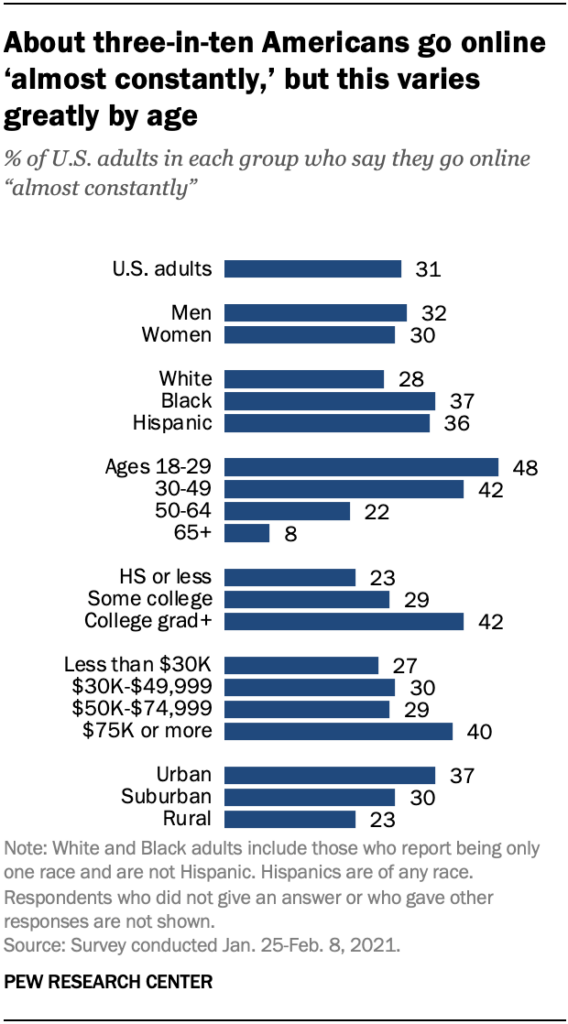
Figure 1. Stats on chronic-online-ness.
If we care about politics in games, I’d rather focus on labor rights, on exclusionary hiring practices, on “crunch” culture. I’d focus on how they exploit our attention, they exploit kids attention, and thus prevent us from talking to people. Or dark patterns that companies use to siphon our money. Whether Minecraft is colonialist or not? Not so much.
Finally, I thought this comment in the Minecraft YouTube video by @TheEnmineer was particularly insightful: Honestly, the effects of games on morality is significantly lower when it comes to producing these negative outcomes. Generally speaking the agency involved in this form of media means that it’s less likely to change people’s opinions on things than a good book or movie could. Games are a wonderful way to explore mental frameworks, but generally speaking aren’t very effective at actively changing people’s opinions much. It’s why we need a greater diversity/variety of games. Through gaming I’ve actually been able to get into the frameworks of a nuclear physicist, a ruler, and a thief. Though if my life is any example, I haven’t really changed my core beliefs much because of these experiences. The only thing I see here is an opportunity to see the world through a different set of eyes and actually increase human interconnectivity, not breed hostility.
If we want to do politics, we should just do politics. Sometimes, games are just games.
