by JP Aguilar, Reyna Duffy, Ananya Navale, Jessica Yauney
Artist Statement
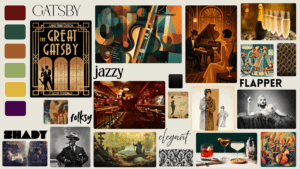
City of Vice is a hybrid analog-digital 4-player game that invites gamers to enter a stylized underworld of secrecy, deduction, and either pursuit or scheme. Set in a 1920s-inspired world where no one is squeaky-clean, the game draws on the visual language of noir glamour. Some light jazz music underscores the environment, shaping play as both challenge and theater.
At its center, the project reimagines the “escape room in a box” by replacing an abstract and generic timer with true narrative-infused stakes. Players do not simply race against the clock – they race against each other. Split into detective and heist teams, they experience urgency as a social and dramatic condition, generated through rivalry, asymmetrical identity, and the pressure of being outsmarted in real time. The result is a more believable and immersive reason to hurry.
Narrative is also embedded directly into the structure of play. A leaked note, a piece of evidence, a coded letter, and a rotating weekly password make each puzzle feel like a fragment of a larger criminal world rather than a detached challenge. City of Vice aims to turn puzzle solving into suspenseful storytelling: elegant, competitive, and alive with intrigue.

We built a hybrid project that includes an MVP and a slice. Given the competitive nature of the game we felt it important that players were able to complete the game. How unsatisfying would it be to play a game and then be told sorry we don’t know who won, that part isn’t built yet? However, we also felt that it was important that they feel the full aesthetic and narrative experience we were aiming to build as well. This led to us creating a full game where each team interacts with four puzzles (a tutorial + 3 full puzzles) but only the first full puzzle has been fully designed to match the narrative. The remaining two puzzles, while they contain many narrative elements, are only formatted text files, while the full puzzle includes elements like an evidence label and newspaper headline.
Game Core: Target Audience + Mechanics
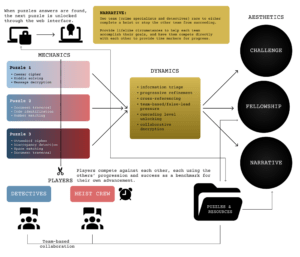
Our game aims to appeal to a target audience of teenagers, young adults, and full-fledged puzzlers who want an at-home immersion in a crime-cracking experience. The mechanics of the puzzles across the game include decoding letters, referencing documents, utilizing various ciphers (Caesar, Ottendorf), and identifying discrepancies – not very common game mechanics, but ones tailored to this particular game we’ve chosen to design. Based on the complexity levels of the 3 puzzles, there is a necessity to collaborate with another teammate to work efficiently and pool ideas for approaches. As a result, we intentionally created a dynamic of puzzle-solving collaboration that would replicate real-life circumstances of heist groups working together (like Ocean’s 11) or detectives piecing together different parts of a crime until they can identify a perpetrator (like Hercule Poirot in Agatha Christie’s Murder on the Orient Express). With two teams competing against each other to the finish, there is an additional dynamic of resilient thinking-outside-the-box. When one approach fails, players need to broaden their minds to retrace their steps and pick up the trail before it goes cold and the other team leaves them behind in the dust (so many metaphors!). Based on these mechanics and dynamics, we’ve designed a game that resides solidly in the Challenge, Fellowship and Narrative aesthetic spaces.
Narrative Type
City of Vice uses a combination of embedded and evocative narrative. The story – a rivalry between a heist crew and the police racing to beat each other to the punch! – is embedded directly into the puzzle artifacts themselves: intercepted letters, shipping logs, speakeasy order records. Players don’t watch the story unfold; they excavate it themselves. The narrative is fully baked into the documents before play begins, and decrypting the content is simultaneously the act of playing and the act of reading the story.
The evocative layer comes from everything surrounding the puzzles: the 1908 setting, the criminal correspondence voices in the letters, the accordion folder as a physical artifact. In addition, players bring their own background associations with heist films, speakeasies, and Prohibition-era crime to fill in the world (like our designers thought of Bond, Pink Panther, and The Untouchables). The game trusts them to build their own sense of urgency and undercover-ness along with the ramping difficulty of the puzzles, getting them closer and closer to the finish.
There is also a thread of emergent narrative in the competitive structure: the story of this particular playthrough – who solved what first, who almost cracked a cipher, who got stuck, at what points teams were stymied – is different every time and belongs entirely to the players, creating a unique dynamic that will change every time a new set of players embarks on the task.
Game Format & Analog vs. Digital
The game splits its affordances deliberately across two platforms, giving each medium only what it does best.
The physical documents exploit the unique affordances of paper: they can be held, annotated, passed between teammates, spread across a table, and physically compared side by side. A suspicious capitalized letter in a handwritten note reads very differently on paper than on a screen. The tactile act of pulling a file from a labeled slot in the accordion folder is in itself an intentional narrative gesture – the player is, for a moment, actually the detective or the criminal who found this document. No digital interface can replicate that feeling of handling evidence.
The accordion folder specifically earns its place as more than a container. A cardboard box would store the documents; the folder performs them. Its vintage aesthetic reinforces the 1908 setting the moment players see it. The labeled slots create a natural pacing mechanism – players are told by the website which slot to open next, so the folder becomes an interface, rationing information and building anticipation between puzzles. It also prevents the common analog game problem of players accidentally seeing puzzle three while solving puzzle one.
The website, meanwhile, handles everything paper cannot. It validates answers instantly and unambiguously – there is no GM necessary to adjudicate whether a solution is correct, and no risk of a team quietly convincing themselves a wrong answer is right (this was an insight we pulled from one of our group members’ critical plays). It tracks the competitive race between the two teams in real time, which would be cumbersome to manage physically through external means like a phone timer. Finally, it serves as the director of pacing, telling players when to advance and which slot to open next, a job that would otherwise require a human facilitator hovering over the table.
The result is a consolidation that finds a happy, non-redundant medium ground: the physical paper/folder layer provides immersion, texture, and the irreplaceable pleasure of handling paper artifacts, while the digital layer provides structure, verification, and competitive stakes. Each puzzle is solved in the physical world and confirmed in the digital one, and that handoff between the two is itself part of the rhythm of play.
Game Structure
With our game being intended for two teams competing with one another, we wanted to ensure that the level of difficulty with regards to the puzzles for both teams remained equal. In order to accomplish this, we designed rewritten versions for each of the 3 puzzles that we created. Each new version included the same puzzle mechanics but with different narrative elements that were specific to the team they were intended for. For example, the first iteration of the puzzle was created for the police team and the answer was meant to reveal the location of the heist. When creating the heist version of the puzzle, we kept the cypher mechanic the same while changing the contents of the puzzle and the answer to reveal the name of a traitor to the heist crew. This allowed the difficulty for both teams to be highly similar.
Furthermore, we included an increasing amount of difficulty to our puzzle structure (meaning puzzle 3 is considerably harder than puzzle 2). We accomplished this by introducing a less clear structure as the puzzles progressed. For the first puzzle, the directions are clear to the player that they must use the letters they have in order to find the letter each number is associated with. This results in a more time consuming loop of identifying words and letters that must be correct. However, in the next puzzle the directions are not as clear to the player. The player only knows that a 4 digit code is needed, that the week is important in determining the rotation of the sequence, and a key that is useful in determining the code. There are no clear next steps in identifying the numbers in the code. Players need to leverage the information on the key and identify which documents are needed to solve the code. For the last puzzle, there is no clear key with every important element being hidden in the letter itself. This puzzle therefore is the most difficult, although looking at the contents needed to solve it gives players the direction needed to solve it. These two components encompass the core of our puzzle structure.
As our game includes multiple components we engaged in iterative development of each of them in parallel. The record of playtests and improvements is separated by major game elements including the companion website, puzzle 1, puzzle 2, and puzzle 3. Then the information from the final play test which included all of the elements is included.
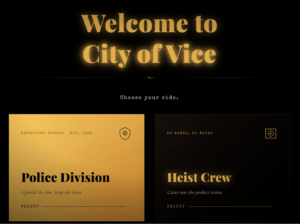
The website is intended to function as our rulebook, providing players with timely rules and instructions as they progress through the game. Rather than presenting all of the information at once, the site gives minimal, moment-to-moment directions, such as guiding players to a specific slot to retrieve the next puzzle. In this way, the website helps maintain the flow of the game while keeping players immersed in the experience. Its 1920s-inspired design reinforces the game world through dark color schemes, typewriter-style fonts, and subtle jazz music.
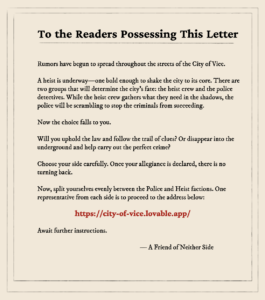
One concern we considered was whether players would be able to comfortably move between the website and the analog components. We had to think carefully about how onboarding would work, including how players would be introduced to the website in the first place. To address this, we decided to begin the game with a letter that explains the premise of the story world. At the end of the letter, players are instructed to split into two teams and visit the website. We chose this approach because we wanted the website to feel like a natural extension of the game rather than a separate rules document. By introducing the website through an in-world object, players encounter it as part of the narrative instead of as an external instruction manual.
Once players arrive at the website, they complete an onboarding puzzle framed differently for each team: as “training” for the police and as a “warm-up score” for the heist crew. This proved to be an effective form of onboarding because the puzzle is intentionally simple, allowing players to focus on learning how to navigate the system rather than struggling with the puzzle itself.
There were not many full iterations of the website. Instead, the website evolved alongside the development of the puzzles. As puzzles were created, changed, or rearranged, corresponding sections of the website were constructed and updated to match the new game flow. This allowed the website to remain closely connected to the physical components and ensured that the digital instructions always supported the current version of the game.
Creation & Iteration History
Puzzle 1: The Cipher
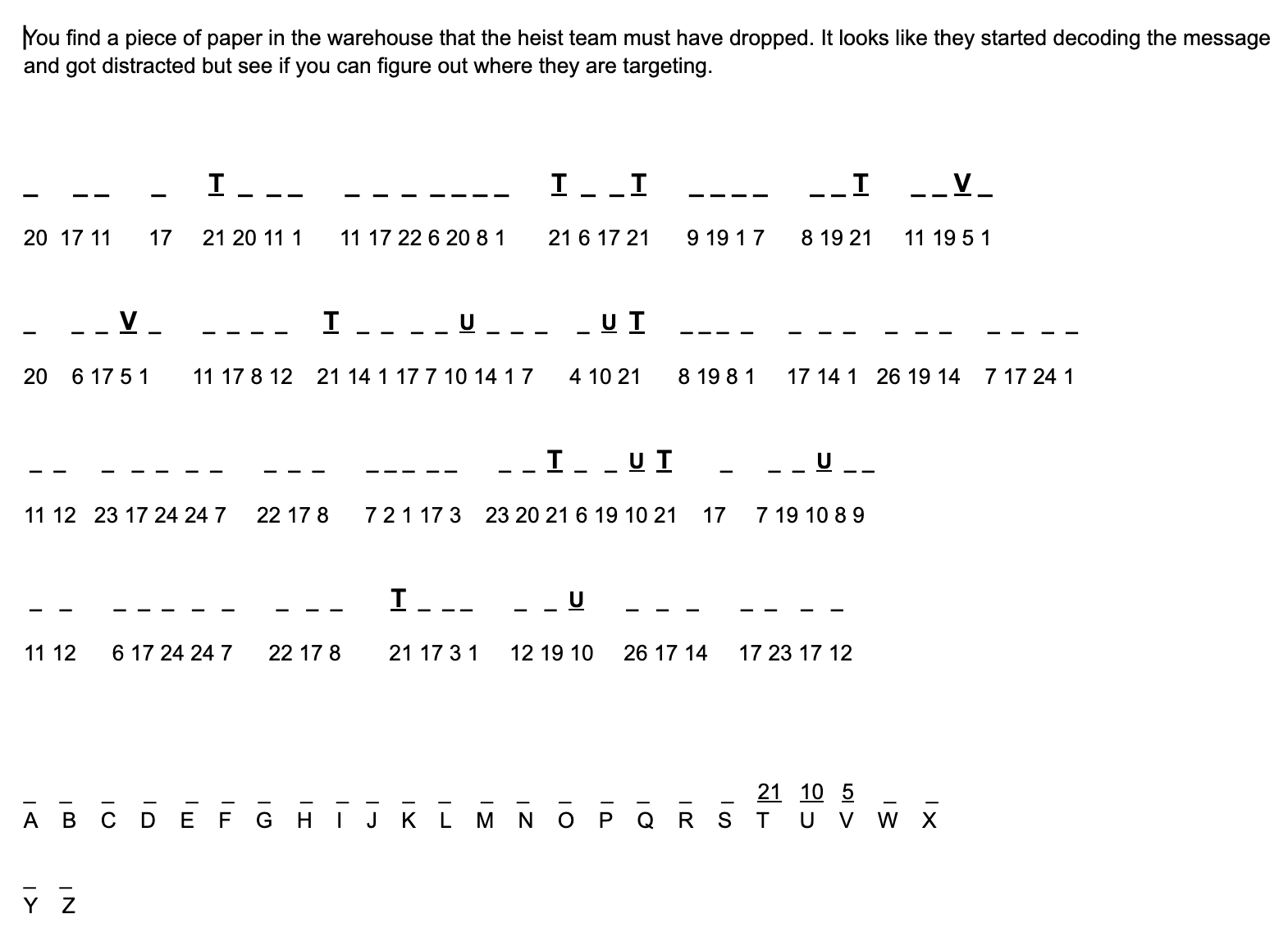
Puzzle 1 is a puzzle where players must iteratively decrypt a message that has been encoded using a Caesar cipher. On each slide there is a narrative explanation for a small hint that provides several letters to begin. The detective team is decoding a napkin that the heist team dropped after starting to decode the message. The heist team is decoding a message from the detective team that was intercepted and put in the newspaper.
Three iterations of the detective team’s puzzle were created that aimed to increase the narrative fluency and ensure that instructions were clear. Three iterations of the heist team’s puzzle were subsequently made to match the complexity but maintain some narrative and contextual novelty for the opposing team.
Detective Iterations
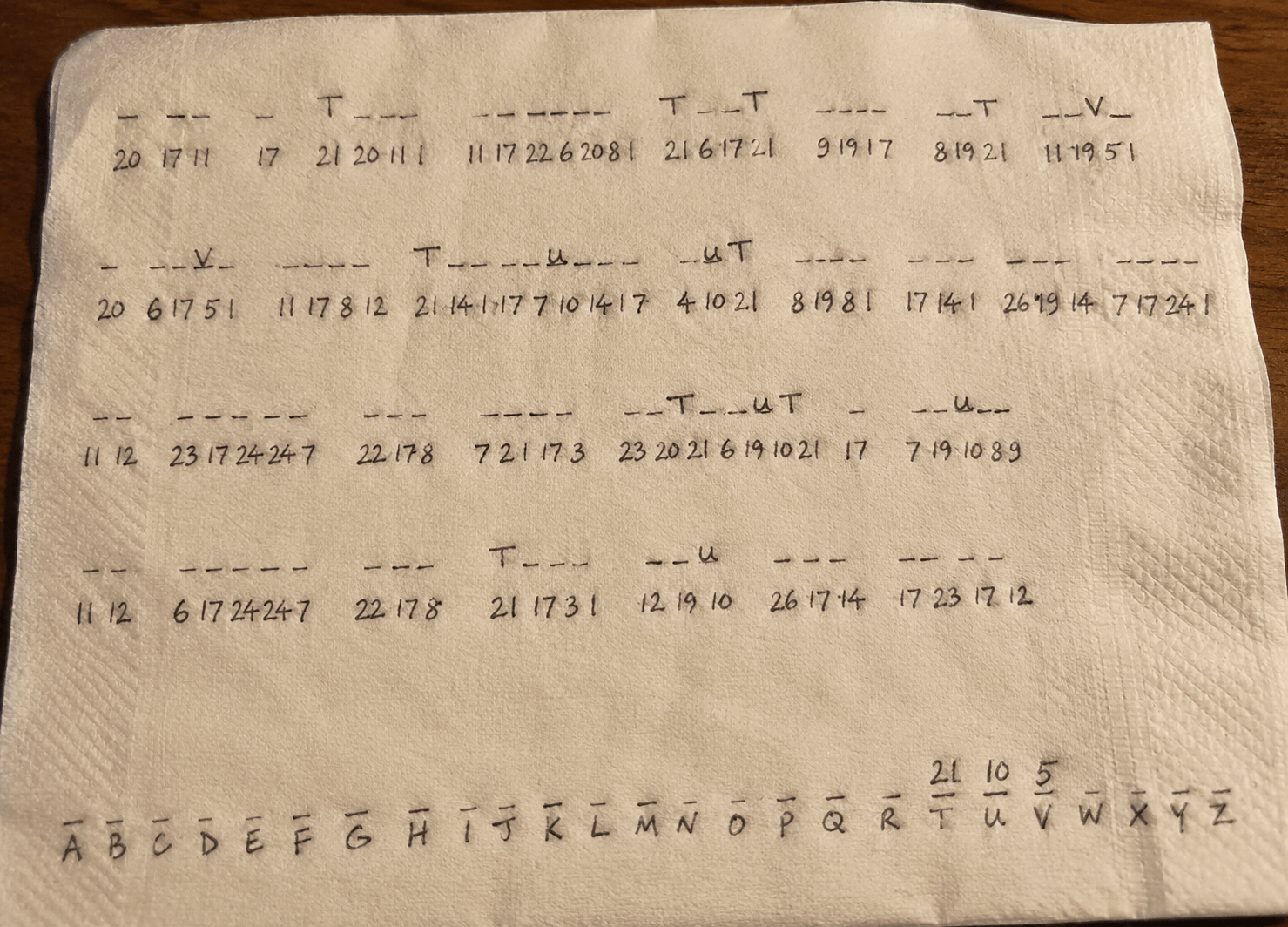
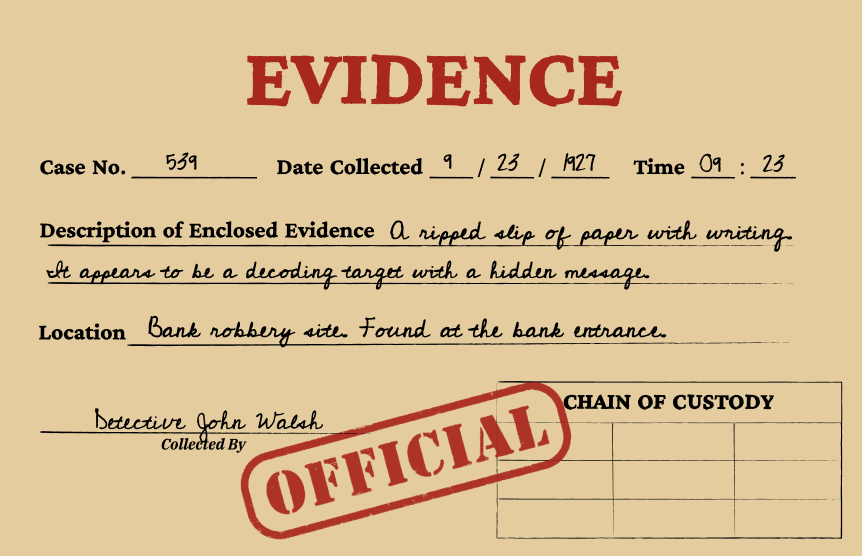
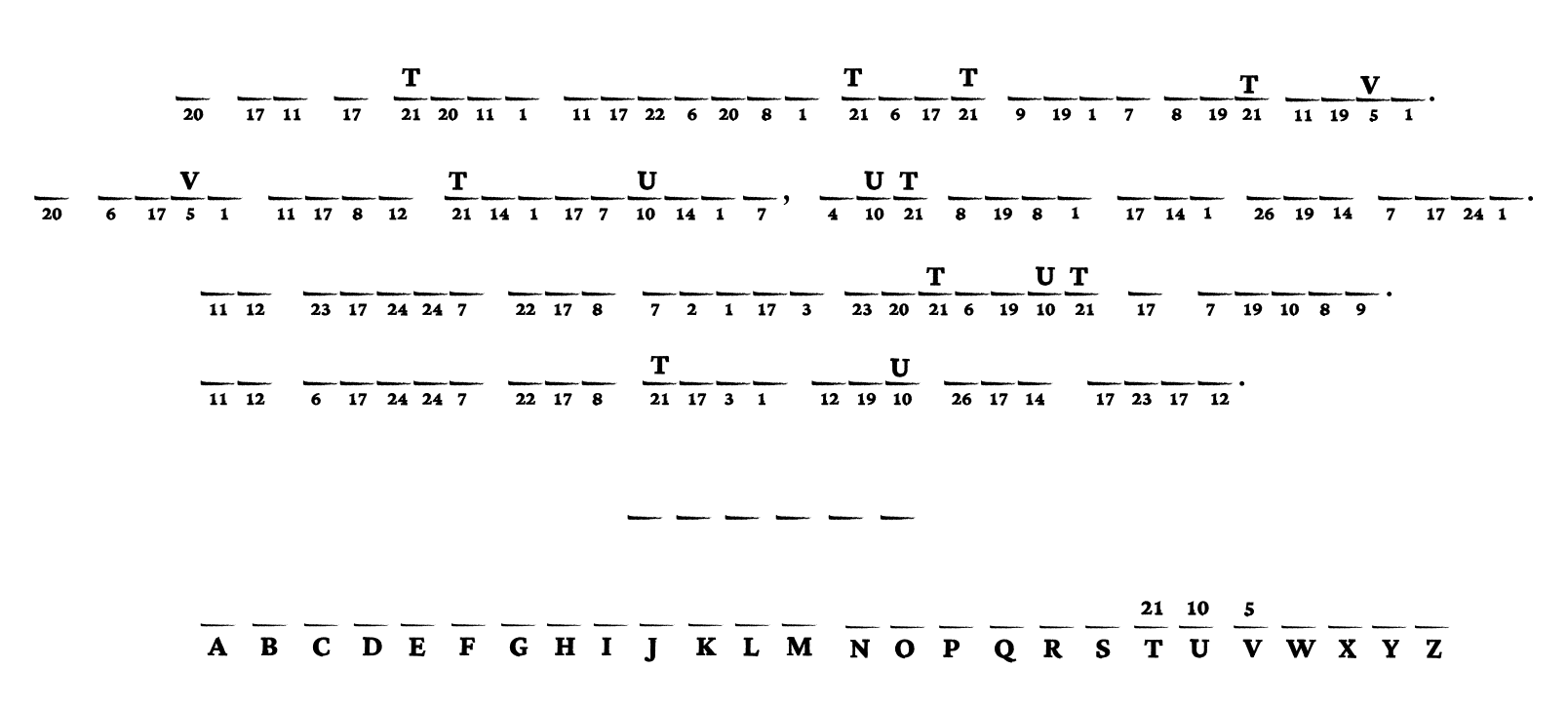
Heist Iterations
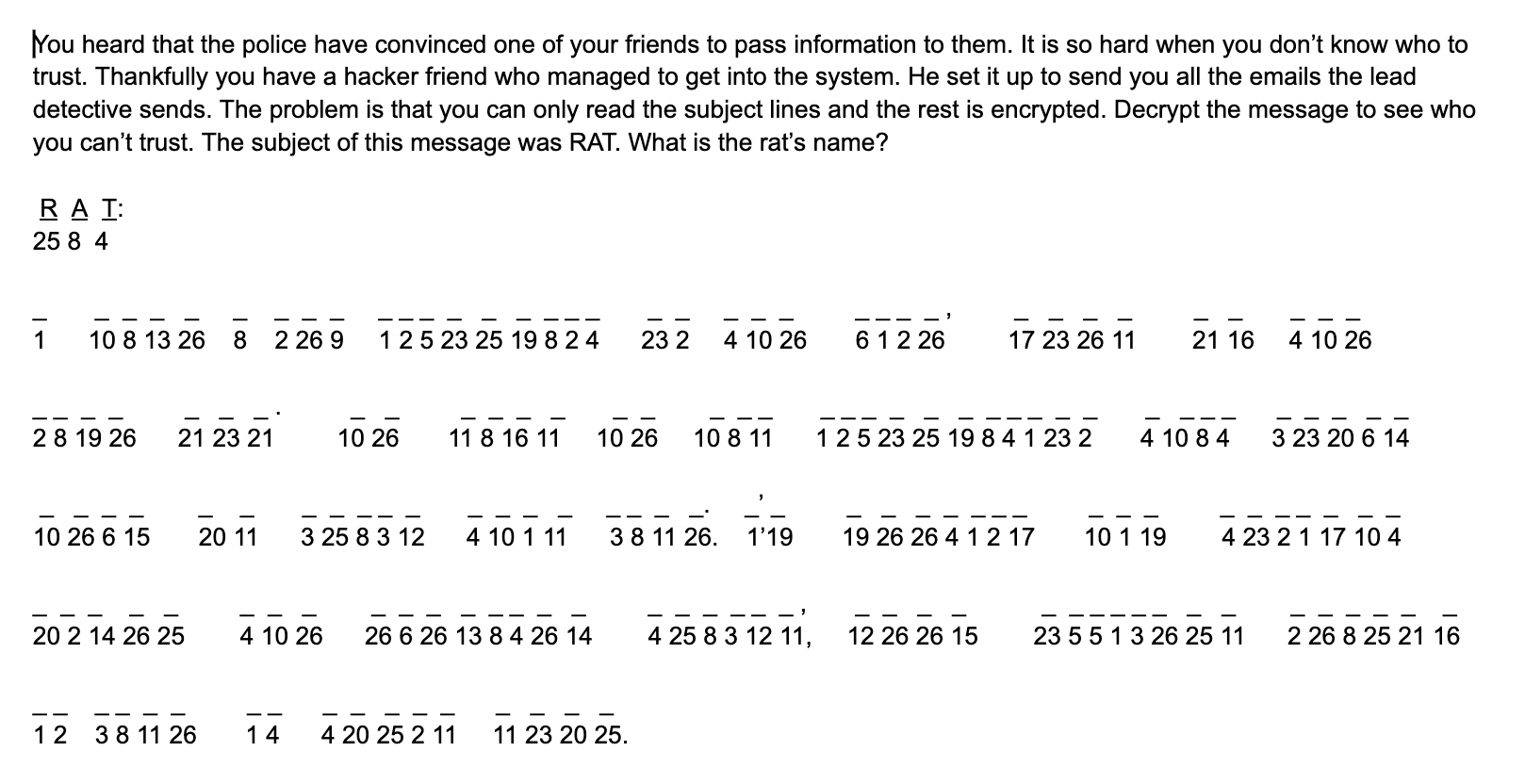
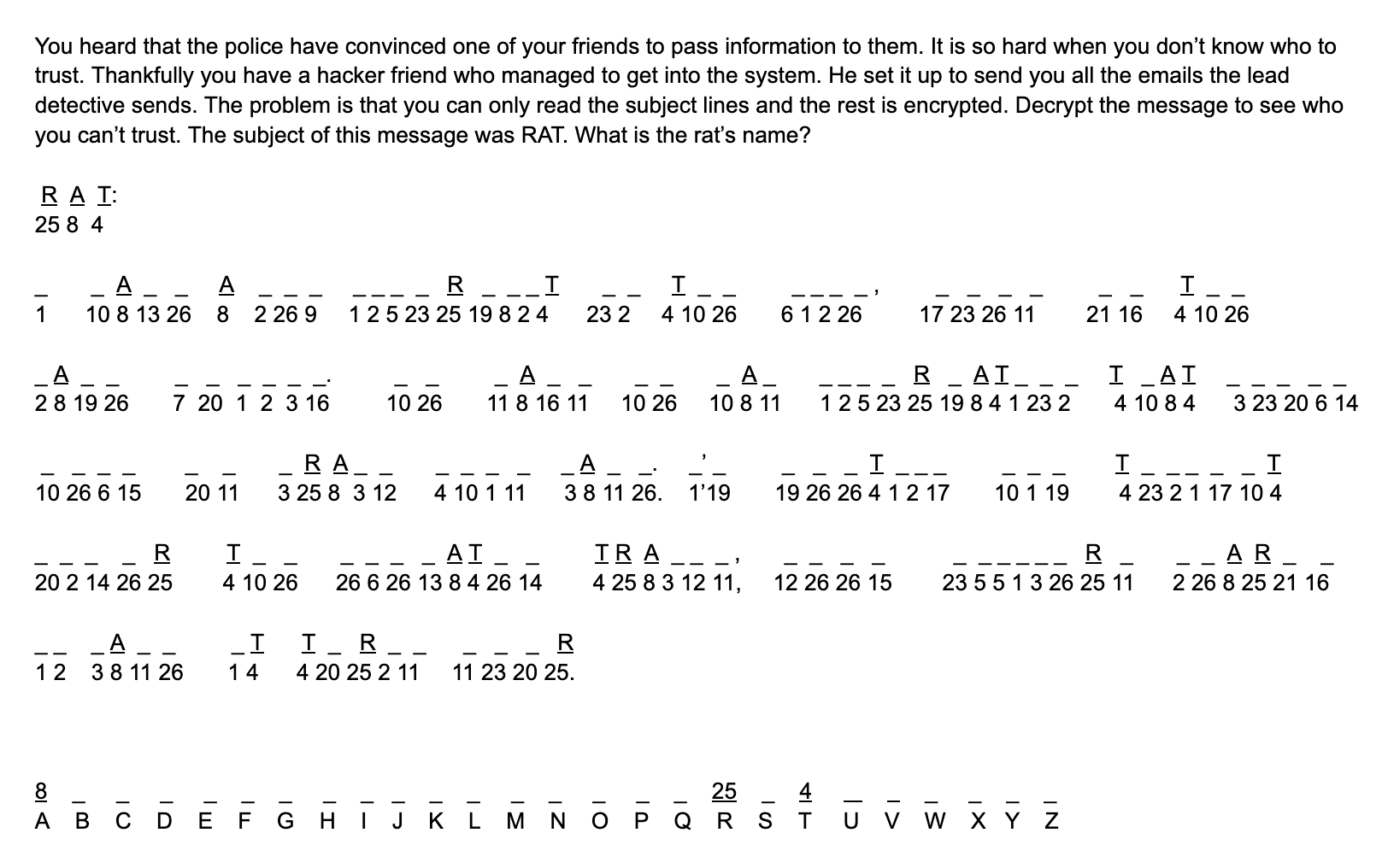
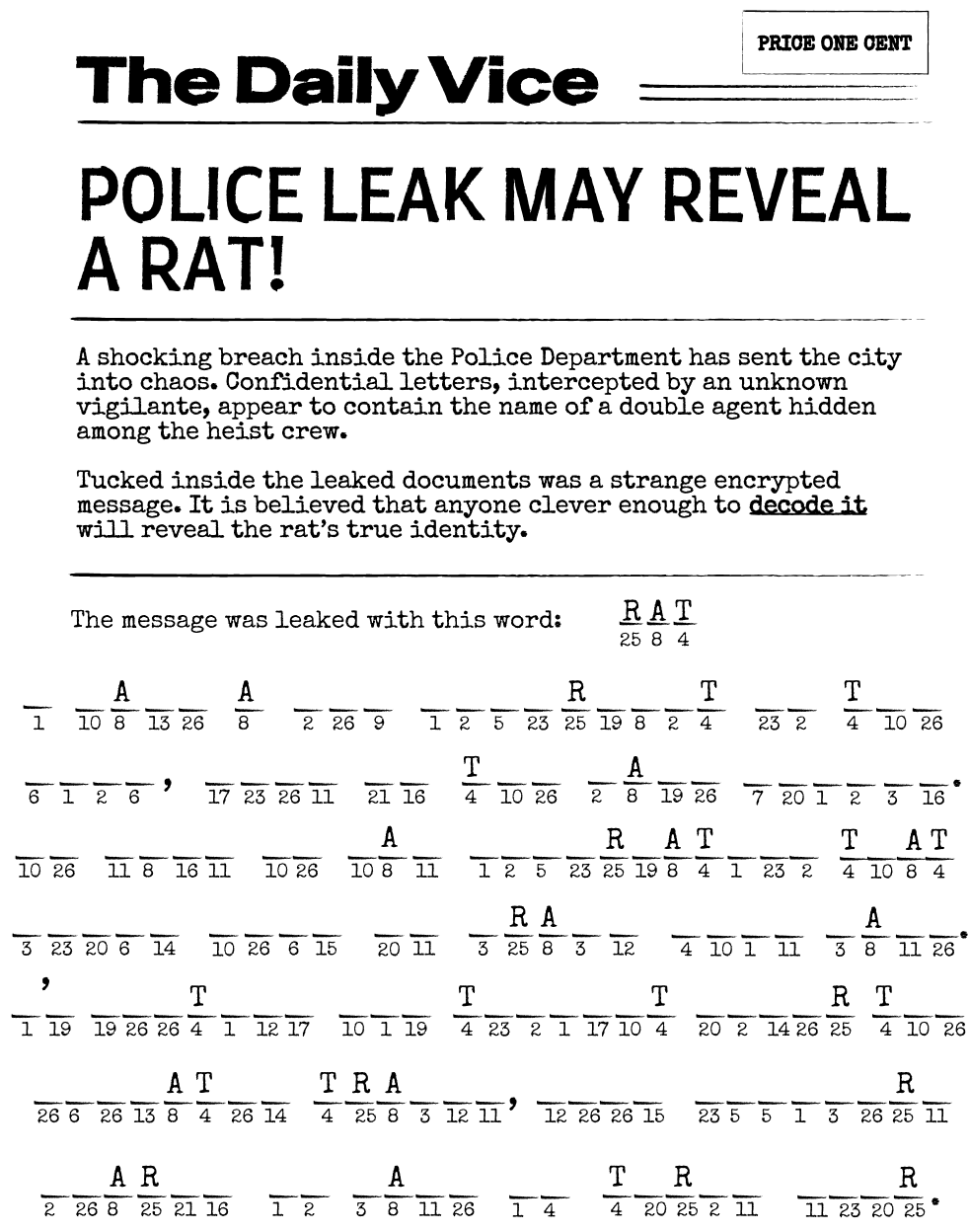
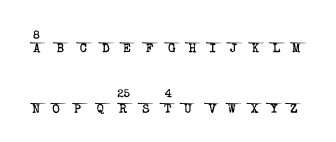
Each playtest yielded a target question to be answered, findings, and updates:
Test #1
Question(s): (Detective version first) Can players solve a Caesar cipher with limited information?
Finding(s): A player solving alone solved the puzzle correctly without hints in 21 minutes – “It’s actually fun and mildly gratifying.”
Update(s): Proof of Concept accepted and narrative added.
Test #2
Question(s): How does the narrative feel to players? Is it fun?
Finding(s): 2 playtesters worked separately and took 54 and 40 minutes to complete, respectively. They needed a few hints to confirm they were on the right track. They noted that visual affordances outlined what they needed to do, but needed prompting to answer the riddle after decryption. They didn’t think about the narrative after reading the context. They were engaged throughout decryption and thought the puzzle was fun.
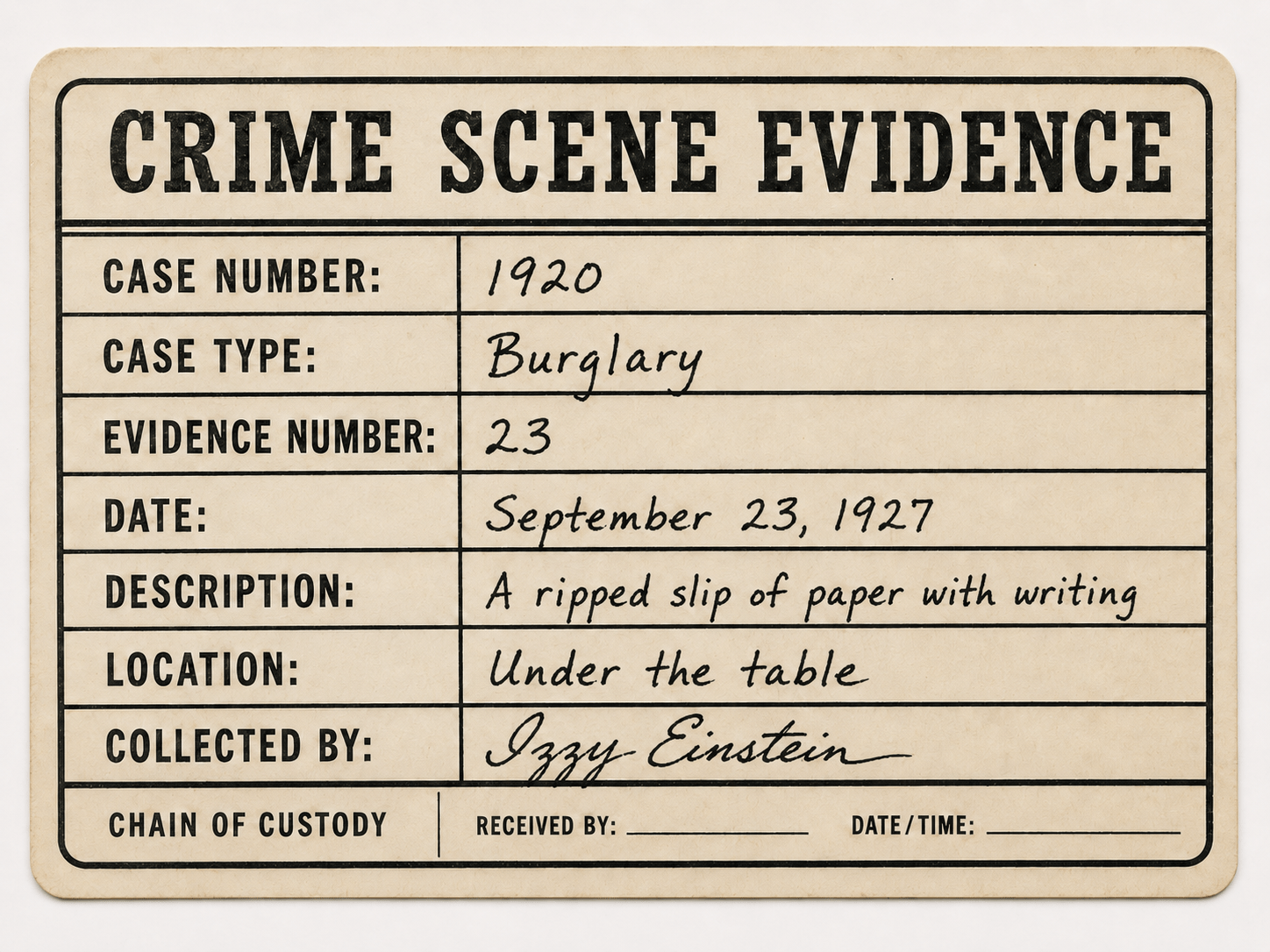
Update(s): The instructions were made simpler and more embedded into the narrative through the creation of an evidence sticker.
Test #3
Question(s): How do players respond to the more creative and narrative puzzle design?
Finding(s): Players repeatedly asked for clarification about the spacing between letters and words.
Update(s): The puzzle page is made more consistent through design rules in Figma. The size of the puzzle was too small for people to read and write on. Accessibility was improved by increasing the font size.
Test #4
Question(s): (Enter Heist version) Can we create an equivalently difficult mirror puzzle for the other team?
Finding(s): Fellow team members solved the puzzle without difficulty but they identified the answer keyword before completing the puzzle.
Update(s): The answer name was changed from Bob to Quincy with the Q not being included elsewhere in the letter so it would be the last item to decode.
Test #5
Question(s): Is it reasonable to include a letter in the solution that is not found elsewhere?
Finding(s): Classmates started at the beginning of the letter and struggled to decode the puzzle. However, they did reach the correct solution saying “The name is ambiguous? It has to be an unused letter and QU but still.”
Update(s): The Rs, As, and Ts were distributed throughout the puzzle so that the affordance of solving the problem out of order was more obvious. The narrative was improved.
Puzzle 2: Doc and Key
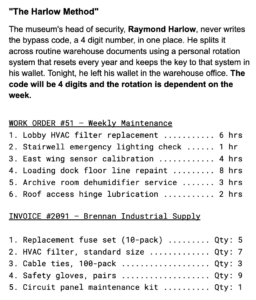
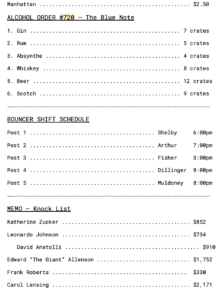
Puzzle 2 is a puzzle where players must leverage the information given to them in the key and identify its significance with the relevant documents to uncover the 4 digit code. Each team is given a narrative backstory for how they obtained their key and why it is important. The detective team is searching for a door code for an underground speakeasy while the heist team is searching for a security bypass code from the head of security.
Three full iterations of the heist team’s puzzle were created to increase the narrative aspect and clarify the direction of the puzzle with the third iteration inspiring the police team’s puzzle.
Detective Iterations
Iteration #1:
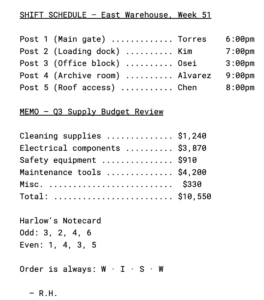
Iteration #2:
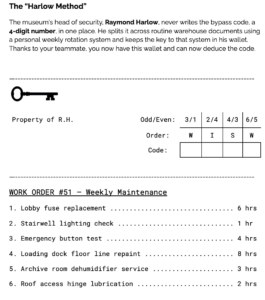
Iteration #3:
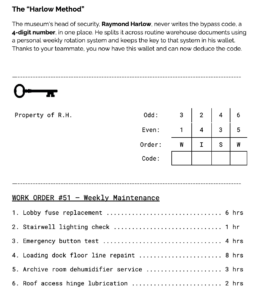
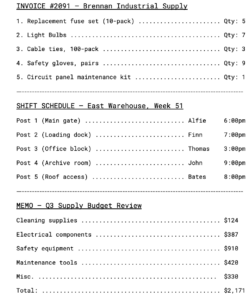
Heist Iterations
Iteration #1:

Test #1
Question(s): (Detective version first) Can players solve the deduction puzzle within 15 minutes?
Finding(s): A player solved with minimal hints of clarification within 6 minutes, said the puzzle was fun and felt satisfying to solve.
Update(s): Proof of Concept accepted and narrative solidified.
Test #2
Question(s):Does this puzzle feel like there is enough narrative involved?
Finding(s): 2 playtesters collaborated and took about 10 minutes while 1 playtester played alongside and took 20 minutes. They needed many hints to confirm they were on the right path, but often were complicating further than necessary. They said they didn’t think about the narrative much
Update(s): The instructions were made clearer about the importance of the week with bolding.
Test #3
Question(s): Do the new instructions make it too easy for players to solve?
Finding(s): Players still confused about the importance of even versus odd and kept attempting to individually assign each document as even or odd rather than all documents in one sequence.
Update(s): The key was made clearer to instruct players that one sequence applied to the entire puzzle.
Test #4
Question(s): (Enter Heist version) Are both versions of the puzzle equal in difficulty?
Finding(s): Players came across typos that made the puzzle unable to be verified on the website.
Update(s): The typos were removed and the week was explicit in the context of the puzzle to draw importance.
Puzzle 3: Do You Read Me?
Puzzle 3 is a letter/document-based puzzle in which teams must decrypt an embedded message hidden in letters exchanged between criminals that are supposed to be affiliates of the heist team. The detective team intercepts a letter and shipping log, while the heist team is delivered a similar letter and fulfillment order list for a speakeasy. Both puzzles have hidden clues to a location and time where either the mafia boss is hiding out or where the heist is planned to take place.
Based on a scene from the Nicholas Cage film, National Treasure, where Cage’s character Ben Gates discovers an Ottendorf cipher on the back of the Declaration of Independence, we intended to create a version of this experience that could make players feel like treasure hunters through their decryption process. Of course, while they would not be decrypting with the intent of discovering ancient treasures, accomplishing a task that would involve identifying and utilizing a key could make the player emerge feeling smarter than they did when they entered the challenge – a little more Ben Gates-y…
This particular puzzle, specifically the detective’s version, went through five iterations (prior to the completed version). Though it was initially unsolvable, we worked to whittle the complexity down to a manageable state, offering players just enough cues to identify patterns and be more confident of their directions. Although there were indeed shifts between various playtests, they were largely subtle cue shifts – a more effective demonstration of all that transpired from start to finish would be a direct comparison between the first iteration and last, with more granular explanations from iteration to iteration.
Detective Iterations
Iteration #1:
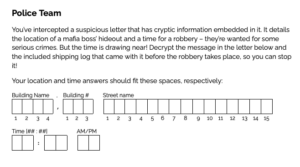
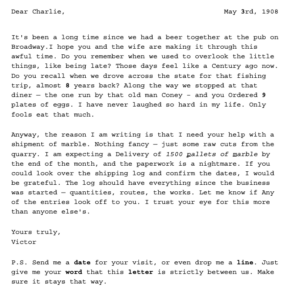
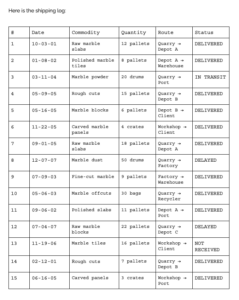
During the first playtest, the player (BG) was so baffled by the vastness of the information they had, and how clean all the documents initially seemed that they couldn’t find anything suspicious and started grasping at straws, pulling out proper nouns and capital letters, and who knows what!
Adjustment(s): Removing unnecessary proper nouns (like “Broadway” and “Coney”).
In the second playtest, the pair of players (E and A) initially discarded the answer outline and went straight to examining the documents. Many players, including these two, found it helpful to circle conspicuous elements of the letter, though their markings would sometimes note to us that they might be pursuing a dead end approach. E and A found the building name quite quickly (within 3 minutes), a large step forward from the first playtest, and followed it up with the building number. At 9 minutes into solving the puzzle, they noticed the correlation between the number of lines in the log and the spaces allocated for the street name. Although they were unable to complete the puzzle in entirety, their feedback was clear and thorough:
- Too much information provided on the log
- Too many red herrings that drew them away from getting the answer
- Offering both PM and military time (4 spaces), though the answer should only have taken 3 spaces
- An imbalance of content taken from the letter vs. the log, though the same quantity of information present on both
Adjustment(s): Cutting down several columns from the shipping log, removing a space from the time answer boxes to indicate a 12-hour clock response, underlining the time-representative number to tie better to the indications for AM/PM.
In the third playtest, testers BB and LL were much quicker to identify the building name, number, and time (all accurately), thanks for the improved affordances. With several nudges, they did discover the technique to utilizing the information in the log to decode using an Ottendorf cipher. However, they were confused as to whether the first “line” of the letter was the greeting line or first body line, and which numbers corresponded to the date-line-word-letter code.
Adjustment(s): Moving each sentence to a separate line of its own and indenting overflow, added date formatting to correspond to the code key (LL-WW-LL), removing all remaining columns in the log besides the row number, date, and status (all shifted to “DELIVERED” to avoid distraction). Additionally, it was time to shift the puzzle answer from a Stanford-themed one to a more narrative-relevant answer, so the puzzle was adjusted to answer with a different location.
In the fourth playtest, final tester J was the first player to completely solve the puzzle with only 1 hint (success)! They did make one comment: to adjust the log date formatting to better differentiate line from letter.
Adjustment(s): Changed date formatting from (LL-WW-LL) to (LL-WW-LT).
Iteration #5:

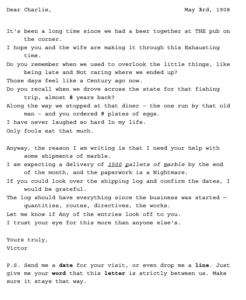
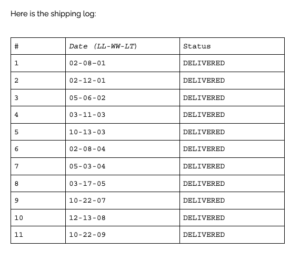
The final version of the puzzle includes all of the previous adjustments, including some changes t0 the shipping log dates to better indicate that the first “line” had to be the first line of the body and not include the greeting (by ensuring every word number was >=03 – the greeting line only has 2 words, so it would not be possible for that to be the first line).
Iteration #1 (Heist version):

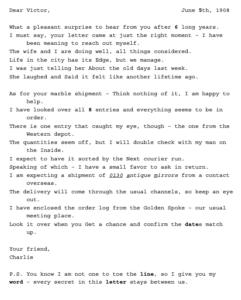
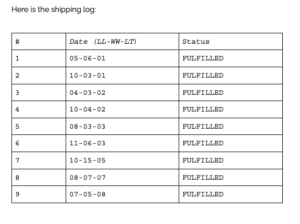
Final Playtest
View our full final playtest here.
This test focused on the Police Team (playtesters A & V), and how they navigated the experience. In the spirit of our shipping logs and time/date evidence-based narrative, we’ve provided a “log” of critical incidents that occurred throughout the playtest below:
- 2:15 – A: “I think it’s HEIST *laughs*” – WARMUP PUZZLE COMPLETE
- Perhaps this word was a little too easy to uncover when fully placed in the context of selecting teams, using the website, etc. But still a good warmup… and made a player chuckle
- 2:56 – V: “Oh my god” upon seeing the number of spaces to fill in for Puzzle 1 – STARTING PUZZLE 1
- Indeed, we debated this, but found that after discovering the answer, entering the information wouldn’t be too taxing
- 3:42 – V: “That’s definitely A or I”
- Puzzle 1’s trick is to first start by identifying the spaces that are single-letter words; those can be narrowed down to two options: the word ‘a’ or the word ‘I’
- This is a quick trick to find if you know what you’re looking for…
- 4:52 – A: “This marker is so wide”
- A small detail but can add to the enjoyment/frustration of the experience – a thick marker could make it difficult to work with the physical copy of the game
- 5:30 – Already started entering the first 5 words of the riddle into the web checker
- 9:24 – A: “Oh wait, 14 is U!”
- We love these smaller moments of excitement when individual letters are found; each letter is a small win!
- 9:40 – A: “There’s a 7 and a 14 labeled U” & V: “Oh, and here a 10 is labeled U”
- Small errors in this puzzle space focused entirely on noticing granular clues can be very detrimental to progress
- 12:09 – Word “Treasures” unlocked!
- The largest word in the puzzle, quite an accomplishment!
- 14:07 – Last word in Puzzle 1 unlocked!
- 14:22 – V: “Oh good, it’s a riddle!” (they said with a smile)
- The decision to push the riddle forward on the web interface and create a separate pipeline step to actually answer the riddle was a good one, rather than relying on players to figure that out for themselves.
- 14:29 – A & V: “Gallery…? Musem.”
- The riddle is straightforward, but still leaves a little open-endedness for other answers before arrival. Gives players a little more satisfaction if they don’t get it straight away.
- 14:32 – A: “Slay, okay” – PUZZLE 1 COMPLETE
- 14:40 – STARTING PUZZLE 2
- 15:10 – V: “Oh my god…”
- Seeing all the documents and numbers in Puzzle 2 can be overwhelming
- 15:50 – A: “Where’s the week?”
- The week number is a key part of accessing the right code
- 16:40 – V: “Wow, I would not have seen that”; A identified the first letters of each document
- This is a critical step, and it demonstrates the importance of having multiple eyes on each puzzle to offer different perspectives
- 18:00 – Identified a dead end
- While they might be discouraging, it’s good that the puzzles have built-in dead ends to avoid being too misleading
- 19:16 – A: “I feel like [Memo] is to throw us off”
- Good identification of red herring!
- 22:10 – V: “The only thing I don’t understand is what the odd/even is supposed to be”
- That remains a tricky incorporation of the clue for this puzzle, and likely the clinch for which answers players come up with
- 22:39 – A: “Can we get a hint?”
- Players are starting to get frustrated internally, and believe they have exhausted their options
- 26:29 – V: “Is this good… or…?”
- Players need validation at this point, they don’t trust themselves because they’ve tried too many ways
- 27:05 – A: “Were we on the right track?”
- 28:04 – PUZZLE 2 COMPLETE
- 28:13 – STARTING PUZZLE 3
- 29:51 – A: “Would it be in military time?”
- Good guess! Glad to know players have awareness of this concept!
- 30:14 – Got the building number
- 30:54 – Identified street name as 11 letters long, matching with log
- 34:12 – A: “These typos are killing me”
- Typos are SO DETRIMENTAL
- 38:00 – PUZZLE 3 COMPLETE
Challenges, Accessibility, and Future Expansion
There were several unique challenges in the design of our game. While the creation of direct competition was an important innovation, it created a very specific need for balancing. It is important for the puzzles to be of similar difficulty so that gameplay is fair such that the winner is determined by skill. Additionally the experience needed to be sufficiently similar so that players would be able to enjoy reflecting over a seemingly shared experience.
In our initial ideation we also set the goal to improve replayability. We were able to create some replayability as players can play on either team and be exposed to novel puzzles. However, we also discussed how with additional time we could add additional puzzles to enable significantly more replayability.
If we had additional time working on this game we would implement the follow 3 major mechanics:
- The current game relies on embedded narratives but it would be interesting both for the designer and the players to add enacted narrative. For example, the heist team could make choices about their target that then trigger specific puzzles for the detectives and the detective team could select who to recruit as an informant that would trigger specific puzzles for the heist team. This would add to the fun as players are able to make more choices and use more agency as well as allow for significantly greater replayability. The use of an accordion file and an online system would make this mechanic relatively easy to implement but would require the creation of many more puzzles.
- Presently the game relies entirely on puzzle solving as a method of determining who wins. This means that there is no element of randomness in the game and that if one team falls behind they may lose motivation, believing that they cannot come back to win. Adding a second round of play where speed and accuracy in solving the puzzles provides an advantage but not an insurmountable one could improve the game significantly.
- While players in our final play test were able to complete the puzzles without hints, we would like to add a hint system. We would implement both static hints that are made available over time and dynamic hints based on the partial solution players have entered into the system. In this case the digital component would provide an exceptionally good affordance where the system can respond to their current progress with a more useful hint.
Access our game website component here.
Access our print-n-play PDF here.