
Some light reading music.
Myodyssey

Mayowa Adesina, Fiona Han, Violet Crow, Hunaida Elhassan, Addis Adam
Artists’ Statement
Myodyssey is a fully playable MVP that presents the core mechanics, emotional tone, and broader vision of our puzzle-based point-and-click adventure game. Our team prioritized building the main gameplay loop to be functional and cohesive because the emotions we aim to evoke are dependent on players playing through the full game. The game plot follows a myopus who must embark on an arduous journey throughout the forest to save their ailing partner by retrieving the golden moss – a rare cure that once thrived in the forest but has become increasingly scarce. At its core, the game is a story about love and resilience set against a backdrop of environmental destruction, where human-caused habitat loss doesn’t just reshape the landscape, but becomes an active force working against survival.
Our target audience are individuals who enjoy narrative-based games and those with proclivities towards empathy and care for the environment and animals. We designed this game to evoke emotions of fear, desperation, and inadequacy in players, so that through these feelings, they might truly see themselves in the woodland creatures they play as and encounter, understanding on a visceral level what it means to be small, vulnerable, and at the mercy of forces beyond your control. Human intervention in the environment is a throughline we wove deliberately into the story, one that quietly shapes the narrative from its very first moment to its final twist. This game is for players who are not afraid to be challenged on their impacts on the environment as humans, and we aim to raise awareness for the consequences of rapid human development and habitat destruction for our players.
System Model
Game Mechanics & Player Interactions

Please see full-size image here if text is difficult to read due to image compression.
Initial Decisions on Formal Elements & Values
Our initial design decisions were shaped by the fact that we wanted Myodyssey to grow directly out of our team name, myopus. After researching the animal, we decided that the game should center on nature, vulnerability, and survival. This led us to choose a text-based point-and-click adventure format, because our main goal was to tell an emotional story rather than create a combat-based or fast-paced game. We also decided early on that the player would take on the role of a small myopus traveling through the forest to find Golden Moss for their sick partner. This helped define the game’s core experience as an adventure: leaving home, exploring unfamiliar spaces, solving obstacles, and moving deeper into an increasingly damaged environment.
In terms of formal elements, we defined the player as someone inhabiting the role of the myopus, a small creature navigating a world shaped by forces larger than itself. The player’s main objective is to progress through the forest, complete puzzles, collect or earn necessary items, and ultimately reach the Golden Moss. The procedures of the game include reading narrative text, clicking through locations, interacting with highlighted or actionable words, managing collected items through an inventory system, and completing minigames that unlock the next chapter. The game’s rules are intentionally simple: players must solve each level’s challenge before moving forward, and each puzzle acts as a gate between story chapters. This helped us make the game accessible even to people who do not usually identify as “gamers.”
We also thought about the game as a small game economy. In Chapter 1, clickable text acts as a source of materials because players collect items from the environment and then exchange them to progress. In later chapters, minigames become the source: completing a puzzle gives the player the material, knowledge, or ability needed to move forward. This gave each interaction a purpose instead of making the minigames feel random or disconnected from the story. Instead, the puzzles became part of how the player enacts the myopus’s journey. The player does not just read about survival, but actively searches, solves, collects, and moves forward through the forest.
This also connects to the 4 E’s of game space, especially embedded narrative and evocative spaces. Our story is not only told through dialogue or cutscenes; it is embedded in the environment itself. The forest, moss, litter, trapped animals, damaged spaces, and increasingly desolate level design all communicate the effects of human environmental degradation. This is a form of environmental storytelling, because players learn what has happened to the world by moving through it and interacting with its spaces. At the same time, the game uses evocative spaces: the early forest is meant to feel safe, natural, and intimate, while later areas become darker, more polluted, and more threatening. These environmental shifts help players emotionally understand the myopus’s vulnerability before the game explicitly explains the message.
Our core mechanics are point-and-click exploration, interactive text, inventory, chapter progression, and puzzle/minigame completion. These mechanics create dynamics of searching, remembering, problem-solving, and gradually realizing that the world is becoming more hostile. The intended aesthetics and types of fun created are narrative, discovery, challenge, and sensation: players are meant to feel immersed in a woodland story, curious about each new area, challenged by puzzles, and emotionally affected by the music, visuals, and environmental tone.
Testing & Iteration History
Initial Designs & Storyboarding
Our project began as a narrative-first point-and-click adventure about a myopus leaving home to find Golden Moss for their sick partner. Because our game is text-based and our primary objective was to create a compelling point-and-click adventure experience, our initial design process was centered heavily around the narrative. We spent a significant amount of time storyboarding, developing the script, and establishing the emotional tone of the story through themes of love, urgency, grief, and hope.
Pre-Playtesting Design
(5/12, Wk 6, Class 6A)
We mapped out our potential levels and the narrative environment within- each level is a separate act/chapter that progresses the player closer to their goal (finding the golden moss). Below are initial mockups we created using Figma.
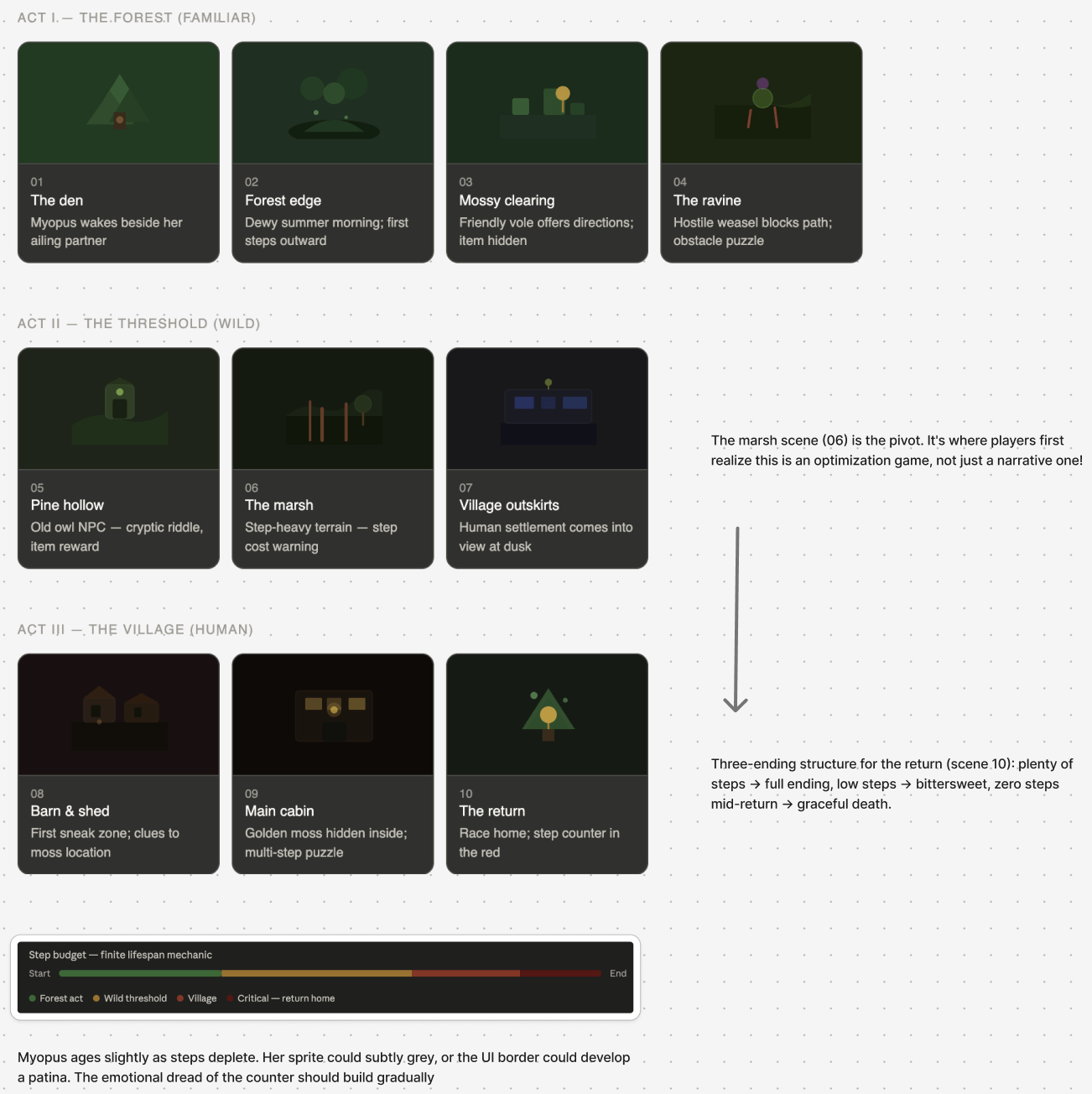
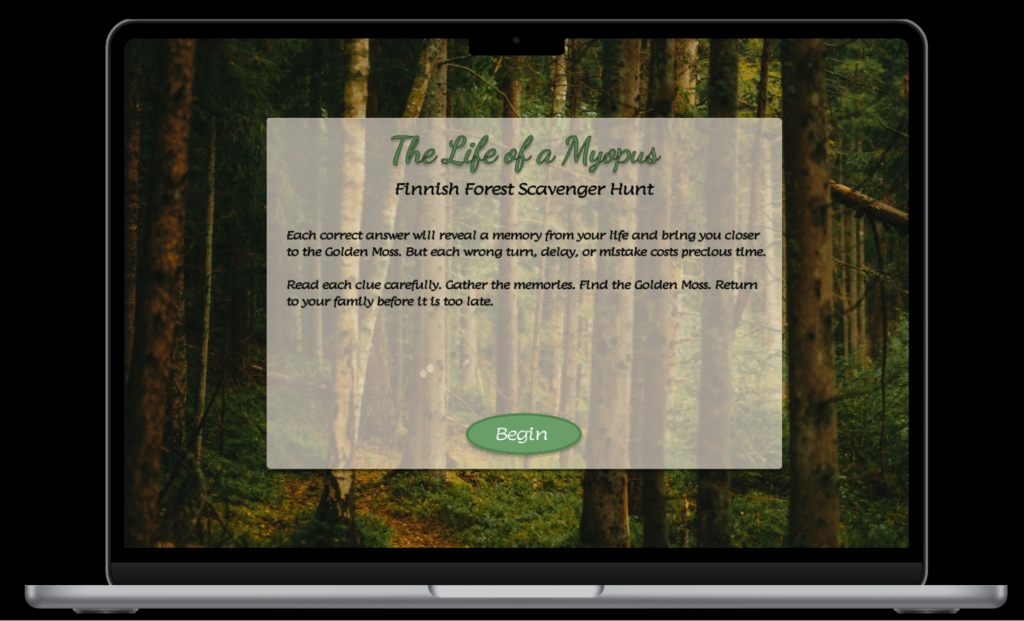
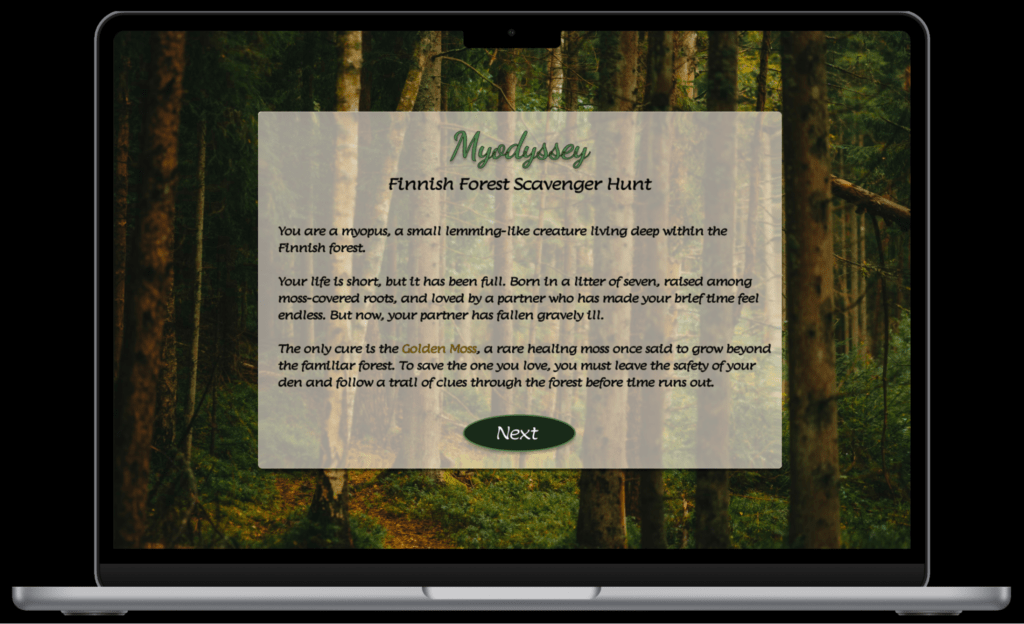
Early Figma mockups of game flow and UI.
(5/14, Wk 6, Class 6B)
We discussed pivoting from a narrative point-and-click adventure game to a narrative scavenger hunt game in an attempt to make players feel more immersed. Our guiding question at this stage was: how can movement, puzzles, and physical space sequence the story while also managing difficulty progression?
We concluded against a scavenger-hunt gameplay because we believed our game’s narrative was best conveyed through difficulty progression of levels, where the player completes puzzles/minigames to progress through the story.
(Outside class)
Additionally, we formalized the game economy (Materials, Exchanges, Sources);
- Materials are specific to each level.
- Chapter 1 – Interactive text mechanic functions as a source that allows players to pick up items (indicated with underlined and different color text) by clicking on them. Items are then exchanged to progress.
- Chapter 2 – Given to the player when they complete a minigame. These materials are exchanged to further progress through the game.
- Chapter 3 – Same as chapter 2.
Sources controlled player behavior by allowing them to progress through the storyline, and make decisions on where to explore first.
We began to focus on puzzle design and how we could ensure each minigame was relevant to the narrative and balanced to favor the player’s solvability. Using inspiration from existing puzzle styles such as “Tower of Hanoi”, Level 2 Puzzle 1 was designed as a medium-difficulty puzzle with unobtrusive instructions for players. It creates challenge (as a type of fun) where players must think through order, movement, and strategy.
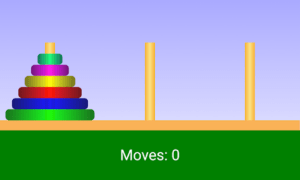

Initial design of the pellet stacking puzzle, and the eventual finished design after feedback.
We designed the puzzles in Level 3 to be the most critical in emphasizing humans’ impacts on the environment, as it’s the last level before the (intentionally) disappointing ending. The exploration and clickable-text sections create discovery, since players learn the world by investigating it. Plus the environmental themed puzzles create narrative fun because the actions directly connect to human impact, such as pollution, trapped animals, or damaged natural spaces.

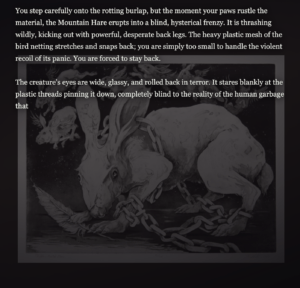
Early design document and UI for Level 3.
Throughout our design, we found it important to continue our design for accessibility by ensuring visual accessibility. This was done with the express inclusion of a colorblind member of our team. We made sure no design elements of our game were solely color-based, making sure every puzzle or gameplay element was approachable for colorblind folks.
(5/19, Wk 7, Class 7A)
We received feedback from another group on our storyline and Level 2 thus far (Levels 1, 3, Intro/Outro were not ready yet).
- Playtesters liked the underlying concept of human degradation of the environment.
- Evidence of human activity throughout the environment must be clear (they suggested pollution, littering, construction, or animal injuries)
- The golden moss could be framed as sacred/religious
- Level 2 puzzles were fun and relevant to the narrative
(5/21, Wk 7, Class 7B)
Before we could start formally playtesting, we finalized our interview/guiding questions:
“Hi, we would like to gather feedback on a game we’re making for a class. The game is a point-and-click adventure. Don’t worry if you’ve never played a game like this before, or haven’t played many games in general. We are not testing you; we’re testing the game. We want to make sure it is accessible for players of any experience level. While you’re playing, feel free to think out loud about what you’re experiencing. Before we start, I have a few questions to ask.”
- How familiar are you with digital games?
- Are you familiar with text-based/narrative games?
- Do you easily empathize with fictional characters in games?
- How do you feel about animals?
Playtest Logs & Feedback
We conducted 9 official playtests between week 7 and 10, each of which significantly improved our game as we iterated on players’ feedback. Version 1 of Myodyssey was unfinished, but needed feedback on core level gameplay and narrative structure.
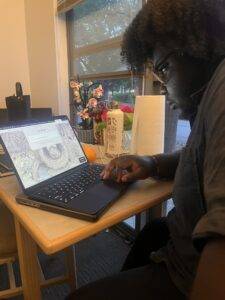
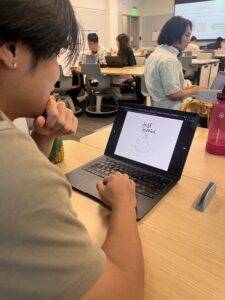
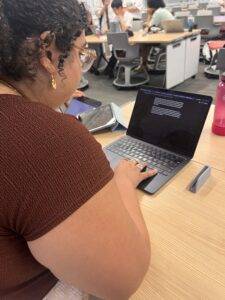
A few images of our game being playtested at various stages.
Version 1
Playtest #1 – Elisabeth (Done in Class)
Elisabeth is a designer in the class, and reported not being used to games, especially text-based ones, but also critically evaluated the game through a design perspective. They also did not report empathizing with animals.
- Confusion about what they are playing as, needs context.
- “It’s hard to keep track of text that’s already been read.”
- Confusion/annoyance trying to keep track of collected items in Level 1
- Was confused about how to light fire
- Didn’t like having to go back and get water from the brook
- Confused about what places have/haven’t been explored
- Boring, obvious what to do.
Playtest #2 – Mohammed (via Hunaida)
Mohammed was relatively familiar with digital games and narrative/text-based games, easily empathizes with fictional characters in games, and does not feel strongly towards animals generally.
- “Transitions between scenes feel abrupt.”
- “It’s not really clear how I’m supposed to know to go back to the brook to get the water, maybe add a glow or something if there’s something new to be picked up” – during L1
- Didn’t understand the context of the game or the character they were playing.
- “Music would be a cool addition”
The feedback we got from these playtests validated our ideas on the narrative structure of the game, but required a big gameplay overhaul. Furthermore, we needed to make sure the narrative was integrated into the gameplay mechanics themself. Finally, we needed to add more to keep the game immersive for players.
Thus, we made the following major improvements to Version 1:
- Added an opening cutscene and a soundtrack that better displayed the story of the game while introducing the game’s aesthetic and mood.
- Made sure text already read by the player was grayed out, better signaling to the player where the narrative was going as well as what gameplay elements to interact with.
- Added inventory to Level 1, which indicated how the player would interact with the game as well as the narrative by encouraging players to visit every screen.
We also added level transitions, wrote more dialogue, and continued to make the narrative a lot more robust for future playtests. Ultimately, we felt like the additions we made would serve to engage all players with our narrative rather than have them bored of it, which would entice them further towards our gameplay. We utilized the Game Designer’s Notebook’s analysis of Architecture as Exploration in order to have them understand space even through text, embolden players’ sense of journey and further tie them to the narrative experience.
Considerations: We chose not to implement these changes because we want to keep a singular experience (difficulty setting) suitable for all types of players.
- Adding glow/marker to unexplored areas.
- Implementing a “hard mode”
Version 2
As we moved into this version of the game, we felt pretty confident in our main narrative with our additions, and so we were more concerned about the levels in particular: how they felt to play, how they related to the story, and how cohesive it felt to the player. We playtested with 3 testers, all familiar with digital games to really zero in on how we could optimize the gameplay as a function of the narrative.
Playtest #3 – Noah (via Violet)
Video of this playtest
Noah was very familiar with digital games, familiar with text-based narrative games but doesn’t play them often due to being a slow reader, empathizes with characters in games, and an animal lover.
- “Make it more obvious that the object text is clickable; maybe add little symbols or a hint something?” (“Oh my gosh, I can click these words? I can! 4:12)
- Make sure to fix music not playing in L2
- Fix text being grayed out early in L1
- Fix text being grayed out in L2
- Lower overall volume of music or add volume slider
- Fix the minigames speeds being tied to refresh rate
- Move the button to suggest that the player visits the hare first for context in Level 3 (or, make it so they have to visit the hare before going to the other places) so it’s clear where to go
- Fix the game crashing when clicking at the ending
Playtest #4 – JiQi (Done in Class)
JiQi was very familiar with digital games, not familiar with text-based narrative games or investigative games, easily empathizes with characters in games, and not attached to animals.
We decided to ask additional guiding questions since we knew JiQi was a designer, in order to get a designer’s perspective of our game mechanics:
- Are any of the in-game puzzles far too difficult or easy?
- Is there a good progression of difficulty throughout the game? If the difficulty remained the same, would you prefer it got more difficult gradually?
- Is the story clear? Do the cutscenes help tell the story and set up the beginning of the game?
Our insights are below:
- He enjoyed the music and was very immersed in the story
- Seemed confused where to go, but the greyed text in Level 2 was helpful, directing his eyes to the important parts.
- Felt hopeful throughout the game
- Before Level 3 plays, he suggested a scene/sketch that shows how the hare got trapped (was chased by humans?
- He didn’t understand the ending, thought it didn’t seem like it ended
- Didn’t feel that the minigames/storyline showed the impacts of human activity on the environment and was confused about the Walmart ending
Playtest #5 – Mai (Done in Class)
Interview answers: Very familiar with digital text-based/narrative games, loves animals, and easily empathizes with in-game characters.
- She was very engaged and really enjoyed the dramatic script (prose throughout levels)
- She enjoyed the music
- Satisfied with game balance
- Thought that the images need to be more consistent overall (match L2, L3, and ending image generations to L1)
- Inventory should still appear when there are no items
- Fix the max speed being tied to refresh rate (shred the netting pt.2 minigame too difficult), she suggested a reset speed button/hitbox off
- Thought the ending was sad, but she enjoyed it
These playtests gave us 2 main insights: firstly, that our minigame ideas were engaging to all players, as well as having a good level of difficulty when it came to people used to games – however, they needed to be bug-tested and continually iterated on to make sure they engaged the player, as well as the levels themselves needing to be mechanically consistent. Secondly, the atmosphere could be improved by keeping levels consistent and adding mechanics that guided the player alongside the narrative. Knowing this, we made the resulting changes:
- New images created for L2, L3, and ending to be more stylistically consistent with the children’s storybook aesthetic prominent in L1.
- Interactive text boxes in L2 and L3 now stylistically consistent with L1.
- Added icons to areas with actionable items in L1 and L3 to reduce players’ confusion on what to do/where to go next.
Minor changes implemented:
- Changed volume + instrumentation of music to make it less jarring and flow better with the gameplay experience
- Fixed the game crashing after credits bug
- Bug with transparent text in L1 fixed.
- Text font for puzzles is consistent with rest of the game
- Press any key to continue on chapter loading screens
These changes not only ensured Version 3 had sharpened up the gameplay experience for the user, but also was more stylistically consistent throughout both visually and mechanically. We felt like this accomplished our goals alongside the positive feedback we received from testers, who accurately recognized the tone of the game and enjoyed the narrative we created for them. For example, in L3 we found that our implementation of the Hare’s backstory signaled to players the human intervention before the twist ending, which Jenkins’s evaluation of Embedded Narratives shows us guided players to engage more with the world we built, rather than solely the plot. We also decided to not implement narrative concerns about our ending, since they came from non-animal lovers; animal lovers, our target audience, really liked our ending and how it followed the narrative structure of the game. We also saw that our puzzles engaged players, which is substantiated with Scott Kim’s argument that good puzzles fit in with the environment and amplify a theme, both what we intended to do with our minigame selection. With both the narrative and gameplay fixed, all we needed was to do final playtests to see how they all fit together.
Version 3
This iteration of the game had 3 playtests: Kwame, Safaa, and Siena.
Our game was mostly complete at this point and we wanted to test how the narrative impacted our players as well as if it was cohesive to our gameplay. To do this we tested on a diverse player base: Kwame, who was more familiar with text-based games, Siena, who was a ‘hardcore’ gamer used to higher intensity games, and Safaa, who was not very familiar with games at all. All of them reported in our pre-survey that they liked animals, making them perfect for simulating how our target audience would react to the game.
Playtest #6 – Kwame (via Hunaida)
- Wanted narrative “to make it clearer that it’s about human intervention in the environment… you should make one of the first cutscene images the myopus’ wife getting sick because of litter or garbage”
- “The music made me feel like a boss fight was coming” – for the last puzzle
- Wanted it to be harder as a result
- Accessibility concerns – “you should put an epilepsy warning for the apple game” referring to the flash
Playtest #7 – Safaa (via Mayowa)
- Enjoyed the first level, and the use of the inventory
- Liked the accessibility of the game as a whole, thought it was cool that it was relatively simple, allowing her to focus more on the narrative
- Loved the music, font choice and dialogue – felt like it really took her into the experience
- “Loving the aesthetics” that switched between the different levels
- Struggled with Hanoi Puzzle, but really enjoyed it: “I’m sure if I spent enough time with it I would’ve accidentally stumbled upon the answer”
- Struggled with level 3: “I feel like I’m having my reflexes tested”, felt like the speed made the minigames more annoying
Playtest #8 – Siena (via Mayowa)
Video of this playtest (file was corrupted so some parts may be missing)
- Moved through the level gameplay very quickly but paid attention to the dialogue
- Enjoyed the differing aesthetics between each level, made her predict something bad was going to happen since it got more desolate
- “I like the interactive text!”
- Easily moved through LVL3 Puzzle 1 but stalled on Puzzles 2 and 3.
- As a gamer though, she found a way to adjust: “it’s called reward hacking” (CS221 reference)
- Felt like the different minigames immersed her into the narrative of the story
All the playtesters ultimately liked the narrative and the gameplay structure, but suggested a few tweaks to make the game a more cohesive and fun experience. Due to the positive feedback, we decided to keep the game’s simplicity: its engine, screen transitions, and aesthetic differences between the minigames were maintained to reflect what testers liked about the game. We made a few changes we thought were important to increase the narrative impact the game had:
- Added more cutscenes, including a sketch cutscene at the beginning of chapter 3 to make environmental degradation more evident. This makes our narrative themes more apparent to the user while adding more immersion that testers liked to the game.
- Added Inventory for L3 to mirror L1 and feedback that enjoyed that mechanic. We didn’t include it for L2 since there were no items to collect, and so an inventory would imply the user was supposed to collect something when they instead were not supposed to.
- Adjusted the last 2 minigames, lowering the speed of the challenge, removing the flash, and making sure they were consistent between PCs with different refresh rates. The difficulty was variable between all different types of gamers, so we made sure to keep it accessible to casual gamers while still retaining the gameplay structure that ‘felt like a boss level.’
Additionally, we modified the flashing behavior in the relevant minigames to be less intense, take up less of the screen, and force more time between flashes, to reduce the risk of triggering those with photosensitivity.
Version 4
Playtest #9 (final playtest) – Hunter (via Violet)
Interview answers: Very familiar with digital games, familiar with text-based narrative games but doesn’t play them often because he prefers more action-packed games, empathizes with characters in games, loves animals and has many pets.
- Had an issue where he couldn’t scroll down during long dialogue threads in level 1 due to his mouse, preventing progress. To fix this, we added a behavior where it will scroll to the bottom automatically, as seen in this playtest. We then added some padding so it is visually clear what’s happening (as requested during the playtest).
- This playtester found the controls for the apple fermenting minigame to be unclear, so to fix this, we added explanatory text that matches that found in other minigames (“…by pressing SPACEBAR when they are inside the ring”)
- This playtester found the directions for the “Shred the Netting” puzzle to be confusing, so to fix this, we clarified slightly (“…exactly when the moving node touches the EDGE of the terminal circle!”)
- Additionally, we (finally) identified the bug causing the text in Level 2 to remain grayed out before being read, and fixed it
Optional Additions
Future Expansions
One possible future expansion to our game would be adding extra levels in between. Another idea is making a mini “sequel” where the user can play as one of the main character’s children. In that case, we could develop a new quest that would build off of the existing plot. Adding in a minigame or playable aspect to the cutscenes/backstory would also be nice. It would likely have a big impact on the players if the first character they played was the spouse who gets sick as a result of coming in contact with human food or garbage that has been littered.
Cut Ideas
One of the ideas we developed before settling on a game style more like a visual novel was having the game be a point-and-click adventure in the style of the ‘90s PC point-and-clicks (Monkey Island, etc). However, this was abandoned as it was deemed too technically challenging to collaborate on a game of this style given some of the development team uses Windows computers, and some macOS computers, and the two platforms would require using different development tools (and make playing the game difficult). Another cut idea was having one of the levels in the game take place directly in the house of a human, who is trying to capture or kill the player. We ultimately didn’t go this route, but this would make for an interesting level, as it has a different setting to the rest (indoors vs nature), and potentially a more dangerous or threatening tone.
Game Link
Demonstration of Experience Video
Behind the Scenes
For a closer look at how the development of the game shaped up, take a look at the GitHub!
Also feel free to listen to our soundtrack, composed, arranged, and mixed by Violet!