

For this week’s Critical Play, I played Depression Quest, a single-player interactive fiction game made by Zoe Quinn. The game is available online on its eponymous website, and is generally targeted at players who have experienced depression or who would like to better understand the experience of depression. To play Depression Quest like a feminist is to consider how the story follows the basic template of masculine-coded adventure games while challenging these tropes by limiting the player’s agency and focusing on their interiority, and to understand how this approach can play into feminine stereotypes while challenging existing cultural assumptions about depression. By prioritizing this interiority, the game makes itself accessible to diverse players but limits the extent to which specific theoretical frameworks can be applied.
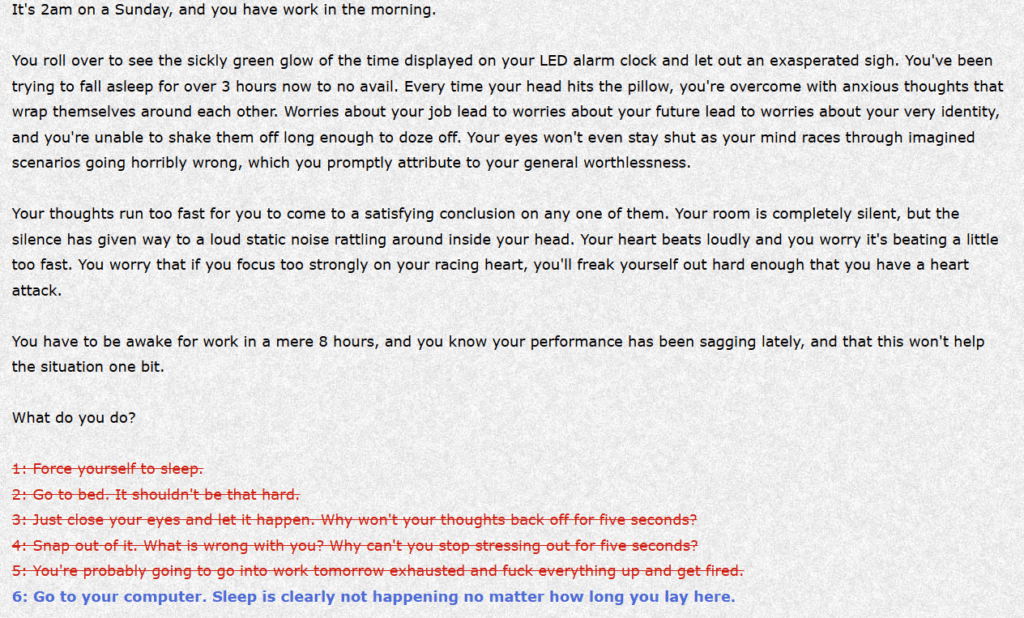
In many ways, Depression Quest is set up like a typical text-based adventure game, and it uses this format cleverly to highlight the interior struggles of the protagonist. The game’s primary mechanic is allowing the player to choose how to respond to a given event or situation at different points in the story. This setup, combined with the decision to describe the game as a “Quest” in its title, primes the player to expect a conflict-focused adventure game of a sort that is traditionally masculine-coded. However, it quickly becomes apparent that the game’s content is much more internal, and that the struggles the player faces, such as getting out of bed in the morning, deal much more closely with emotional and social concerns. The game even undermines its own mechanics to showcase the player’s lack of external agency; for instance, many levels use red strikethroughs to highlight decisions that might theoretically be on the table, but are not actually feasible given the player’s mental state (see the first image). A feminist reading of this might observe that even though the game uses the masculine-coded dynamics of adventure and conflict to frame its struggles, it uses these dynamics to frame an experience that is about interiority and emotions. Applying the analytical framework used in “Play Like a Feminist” reading, we can interpret this in multiple ways. One could see it as an appeal to stereotypically feminine interests, in that it focuses on emotions and relationships and feelings, things that the “female gamer” is supposed to be drawn to. On the other hand, the player’s lack of agency is an apt metaphor for the experience of depression, and the way that the world often expects people with depression to be able to “motivate” themselves out of their struggles. This is underscored by a conversation the player has with their mother, who tries exhorts the player to work harder to get what they want, to which the narrator responds with the following line: “You try to explain that it’s not a matter of that, but you can tell that you’re not getting anywhere.” Thus, even as the game deals with stereotypically feminine subject matter, it also validates the experiences of those who suffer with depression, and the frustration of trying to describe their interiority in a world that tends to misunderstand and judge them for their struggles.
At the same time, the game’s desire to articulate the general experience of depression also keeps it from grappling with specific experiences. The game’s narrative is told entirely in the second person, and the designers are very careful not to tie the player’s character to a specific identity. In this way, it is similar to other interactive fiction games, such as Adventure or even Choose Your Own Adventure novels, which use this device to immerse the player in the narrative while refraining from using specific personal details that could alienate them from their character. We are told at the very beginning that we are playing as a “mid-twenties human being” with a “a significant other named Alex” who we later learn is a woman (see the second image). Otherwise, we are told little about who the player actually is in terms of their gender, ethnicity, sexuality, and so on. This makes the game’s magic circle more accessible, allowing the player to imagine themselves in a more expressive array of bodies and roles, but the limited characterization of the protagonist also limits the depth of its analysis. For instance, if the player’s character is a man, we might also interpret their difficulties asking for help as a struggle against masculine-coded social norms. As it is now, the player must decide what their character does and why, which allows for more expression but, as is often the case with games like Adventure that use branching narratives, it is difficult to draw deeper conclusions from the story. Since we know so little about the protagonist, it is difficult to analyze their decisions through a feminist or other theoretical lens, which limits the depth of potential analysis. One way to address this could be to add more grounding details about the protagonist and to consciously explore how their identity shapes their experiences with depression. In order to allow for a broader range of expression, the game could introduce several diverse protagonists to choose from, allowing players to discover how their identities inform their experiences with depression.

Overall, this game combined gaming tropes and expectations cleverly to provide an honest and surprising analysis of the experience of depression, although there is still room for a deeper and more analytically rewarding discussion of identity and mental health.


