

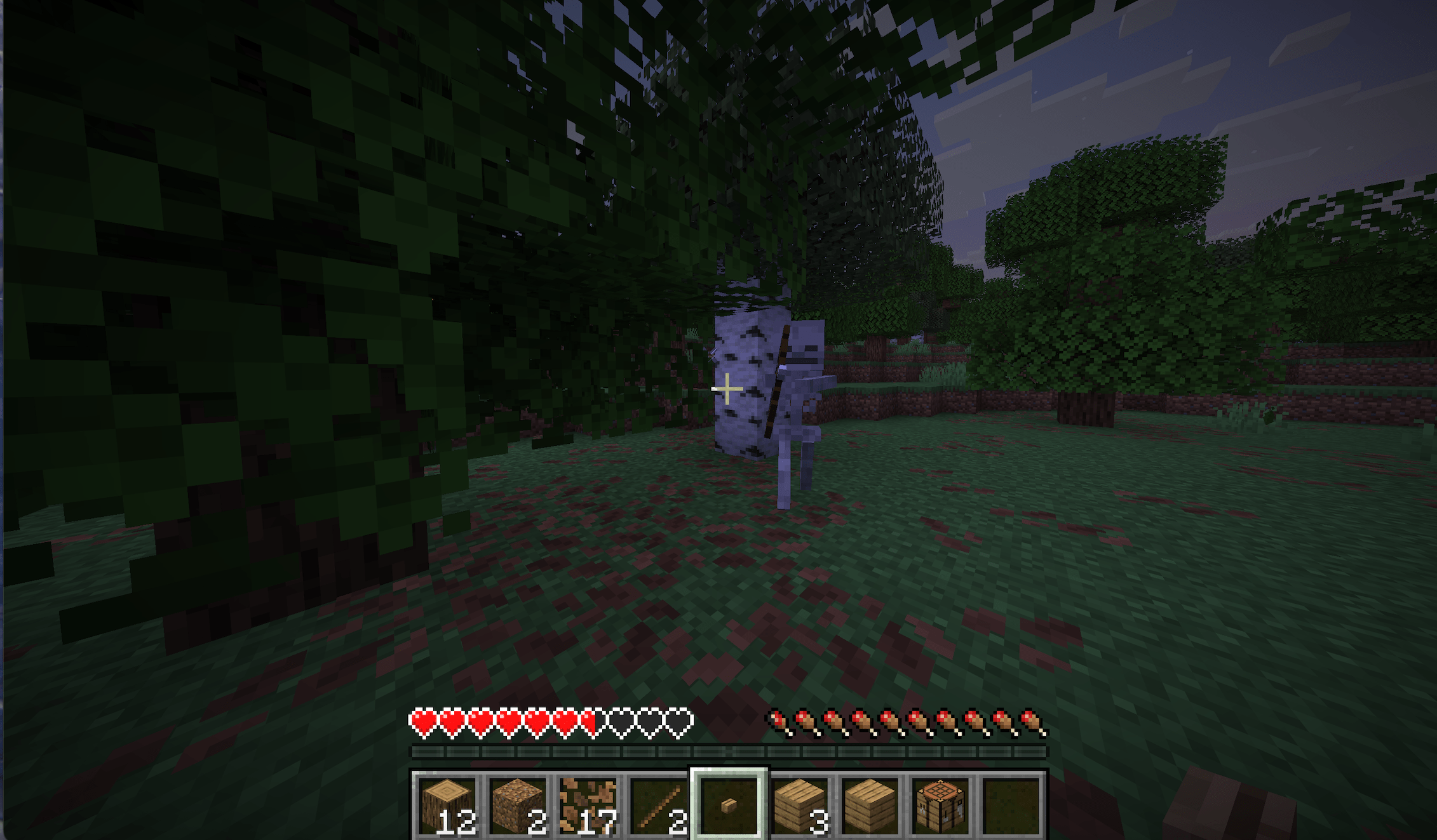
My introduction to Minecraft is a wide view of trees. I don’t see myself, or what is coming behind me, but everything feels clear and calm and it is the beginning of the first day. I walk around, testing the commands, and realize all I can do is strike. So when the command appears to destroy a tree, that is precisely what I do. Quickly, I fell the tree into blocks that I convert to planks, which I use as tools to fell more trees.
 As I mindlessly continue this task, all I can think about is what I am going to do with all this wood. McLuhan refers to this as the ‘content’ of the medium blinding us to the character of the medium. I was so focused on the content, “what am I going to do with all this wood,” that I failed to notice what the medium was doing to me, training me to strike without a second thought, and for my first day, I was completely blind. Minecraft’s medium trains unconscious extraction as McLuhan predicts, until the logic breaks down, and in that gap, the player’s own ethical framework rushes in to fill what the medium has been suppressing: the question of whether any of it needed to happen at all.
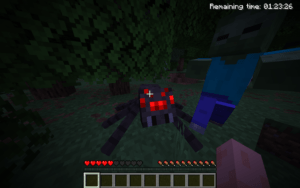
A spider approaches, and before it attacks, I know it will attack. The medium of the game presents the Spider as a threat even before it provides any evidence that it was one. It is not only big but also monstrous, with red glowing eyes and long arms. Even without seeing how big I am, I have a feeling that the spider is bigger than me. It lunges at me, and I engage in combat with it, striking frantically using planks, until I kill it. Afterwards, all I feel is relief.
Later on, I encounter a pig. Until then, I have been cutting down trees and killing the creeper and bees that have been trying to kill me – and striking is the only verb that I have. So when I see the pig, I strike, and realize that I had hurt it because it turns from pink to red; however, there is nothing else I can do in terms of the controls that I have, and the only thing I am allowed to do is strike again. The pig dies, and I get meat. I realize then that the game extends my ability to strike, but it amputates any other way of relating to the animals. There is a senselessness to the slaughter of the pig that catches my attention. I didn’t need the meat for food at that moment, and the pig was not attacking me, so I cannot claim that I struck it in self defense like the spider.
As I continue around the game, chopping more wood, lighting torches, and getting into caves, I keep killing the passive animals that I encounter: cows, sheep, chickens, and I convince myself that their meat is a ‘just in case I need this’ resource, but I am filled with guilt because of the senseless slaughter. McLuhan warns that “any medium has the power of imposing its own assumption on the unwary, and prediction and control consist in avoiding this subliminal state of Narcissus trance.” When I killed the first pig, this Narcissus trance was what I broke. Until then, the medium had been imposing its assumptions on me (strike everything, collect everything – including litter, rotten meat), and I had been unwary. When there was no functional logic to kill the animals, I snapped out of it. This lack of functional logic in the moment means that the medium’s numbing had failed, and my ethical framework had filled the gap. This gap that has existed to let my ethical framework in is what McLuhan’s argument on the medium is missing.
Minecraft agrees with McLuhan but not fully: the medium of the game does shape my behavior, but not completely. The gaps where the functional logic breaks allows for my ethical framework to seep in and snap me back to moments of reflection. The guilt didn’t just appear when I killed the pig, it revealed that the medium had been making me extract without clear intention from my end, and I hadn’t noticed because the content was distracting me from what the medium was doing.
