

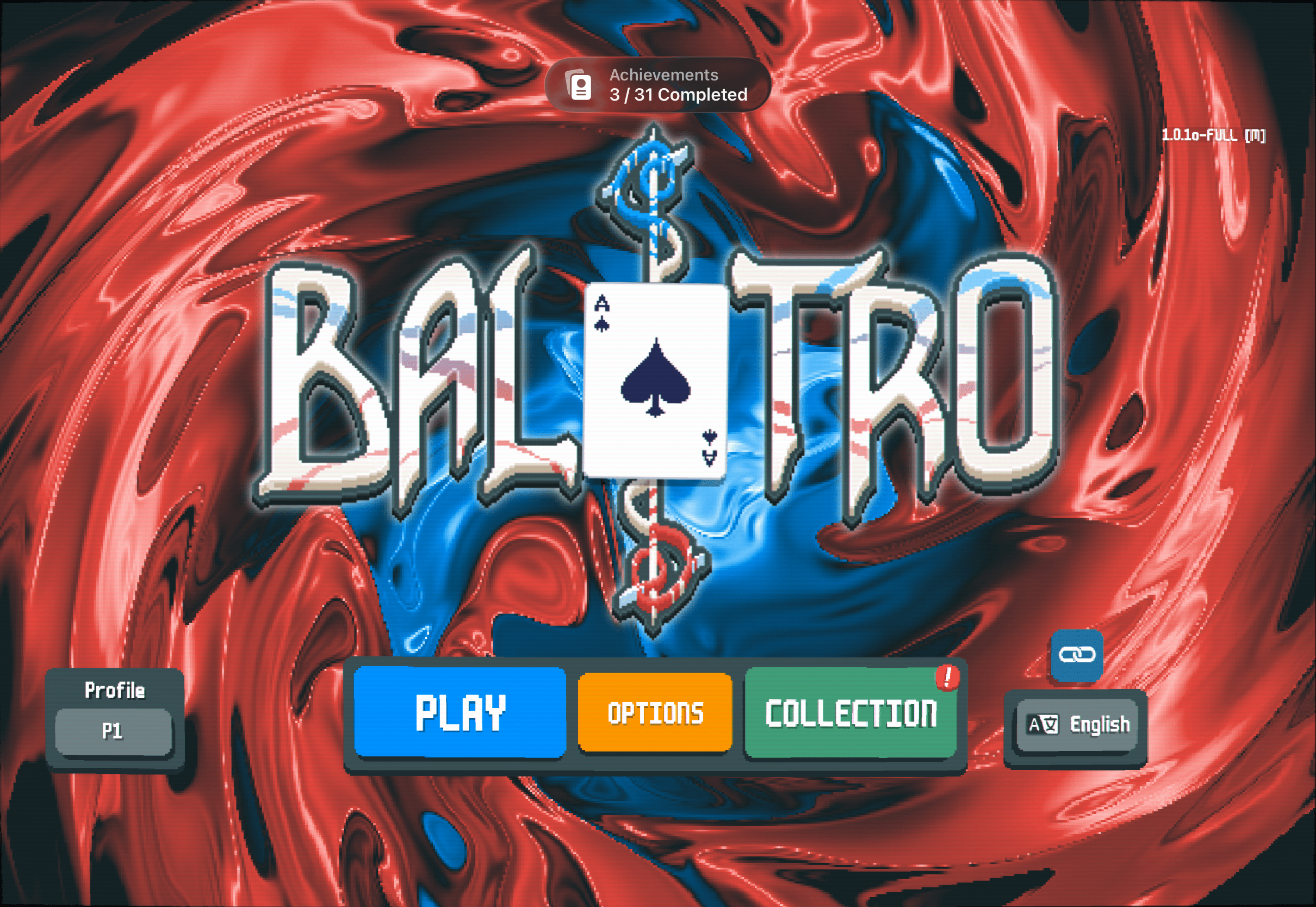
Balatro is a poker-themed roguelike deckbuilder created by a solo anonymous developer named LocalThunk and published by Playstack in february 2024. The game targets people over 12 years old who enjoy card games, deckbuilders, and roguelike mechanics and is available across multiple platforms, and I played on the iPad. Balatro does for Poker, what Mario Kart does for GoKart racing: It adds fun new mechanics and scoring to create a fresh experience that feels more approachable than traditional poker because of its lighter atmosphere. Balatro is grounded in an addictive parlor game, and I would argue that the inclusion of roguelike mechanics make this game even more addictive, while simultaneously protecting players from financially exploitative practices.
It’s striking how far addictive design has come since the spring loaded machines or the 1900’s and microprocessor of the 1970’s. Even with this evolution, the core design principle remains: the game is a black box with a script that seeks to operationalize chance, and that the player never fully understands. What the player does understand is that fun is driven by the challenge of trying to go on as long a run as possible. The mechanics of the game are relatively simple. The objective of the game is to match a target score each round, and each round, players play a poker hand of up to five cards based on an eight-card draw. They earn points based on the strength of that hand i.e. a three-of-a-kind earns more than two-pair. The twist here is that players can apply all kinds of modifiers to their hands to increase their scores. For example, the game has “joker” cards that give multipliers to random. For example in the image below, the abstract joker adds +3 multiplier for every existing joker.
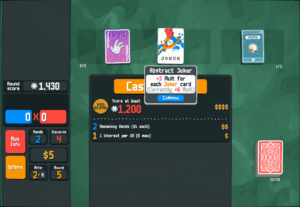
Example of a Joker card power up.
These modifiers add a cartoonish dynamic to the game, where players are constantly seeking to create larger numbers by synergizing their modifiers. This dynamic is where the addictive game loop is supported by the roguelike backbone most explicitly. A key feature of roguelike dynamics is in crafting builds, and Balatro’s endless replayability comes from the opportunity to create builds around specific poker hands, suites, or other elements of poker. Balatro effectively gamifies a game in order to create a single player addictive loop housed within the magic circle of this virtual casino. Previous knowledge of poker is helpful but not required, which creates a low barrier to entry supported by the arcade-like aesthetic of a psychedelic casino. The warped portal background feels like it transports the player to another dimension hosted by the cackling Balatro Joker. There is also a retro feel that the game’s font creates, which supplements feeling like the player is in another dimension with the feeling they are in another time. This vibe of being transported to another dimension is the same feeling that actual casinos seek to create with the lack of windows and clocks building an atmosphere that a person could be in indefinitely.

Round score target of 450 shown in the top left.
Replayability is a key goal of any roguelike, and Balatro does this by expertly managing the information horizon through the Blinds system. Each “level” is a collection of three blinds (small, big, goad) where the player tries to hit increasingly high scores to keep playing. By breaking gameplay up into these bite sized chunks, designers encourage the player to tap into the “just one more” loop that creates an addictive environment. It never feels overwhelming to go after one more blind, and playing in higher levels with huge blinds is challenging and thrilling. Time hardly ever feels wasted because of the permanent upgrades that you collect between runs, such as the ability to have more discards per round.
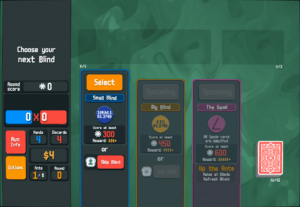
Blind system visualization.
The game also feels balanced at all times as the player is constantly making meaningful choices. Choosing a new upgrade that synergizes with existing ones to craft a build creates a sense of skill among the chance based card draws. This means that chance does not play a role so great that player skill is irrelevant at any time. The difficulty curve also increases steadily through the blinds, with small spikes sprinkled throughout, such as rounds where a suite is debuffed and unplayable.
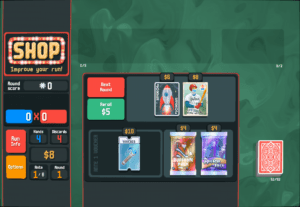
Shop where players make choices about which upgrades to select.
Balatro’s status as a roguelike places it in a different category than the “zombified” live service games that have grown in popularity and are designed to drag out subscriptions over time. Games like Helldivers 2, Star Wars Outlaws, Diablo and the FIFA franchise effectively keep players in an endless payment cycle in order to keep playing through seasons and battle passes. This is where Balatro’s roguelike mechanics actually present an ethical twist: even with how addictive the game loop is, players pay for Balatro once and then can enjoy the game forever. The games mentioned above are designed to leverage this addictive gameplay by maximizing the profits the game-makers can generate from continued engagement. Balatro’s focus on purely “fun addiction” as opposed to financially exploitative design makes it a unique experience in a world that is increasingly extractive in its design.
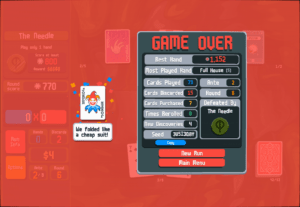
Game over screen with the cackling Joker. Just one more game?


