

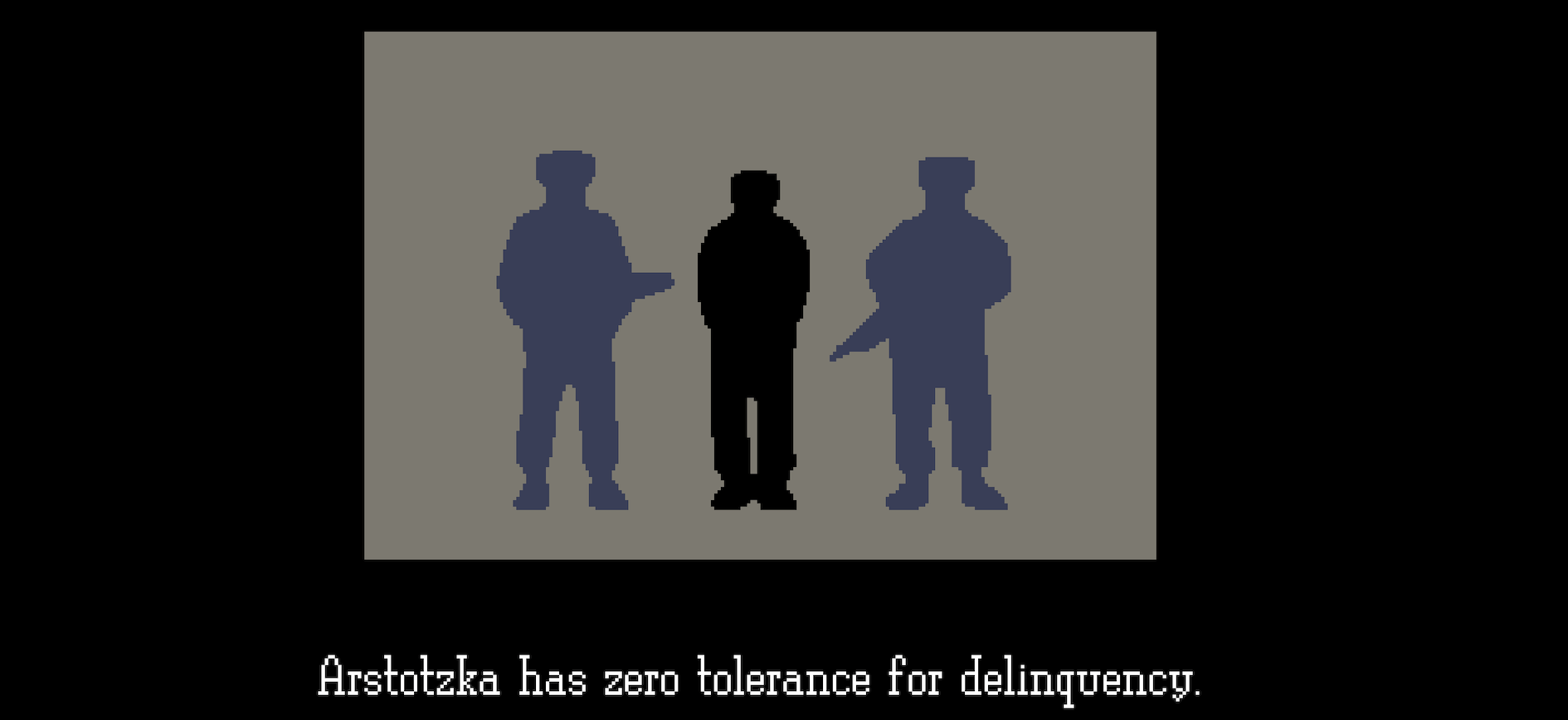
Papers, Please argues that under totalitarianism, personal responsibility is redistributed: narrowed onto family, outsourced to protocol, and weaponized by the system itself. The game’s procedural rhetoric forces the player to experience this redistribution firsthand, implicating them in the very coercion they are subject to.
In Papers, Please, we play as a border control inspector who allows or denies people entry into Arstotzka. As Ian Bogost argues, games make arguments through their rule systems, their procedures, not just their narratives. Papers, Please operates on at least three levels of procedure simultaneously: the coded rules of the game itself, the inspector protocols that dictate our actions and rewards, and the moral calculus we perform to decide who deserves entry or detention. These three levels work together to make an argument that no cutscene or dialogue could make alone: that under totalitarianism, morality itself becomes a system to be gamed.
We quickly learn that Arstotzka values two things: efficiency and precision. We earn credits by correctly processing entrants by following the protocols laid out in an ever-growing rule book. Every mistake is costly as we have limited time every day and citations cut into our meager profits. Everything costs credits. At first, they simply sustain our family: heat, food, and medicine. We can skip these costs but we cannot skip on rent: we are trapped here. Later we can buy upgrades to make our job easier. These mechanics make it clear what Arstotzka values, and what we should value too.
In essence, morality is treated as a resource that can be traded for more credits. A husband begs us to let his wife in without documents, but doing so risks a citation that cuts into our daily earnings. Early on we are instructed to screen all visitors from Kolechia, a gross invasion of privacy that the game presents as routine. Later we can choose to detain violators for extra credit, our morality “refunded” in a way since we are also helping a fellow border agent. As Hannah Arendt argues in Responsibility Under Dictatorship, we are very rarely truly forced to do anything. Instead we are coerced with credits, behind which lie the threats of death and imprisonment. Instead of simply telling us that systemic coercion gradually perverts moral agency, it makes us feel that perversion happening through these moral transactions.
Through this mountain of choices, the scope of our personal responsibilities narrow. Doing the “right” thing all the time is impossible, we must choose who to be responsible for. As Thomas Nagel argues in Ruthlessness in Public Life, public officials bear outsized consequences for their actions, yet are also expected to subordinate personal morality to institutional role. The game mechanizes this tension: every entrant is worth five credits regardless of their circumstances, flattening the moral weight of a threatened woman and an expired visa into the same metric. We follow protocol not because we are evil but because we have a family to feed. Protocol becomes an excuse: if we apply the same rules to everyone, it must be fair. And yet the rules fail us repeatedly. A woman is being threatened by a man and asks us to turn him away but protocol says he is free to enter. A mother needs to visit her sick child but protocol tells us to turn her away.
Papers, Please also forces us to draw the boundaries of our circle of responsibility. We have been supporting our family the entire game, but are we willing to spend credits to let our niece move in, is she “family” enough? The game’s stance on betrayal is similarly instructive. If we accept EZIC’s missions but don’t follow through, we are blown up or arrested. If we follow perfectly, we are conscripted as an agent. The procedures of Arstotzka and EZIC alike exploit the gap between force and coercion, weaponizing our sense of responsibility to keep us compliant. We must walk a thin line between public and private responsibility, and the game punishes us for leaning too far in either direction.
In the most hopeful ending, we confiscate enough passports to escape to Obristan where the roles reverse. We wait in a long immigration line with shoddy fake passports, and miraculously, the inspector lets us in, we are free. By following the system, we managed to escape it. And standing in that line we realize that every person we turned away may have been doing exactly what we just did. Rather than simply tell us this, the game makes us active participants in this transformation, forcing us to confront it.

Personal responsibility is not destroyed by totalitarianism, it is redistributed and weaponized. Papers, Please makes this argument not only through narrative, but through its systems: the credit economy that monetizes morality, the protocol that outsources moral judgment, the escape ending that implicates us in the same coercion we suffered. This is what procedural rhetoric can do that other forms of rhetoric cannot. We don’t simply read about the erosion of moral agency under systemic pressure. We perform it and feel how easy it is to slip down that slope.

