


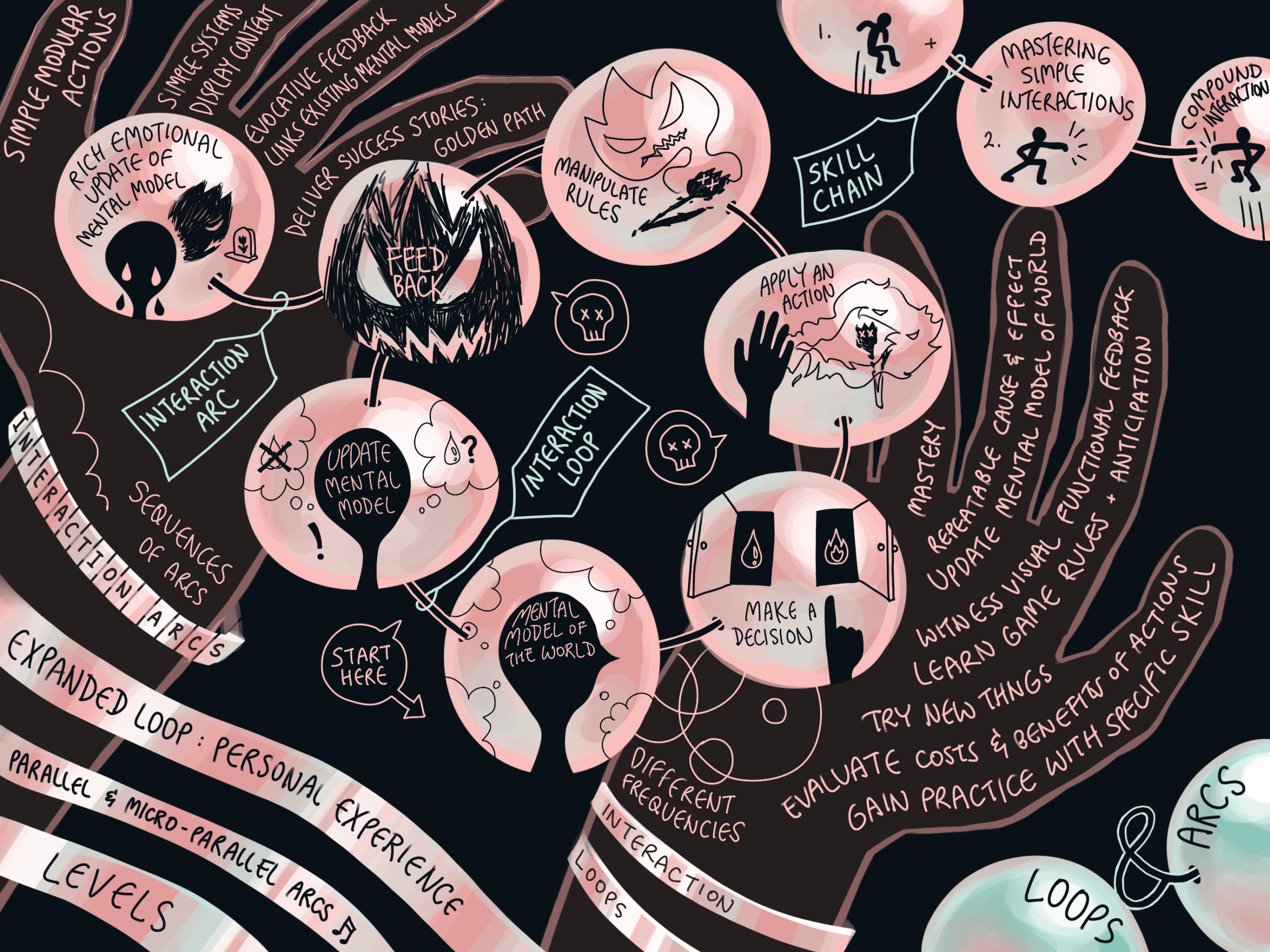
The signature game I bring up time and time again, which also coincides with my sketchnote theme, is Pokemon Pearl! This game has an overarching narrative arc of following the growth of the player character—from a small town kid who chooses their first starter Pokemon, to becoming the Pokemon champion of the region. Following this story, the game architecture is punctuated by a sequence of interaction arcs—the gym leader to beat in each city—and between each arc, players engage in repeatable interaction loops of wild Pokemon encounters, Pokemon battles, and catching Pokemon.
One example of an interaction loop would be learning world-specific optimal strategies in Pokemon battles. The inexperienced player may begin with a naive mental model of the world: Tackle is an attack move that deals damage. Upon encountering a Geodude, the player makes a decision to tell Piplup to use Bubble instead. Then, Piplup applies the action of Bubble on Geodude, which manipulates the game’s underlying rules of Water type attacks being super effective on Rock type Pokemon. The player receives this feedback through the text “It’s super effective!”, a different sound effect, and twice the usual damage being dealt to Geodude. Thus, this would update the player’s mental model to learn that there are certain types that are doubly effective on others, in this case Water attacks on Rock type Pokemon.
Through these interaction loops, the player gathers world-specific information to develop a robust mental model of how Pokemon effectively battle, conditions of when they are likely to be caught, and different battle tactics. They are free to repeat these loops as much as they’d like to practice and improve their battling skills to be able to confront interaction arcs that evoke a sense of accomplishment, and allow the player the proceed to the next arc.
