


How Monument Valley Turns Puzzles Into Perception
Monument Valley, by London-based studio Ustwo games, is a touch-based isometric puzzle game aimed at players ages 9 and up- a casual mobile audience reached with the polish of a gallery piece. Released in 2014 for IOS and Android, it runs approximately 90 minutes across ten chapters. I downloaded it on my phone and started playing, captivated by the shapes, colors, and overall design of the game. The level I returned to most was Chapter II, “The Garden.” What struck me wasn’t the level itself but how it began: the chapter title appears overlaid directly on the unsolved puzzle, so the words “Ida embarks on a quest for forgiveness“ hover in the air above a structure I could not yet read. The game was asking me to look at a story and a problem at the same time, in the same image. That overlap- where narrative and puzzle occupy the same visual field- turned out to be the whole game in miniature.

My central argument is that Monument Valley’s puzzle mechanics are perceptual, not logical- and that distinction is what makes the experience of playing it feel meditative rather than frustrating. Most puzzle games ask you to deduce, calculate, or recall; Monument Valley asks you to look again. The drag, the rotation, the camera pivot are not tools for solving. They are tools for seeing. Because the mechanics demand perception rather than analysis, the experience the game produces is closer to circling a sculpture than to working through a physical puzzle.
Mechanics, Dynamics, Aesthetics: The Puzzle as a Perceptual Act
I believe the mechanics are minimal- tap to move Ida, drag a wheel to rotate a section, pivot the camera until a previously broken path looks continuous. I quickly noticed what was missing in the game: nothing to count, no rules to internalize, no inventory. Players aren’t given a problem to think through; they are given a view to adjust. The dynamic is what designer Ken Wong has called “the central character is architecture”- Ida is small and almost incidental, while the building reveals itself one rotation at a time. The resulting aesthetic produces types of fun like discovery and sense-pleasure- it feels very different to the fulfillment from figuring out a logic puzzle, and more like the quieter pleasure of realizing the solution was right in front of you.
This is why the experience feels distinct from any other puzzle game. The course frames games as exercises for the brain that produce fun from mastery- and Monument Valley narrows the idea into perceptual mastery: the slow training of an eye that learns to look for impossible alignments. Solving a level isn’t analytical achievement; it’s the moment your brain accepts the optical trick the screen has been offering all along. Additionally, I noticed Monument Valley never punishes you- no fail state, no timer, no death- because punishment would imply you got something wrong, and the design holds that there are no wrong perceptions, only ones you haven’t tried yet. I realized this early in the game, on Level 3. I could not figure out how to allow Ida to progress through the level, tapping the environment to no avail. I tried moving objects in the environment, and finally realized that I can tap and drag paths to progress Ida in her journey.
Evocative Space and Escalating Constraint
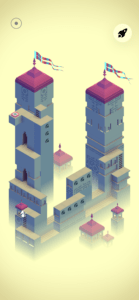
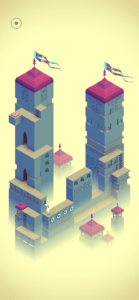
The formal elements are spare: single player vs. game; tap to move, drag to rotate; one objective per level; no inventory. With so little formal scaffolding, the game purposely draws viewers attention to the evocative space conveyed through the architecture and setting. The towers, flags, and onion-domed spires draw on cultural genre memory of Islamic/Turkish palaces, Russian Orthodox cathedrals, and Indian step wells. A player who has never seen any of these still recognizes the architectural vocabulary; the built environment feels like it has a rich history before Ida steps into it. The way Chapter II is structured- a stone pavilion ringed by onion-domed minarets on a green plinth scattered with white wildflowers- whispers a story before any puzzle is solved: a sacred place, a small intruder, a quest with consequences.

But evocative space alone would not sustain a ten-chapter game, and this is where I believe level design quietly does its hardest work. The early chapters teach the perceptual mechanic in isolation- rotate a tower, align a path, walk to the marker. Then Ustwo introduces the crow people, and the puzzle grammar fundamentally changes. Crow people don’t attack Ida or threaten failure; they simply occupy space, refusing to move and blocking the exact tiles she needs to cross. Suddenly I had to perceive and plan- to see the impossible alignment and then figure out how to route around a stationary obstacle, often by manipulating the architecture itself to scoot a crow off its perch. The mechanic doesn’t change; the constraint does. Solving a level with crow people requires holding two perceptual tasks at once- where the path would be coherent, and where the bird is standing in the way of that coherence.
This is escalation without complication. Ustwo never adds new verbs to the player’s vocabulary; they only add new pressures on the verbs already there. By the late chapters, a single screen can demand that the player rotate, align, route around multiple crow people, and recognize that moving one piece of architecture will dislodge a crow that was blocking another path entirely. The puzzle is still purely perceptual- but perception under interference is a much harder skill than perception in stillness. The genius of the design is that balance still favors the player, because the mechanic stayed the same the entire time. Only the player’s eye had to get sharper.
A Design Critique: When Perceptual Mechanics Hit a Ceiling
Perceptual mechanics scale beautifully within a single screen, but I believe the game lacks elements across a long arc. Each chapter is a self-contained vignette- Ida arrives, perceives, exits- and the game’s commitment to one-puzzle-per-screen architecture means there is almost no carryover between levels. The crow people who block her path never become characters; they are obstacles with feathers. I believe the enacted storytelling within Monument Valley could have been so much richer if a previous chapter’s geometry left a mark on the next. Imagine a level where the tower Ida built in The Garden reappears as a ruin three chapters later, asking the player to re-perceive a space they once solved. Cross-chapter memory would have given perception itself an arc.
Ethics: What “Sacred Geometry” Assumes
Monument Valley calls its impossible structures “sacred geometry,” and the design is genuinely reverent toward the architectural traditions it borrows from- Islamic geometric tilework, Russian Orthodox spires, the carved works of Indian temples. However, I believe these traditions deserve to be named, not absorbed. The perceptual mechanic that defines the experience- “look again, until you see”- assumes a particular visual literacy. A player educated in any of those traditions enters with knowledge the design treats as decorative. A player without that background sees beautiful shapes.
This affects the experience of the game more than it might seem. If Monument Valley’s central pleasure is perceptual mastery, the game has quietly defined whose eye gets to feel it most fully. Players whose visual vocabulary already includes traditional tilework, arches, and domes aren’t being trained to see- they’re being asked to recognize. The same mechanic produces different experiences depending on what the player walked in already knowing. I believe that the game’s own logic of inviting the player to look again actually applies to the design itself, and to crediting the traditions that built the impossible.