Baba Is You is a single-player digital puzzle video game developed and self-published by Arvi Teikari. I downloaded it off of Steam (thanks to my new family) and played it on my Apple Laptop. The game is suitable for all ages, and thanks to its simplistic nature, is great for gamers and non-gamers alike interested in the puzzle genre.
I remember hearing about Baba Is You a while back from when it won some award or something, so I was glad for this opportunity to play it a couple years later. The game operates on a similar principle to the card game Fluxx, where the point of the game is that the rules change as you play, except in Baba you’re given way more agency over how the rules change instead of being dealt a random rule card that makes it much easier or harder to win. The main types of fun it carries is challenge and discovery, and it doesn’t have any sort of pronounced narrative, mainly relying on spatial storytelling through props, sort of like Monopoly or Uno, though I guess one could argue that it’s an enacting story because Baba is forging their own path forward on their puzzling journey.
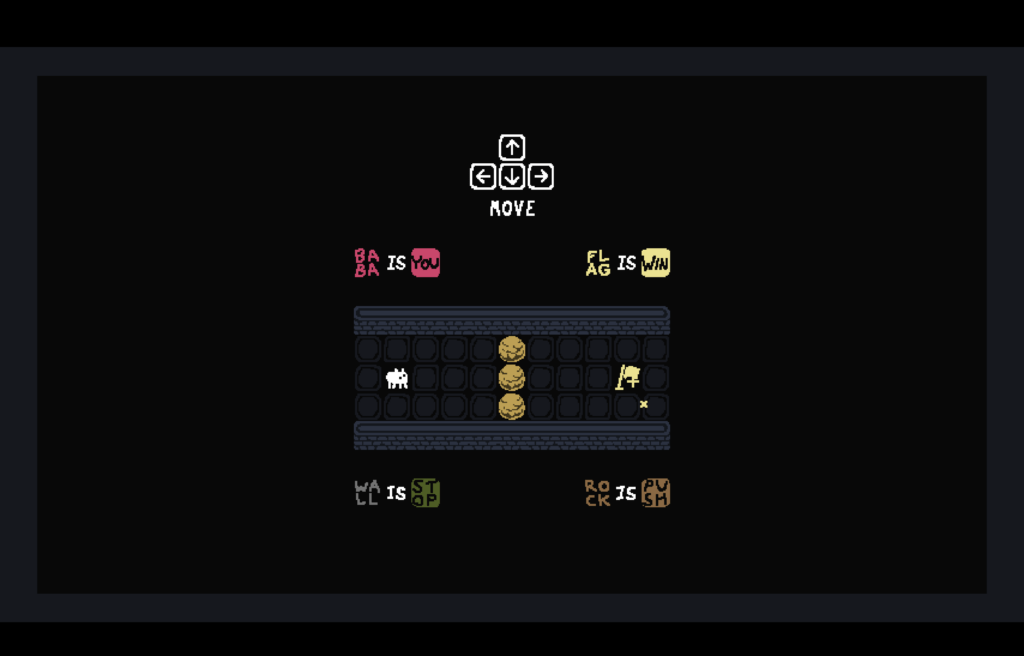
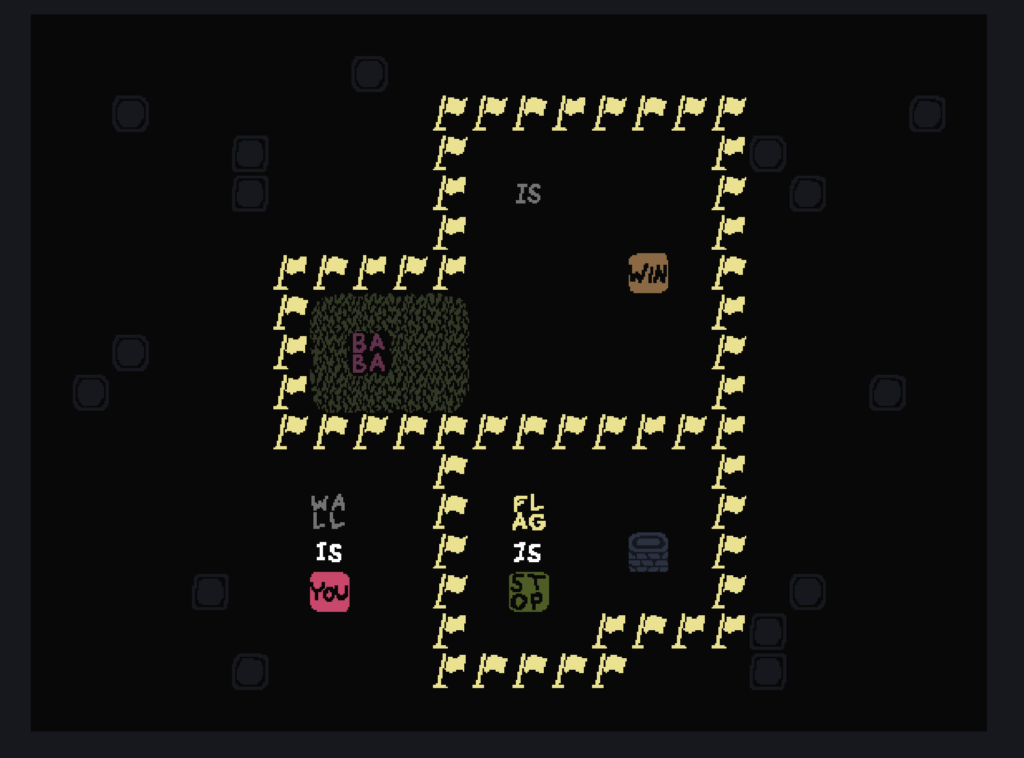
In Baba Is You, you’re dropped into the world with a quick, visual introduction that explains the rules to you (see fig. 1). Rules in Baba are formed of three (or more) “key words”, usually a combination of “[noun] is [verb].” For example, “Baba is you”, “Flag is win”, and “Rock is push”. During that intro section, you reach the flag without any trouble. This doesn’t seem like it would be a super interesting game; it’s so simple after all. However, on the next level, you discover something unexpected. You can push a keyword out of its place to deactivate the rule, and you as the player don’t have to be Baba at all, you can be a wall! This is just the beginning of showing the creative possibility space of Baba Is You’s simple “base” mechanics (see fig. 2).
This simplicity is interlaced within all parts of Baba Is You’s design. From the art style that fits clearly on a square grid, to the lack of narrative, to the almost childish rule grammar, to the fact that the only abilities you have as a player is to move your character, this factor is crucial for the game to be laser-focused on its puzzle component and nothing else. Due to the movement limitations, something clever I noticed is that in order for the game to make it clear that it’s impossible for you to change a rule, they will just place it in a corner because you’re unable to reach a position where you’re able to push it from the corner. This simplicity allows for a natural layered complexity that doesn’t isolate beginner players.
As someone who’s pretty bad at puzzle games, the fact that the base mechanics were so understandable allowed me to get dropped in as quickly as possible to the gameplay. Game balance was discussed in lecture pertaining to when multiple players are playing at the same time and their chances of victory, but for singleplayer games you still have to balance for different people with different experience/skill levels. I think the game does that very well as I was also able to solve harder and harder puzzles because of the simple “base” set of mechanics that layered on top of each other. Something else I appreciated was being able to move past a “section” of the map without having completed the last level, which is often a bit harder than the others.
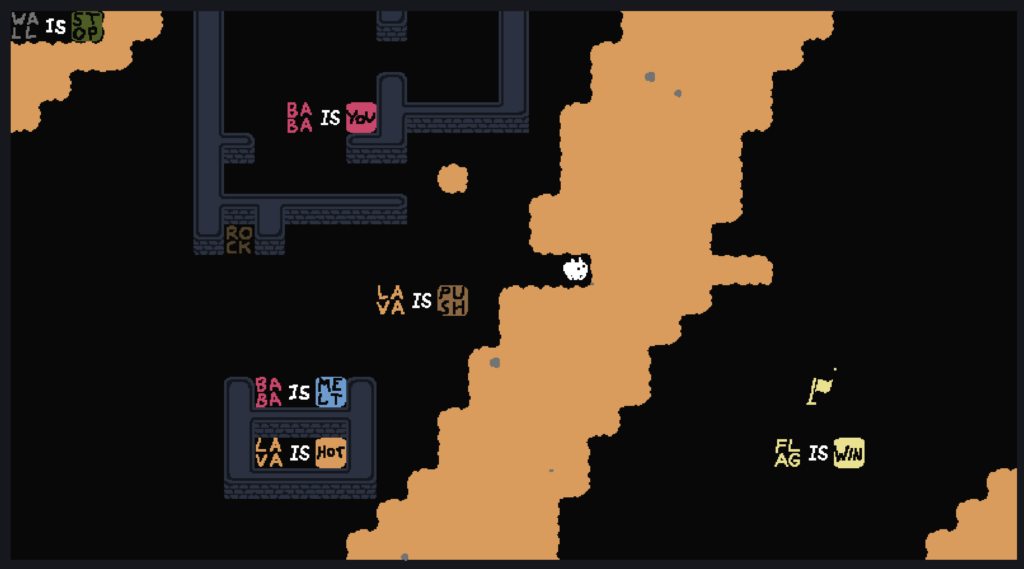
There were some standout moments during the game, such as pushing lava out of the way after adding a second rule (fig. 3) or turning into a bunch of pillars. These were moments of emotional catharsis as they were often a result of me thinking creatively with the little components that existed, but were also generally funny moments as well. Baba Is You is also subversion of common video game knowledge as it takes the intuitive approach (you being the main character, reaching the flag being the win condition), and flips it on its head. What does it mean to be you? What does it mean to win? In this way, it creates a fresh experience that doesn’t require a bunch of different rules and complexities. I think a lot of game designers try to make their games really fancy with a lot of different mechanics, but Baba Is You shows that a small cluster of simple mechanics can really build on themselves to create something special.
One question I ran into while playing Baba Is You is the translation of the game into different languages. While the game seems very simple to translate at first, the fact that the syntax of English is so deeply rooted into the gameplay makes it really difficult to translate correctly into languages with different syntax structures (I Googled it, and apparently the game has translations for the UI but not the gameplay.) This is somewhat mitigated by Baba’s simple grammar so it’s easier to learn these specific English patterns, but it would be challenging to play if someone didn’t know any English. I believe that ethically, game designers should consider more heavily which locations are allowed to or prioritized when accessing games.