

For this week’s critical play, I played Gorogoa – a puzzle video game developed by Jason Roberts and published by Annapurna Interactive on December 2017. The game is designed for audiences of age 6+, and is available on PC via Steam and mobile via iOS and Android, and consoles as well (NS, PS4, XB1). I played the game on my M1 macbook via Stem.
My experience with Gorogoa can be summarized as a sequence of “Wait, that’s how it works?” exclamations. In one sequence, I needed to rotate a gear — and the solution was to connect two seemingly unrelated image patches that show a sun and a castle below it. Once aligned, the scene shifts: the castle’s merlons catch the sun’s rays, and the rays themselves become the teeth of a gear that turns the mechanism I was trying to move. The brilliance is in the repurposing — sun rays and stone battlements, drawn for one meaning, suddenly function as another. This artistic ingenuity, woven into the puzzle mechanics, creates an out-of-the-box thinking experience that propels players forward through the game. Gorogoa demonstrates that puzzle mechanics, done right, can carry an entire game on their own.
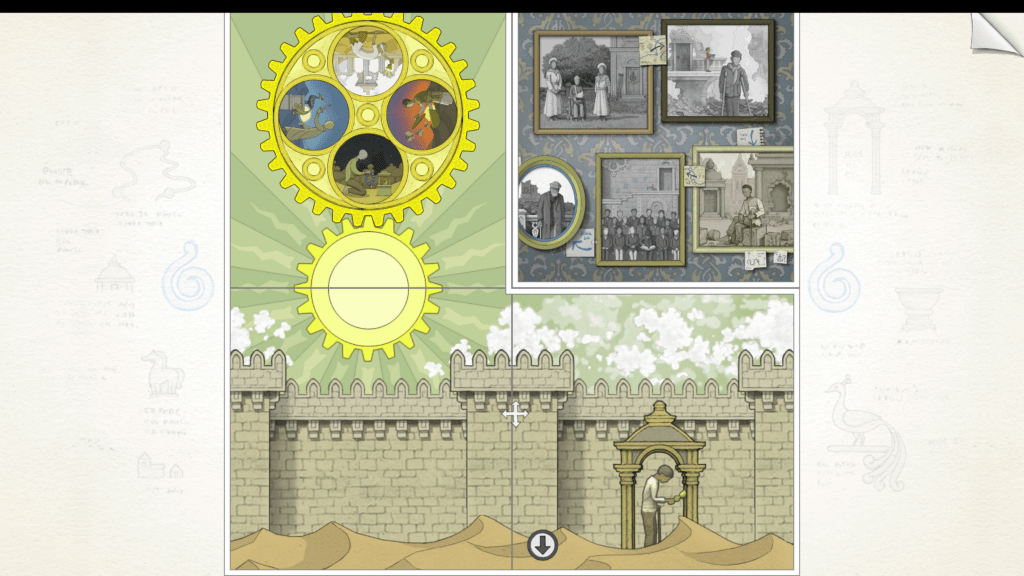
[Fig 1. The sun and castle merlons act as gear teeth to rotate the gear on the upper left corner.]
The mechanics of Gorogoa are deceptively simple. Players are given a 2×2 grid of click-and-drag image panels, and can zoom in or out within a panel, split a panel apart, or align two panels so that elements across frames connect. The objective is to use these actions to advance the scene depicted in the panels. While it sounds straightforward, in practice it actually proves to be an intellectual challenge as a single panel often contains multiple layers of zoom, and players must hold a mental map of which images live where in order to find the right connections. This produces a challenge and discovery type of fun — and, thanks to the game’s intricate hand-drawn art, a strong sensation fun as well.
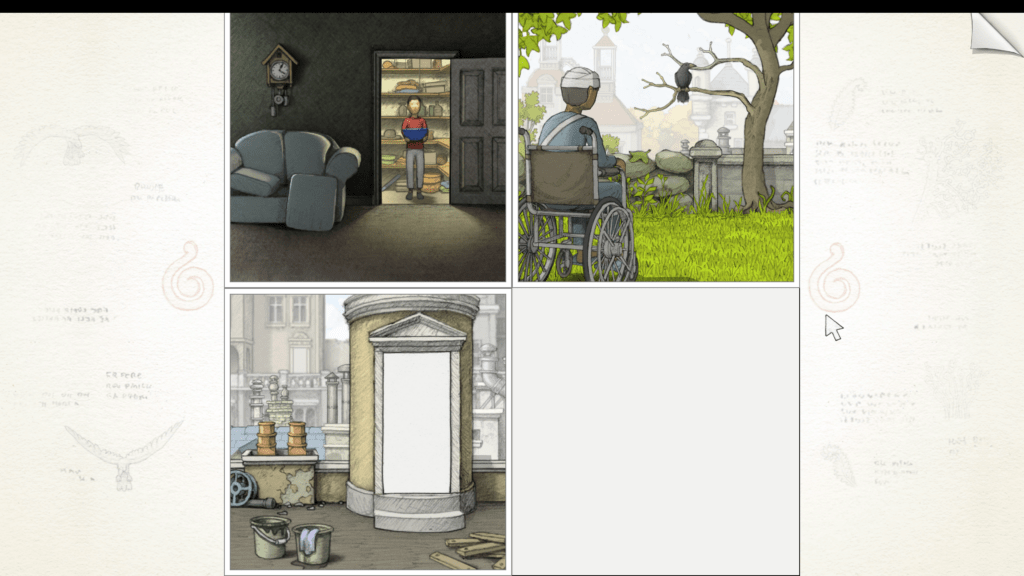
[Fig 2. UI of Gorgoa – players are given a 2-by-2 grid with image click-and-drag image panels.]
What’s astonishing about Gorogoa is how it draws players in without relying on narratives. Other puzzle games I’ve played — such as Cube Escape: Paradox or The Legend of Zelda: Skyward Sword — use story as a supplementary tool to motivate the puzzle-solving. In Skyward Sword, you bust through dungeons to save Zelda; in Cube Escape: Paradox, you piece together who you are. Gorogoa offers no comparable thread. While the game does take an embedded narrative approach – Progressively revealing its story through image panels – the story functions as a bystander, showing what is happening rather than giving the player a reason to push forward. What pulled me forward instead was raw curiosity, triggered by the game’s unconventional puzzle structure and its constant repurposing of familiar elements — sun rays and castle merlons becoming gear teeth, stars becoming lantern lights. I found myself flexing my brain in ways I never had in a puzzle game before. In one sequence, I needed to build a clock that read 7:20. My first instinct, shaped by every other puzzle game I’ve played, was to rotate the hands of an existing clock — but no such clock existed. The solution was to assemble one: the minute hand had to come from a compass needle I rotated using a magnet from another panel, and the hour hand from a pressure gauge I had to move by boiling water in a pot elsewhere on screen. Puzzles like this one aren’t tethered to a narrative or guided by dialogue. They rely entirely on visual cues, lateral thinking, and the willingness to see ordinary objects as something else. That alone was enough to carry me through the entire game.

[Fig 3. Visual hint of clock sequence – we need a clock that points to 7:20]
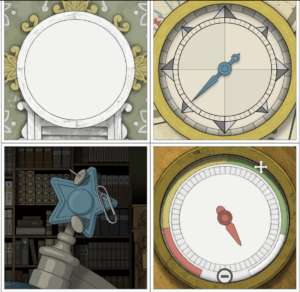

[Fig 4.1, 4.2. Rearranging the minute hand – The blue hand is the compass needle, and star-shaped object is the magnet.]

[Figure 5. Rearranging the hour hand – increase the pressure by boiling the water inside the pot.]
Yet this very mechanic that makes Gorogoa feel universal also quietly excludes some players. On the surface, the game looks like a puzzle anyone can solve just by looking – the complete absence of text removes language barriers. But underneath that surface, the puzzles assume a specific kind of literacy. Take the clock sequence I described earlier: to set the hour hand, the player must recognize a pressure gauge, infer that pressure can be increased by heating, and then locate a heat source elsewhere on the screen. To set the minute hand, the player must know that a magnet can deflect a compass needle — and recognize a magnet that’s drawn not as the familiar red-and-blue horseshoe but as a star-shaped object with metal fragments clinging to it. Elsewhere, the game expects common sense from players such as how gears mesh or how levers pivot. This is a particular vocabulary of industrial and post-industrial mechanical knowledge, the kind taught in elementary science classes at school. A child who hasn’t yet covered these concepts, or a player whose education emphasized different domains entirely, would face puzzles that are not just hard but illegible. What looks like a game entirely built on visual intuition turns out to rely on a fairly western, industrial, schooled way of seeing the world. That doesn’t make Gorogoa a bad game in any sense — but it does challenge the idea that wordlessness is the same as accessibility.