Why are people driven to fight? What impacts one’s choices towards the need to fight – how generational hatred propagates over time? Bastion, created by Supergiant Games, utilizes the medium of video games to answer this particular question – that societal genocide is something inevitable even with repeated deaths and time loops, decided by forces outside the Kid. Through a murky, unstable world that builds itself as the player moves, information revealed gradually in a slower fashion than most game mechanics, and a functionally linear narrative until the last final choice, Bastion uses the game medium to implicate the player in generational and cultural hegemony with disastrous, world-ending consequences.
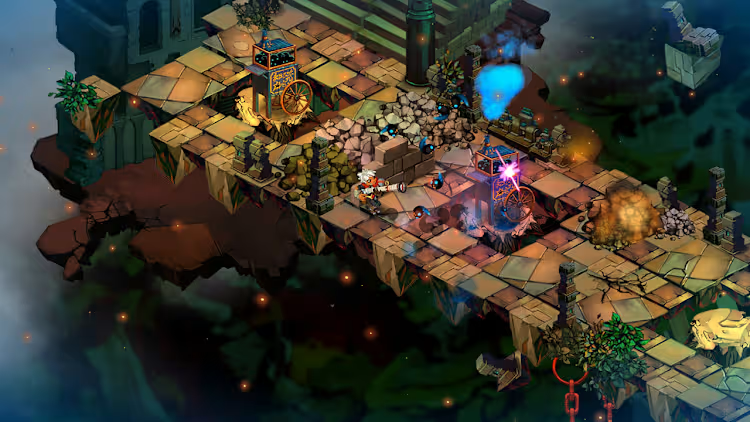
In Mitchell’s Nietzsche-fueled analysis of Bastion, he writes about the unstable world: “The visual style of the game suggests that the player is actively but shakily constructing their world simply by being in it, and the ludic toolset reinforces this suggestion.” (Mitchell 28). The world is dim and dark – only the player’s immediate surroundings are initially visible when in a given level, until walking close to a path causes it to be constructed. However, I extend Mitchell’s analysis through noting that it is not the player constructing their own world, or even the player character (Kid), but rather Rucks himself – the (eventually clear) unreliable narrator – that is telling you what happened in the past, what to do next, and even who you are. In this way, Bastion plays with the age-old question: who gets to control the narrative? And ultimately, why might this be the method of storytelling employed in Bastion?
Rather than create psychological distance between the Kid and the player, hearing the story through Rucks’ voice, rather than the more traditional internal monologue and dialogue, causes us to feel aligned with the Kid and the Kid’s own position in the world. By the time the player is prompted with the choice to save or leave Zulf, or turn back time or leave the Bastion, we are acting within our own agency, regardless of what our initial instincts are. Bastion relies on breadcrumbed information – inviting a sense of achievement in the player through small wins at the end of each level and small gains in passive ability, distracting from the larger picture of cultural genocide that Rucks gradually reveals, prompting the player to slowly grow distrust with the narrator.
While the Kid’s reasoning may be excusable, the Kid’s actions are still what they are – through the course of the game the Kid slashes through the Ura, the animals/plants inhabiting the world through the calamity, and generally acts without seeming remorse. Bastion additionally represents a narrowing of priority – that there exists a task based kind of behavior, partitioned. The Kid is just making a part of the nuclear bomb, not the whole nuclear bomb — though still intended to destroy the Ura. In this way, the Kid is continually implicated, and absolved of guilt, in the cultural warfare. He is impacted by the generational expectations being passed down on him, in this violent world, where further information can only be gained through beating certain violent levels. Progress, then, is associated with destruction, but this is something enforced through Rucks’ choices, demonstrating how generational expectations are pushed down until one finds the resolve to break through.