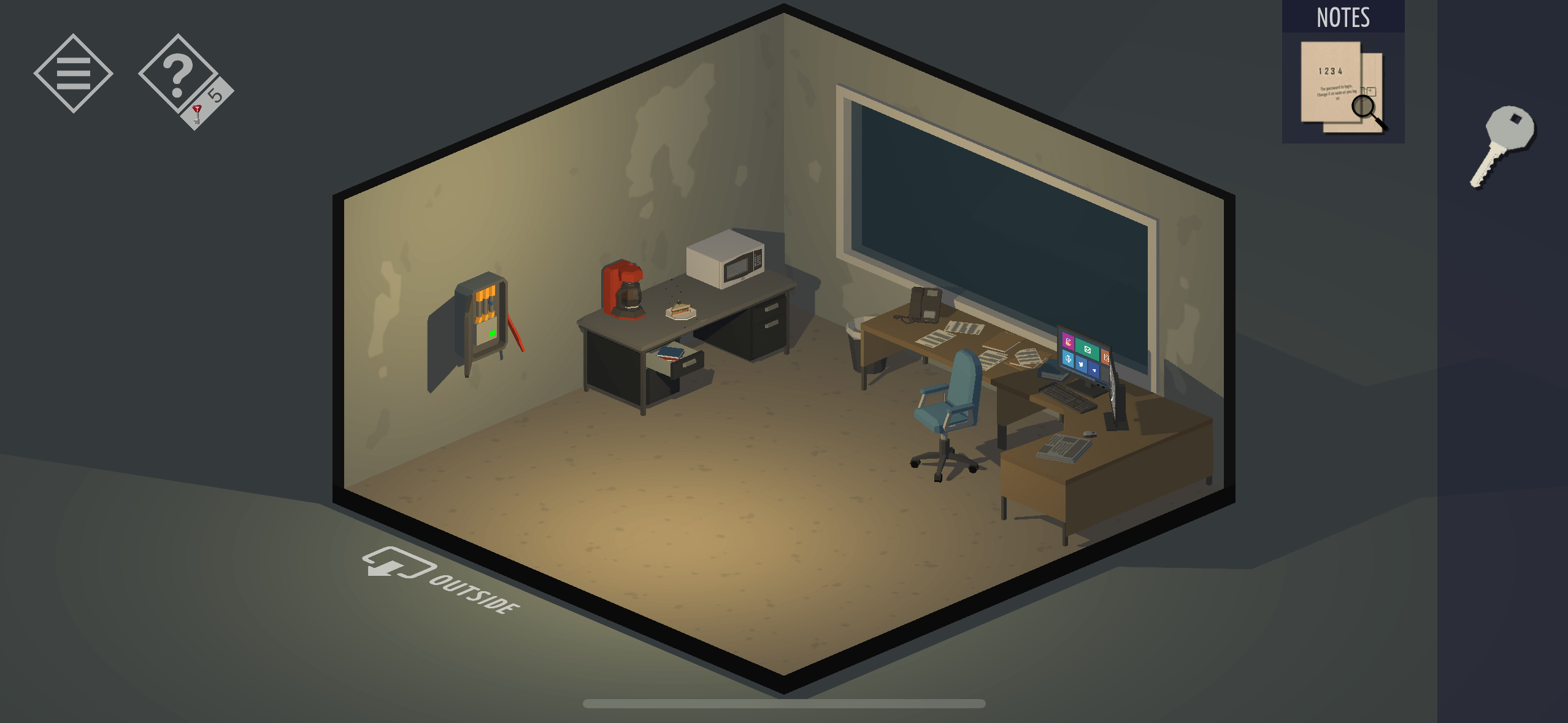
I played Tiny Room Story: Town Mystery, a mystery game in which the player must decode clues to unlock new rooms and proceed through spaces in a small town. The game is a third-person puzzle adventure created by Kiary Games, and I would say that the intended audience, though not specified, is probably ages 14+. The game would be especially fun for people who enjoy environmental problem-solving, escape rooms, and detective games. I played using the app version on my phone. In this critical play recap, I will argue that while Tiny Room Story: Town Mystery absolutely uses space to shape the narrative, the game’s mechanics miss opportunities to advance the narrative through the gameplay.
I want to preface this with important context about me, which is that I am new to video games in general, and I think my experience playing this game took far longer than it might for someone more experienced. I got through Chapter 1, and by the end, I felt pretty exhausted. I felt pretty disconnected from the emotional/moral truth of the narrative, which had originated with a story about saving the main character’s father.
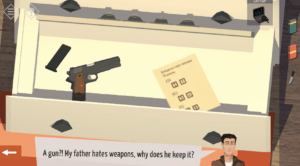
That being said, I still think there is a lot to learn from the experience of a novice player struggling through the game. I believe that my experience losing touch with the narrative of the game could indicate a broader structural issue with the way the game is set up. While the game absolutely uses space to shape the actions of the player in ways that I found intriguing and compelling, the actual game mechanics did not feel aligned with the embedded narrative. Although I felt like I was solving a mystery, none of the clues felt connected to my father, aside from one that mentioned his aversion to gun ownership. At that point in the game, I felt so in the weeds with the clue mechanics that I had completely forgotten I was trying to save my father at all. The embedded narrative fell flat for me. Using evocative or emergent narrative could have empowered the player with a greater sense of investment in either discovering or creating the story along the way.
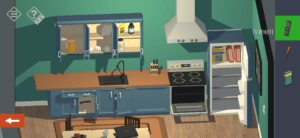
The mechanics of the game did not support the player in remembering the embedded narrative, either. The most efficient way to progress in the game was to click on every single object in sight. One could argue that detectives interact with every object in an environment, but the experience felt more like guessing and checking rather than strategy. The interactability game mechanic led to convoluted experiences throughout the game because I did not need to be discerning about my actions. Instead, if I picked up every object that allowed me to, I eventually had what I needed to solve the puzzles. Below is a screenshot of one of the rooms after I had opened every cabinet and clicked on everything in sight to see if it was part of a puzzle. Including some red herring items to discourage pillaging a room or limiting the number of objects the player can collect could have been good ways to recenter strategy in the gameplay.
Analyzing these mechanics through the lens of self-determination theory reveals another potential place for improvement. Although the player has sufficient autonomy to explore the game and interact with their environment, the game’s “guess and check” strategy does not build toward any core competencies. Future puzzles do not depend on skills learned in previous puzzles. Instead, the game prioritizes exploration over skill-building, which, in my experience, made the game feel redundant. Connecting this observation to the narrative of the game: the lack of strategy, along with the lack of investment in the story, turned the detective role into mindless busy work. I found the autonomy of the game insufficient to make up for my sense of incompetence. Instead, if the skills of each puzzle had built on one another, I may have felt like the game was scaffolding my talent as a detective. Monument Valley does a great job of this – the narrative sometimes takes a back seat, but there is a clear progression of tasks, the challenges build on one another, the design of the world/architecture dictates the gameplay, and each challenge is in service of the broader narrative.
There were a few things I really enjoyed about Tiny Room Story: Town Mystery. Although the architecture does not do much to design the story, spatial elements still dictate the gameplay. The ability to spin the room, for example, created a 3D effect that made exploration more immersive. I also enjoyed the novel clues and indirect solutions, even when they stumped me for a while. Overall, I had an enjoyable time playing Tiny Room Story: Town Mystery, and I believe it could be improved through more evocative or emergent narrative choices, skills that build toward player competency, and more constraints to encourage strategy.

I will turn to the ethical considerations for a moment. There is no clear menu of accessibility features in this game, and the colors are fairly neutral, so although I could not find direct accessibility critiques of Tiny Room Story: Town Mystery online, I do not think the game would be accessible to people with color blindness. I also think that for players with limited hand mobility, some of the buttons may be too small to accurately/easily press. Lastly, I did not see a menu option to play the game in a language other than English, which poses a significant barrier to entry for players who do not speak this language. These barriers to entry did not limit my personal gameplay experience, but they could limit people from enjoying or even playing the game at all, and the developers should consider adding more accommodations for players with these needs.