Walking Through the Aftermath: Everybody’s Gone to the Rapture as Narrative Archaeology
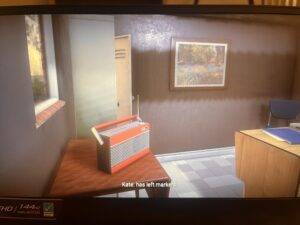
Everybody’s Gone to the Rapture, developed by The Chinese Room and published by Sony Computer Entertainment in 2015, is a first-person narrative exploration game aimed at players 13+. It runs roughly 5-6 hours on PlayStation 4 and PC and follows an unnamed player-figure through Yaughton, a fictional Shropshire village in 1984 whose inhabitants have all vanished. I’d put it off for years- the screenshots looked more like landscape paintings than a video game I knew how to play. The first thing I did when I finally launched it on PC was walk into an office (that seemed to be connected to a gate) where a radio was still mid-broadcast and a bunch of magazines sat lying around on a coffee table. I hadn’t done anything yet, but the game had already told me almost everything it needed to.
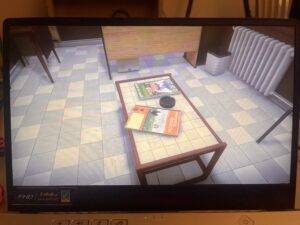
The landscape felt serene, but the atmosphere was eerily empty and void of any living creatures. I began to wonder where everyone was. The more I played, I realized there was already a mystery I had to solve- what happened to everyone, and why I was all alone.
My central argument is that Everybody’s Gone to the Rapture inverts the standard contract of the mystery genre. Rather than asking the player to solve or to author, it asks them to excavate. The mechanics treat the player as an archaeologist of grief, and the village of Yaughton functions as stratigraphy- a spatial record of an event that has already concluded. The architecture is not a stage on which the story unfolds. It is the story, preserved in place.
Walking as Excavation
While playing I kept noticing how well Jenkins’ framework of designers as narrative architects applies here- the village is sculpted, not staged. Walking into the local pub, I found half-finished pints on the bar and chairs left askew- all the objects seemed to be abandoned mid-use. This reinforced the narrative that I was all alone, and something terrible must have happened. The room itself was the explanation for the past. This led me to believe that the most consequential procedural decision in Rapture is its slow walking speed- not a technical limitation but the game’s thesis. In a world where everyone is gone, the player’s only meaningful contribution is observation. I could not rescue, fight, or alter anything- only walk slowly enough to assemble what happened from what was left behind.
The light-tuning mechanic doubles down on this. On Yaughton’s main street, the first memory I encountered refused to trigger for a full minute- I kept swiping the mouse too quickly, and the cluster of golden motes just trembled. The fix was to slow down. Hold right-click, drift the mouse left, right, settle. The orb brightened, the audio clarified, and a conversation transcript began to play, voices crackling like a recording.
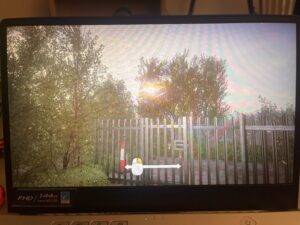

The action felt exactly like tuning an old radio dial. That comparison is the game’s whole formal argument. To me, that moment felt like the cleanest example of enacted storytelling- narrative events performed in place. I took notice of my role- I wasn’t a participant in the enacted scene, but the observer who tuned in to it.
Yaughton as Stratigraphy
Yaughton is a textbook evocative space. It draws on a cultural shorthand most players already carry- the postwar British rural village, with its church spire, pub, observatory, and Cold War radio chatter, summoned through cozy-catastrophe novels and decades of BBC sci-fi. That priming does narrative work before any line of dialogue plays.
Beyond evocation, the village is dense with embedded narratives- story information hidden in the environment. Each of the six character arcs is anchored to a specific zone, and I followed Father Jeremy’s most closely- a flawed vicar trying to be good for his congregation as the Pattern tore through it. The church zone tells that story before any voice plays: hymnals left open on the pews, sermon notes still spread across the lectern, light streaming through stained glass onto a sanctuary emptied mid-service. In this space, architecture takes on a worldbuilding role: a faith and a phenomenon, occupying the same four walls. Standing there, it became clear that the architecture isn’t simply decoration for the chapter; it’s the critical foundation it rests on.
The Friction Between Pace and Pattern
Rapture’s commitment to its contemplative pacing is admirable, but the game also expects players to revisit zones non-linearly to assemble the story- and the pace makes that revisitation punishing. I found out online that the most-cited piece of player advice for Rapture is “you can run; they just didn’t tell you.” On PC the sprint key has to be held for several seconds before the player figure gradually accelerates to something like a power-walk- and that binding never appears in the in-game tutorial. In my opinion, hiding the relief valve from players who need it earns nothing but frustration. A toggle for cinematic versus exploratory pace would have preserved the artistic intent while respecting the player’s time.
Ethics: Accessibility and the Cost of an Aesthetic Commitment
The pacing decision is also where the game’s most serious accessibility issues live. Disabled author Polenth Blake described needing to backtrack across the village to find missed memories while feeling motion-sick from the swaying camera, with no manual save and a “run” function that, in their words, doesn’t help much. That is the core access barrier in a single sentence- the design assumes a player whose body and attention can absorb a slow pace indefinitely.
I believe the deeper question here is structural. By treating pace as artistic identity rather than a player-controlled variable, the original release effectively gatekept its grief behind able-bodied patience. A visible run prompt, full environmental-audio captions from launch, a one-click alternative to the tuning- none of these additions would have damaged the central design argument. They would have democratized access to it. Playing Rapture I learned that the village remembers everyone in it. The question Rapture’s design is still working out is who the village lets in to listen.