

Playing this game felt reminiscent of the two-player games, like FireBoy and WaterGirl, that I remembered enjoying so much as a kid — some of my earliest memories of teamwork in games, working to achieve the same, shared objective. I argue that while humans are placed in systems that might incentivise self-preservation (and even possibly betrayal), we are still motivated to care for others, showing us that human collaboration is not only strategic but the consequence of being in the presence of another conscious being.
The beginning of the game seems to build towards extreme teamwork, trying to navigate this foreign planet and the challenges that come with it. It is only when we are split into two different visions and fed different narratives that some tension occurs between the players. I would like to caveat that while playing this game, I was sitting next to Aanika, so we could see each other’s screens. I wonder if this wasn’t the case, what I would have expected to be happening in the other player’s screen. Would I have thought they were seeing the same story as I, or would I have assumed foul play? Regardless, in our situation, we knew something was amiss and went on, curious as to when these “storylines” would become clear again. While playing BOKURA, it seemed that these “asides”, where the players would be separated, felt like the game was trying to pull us away from our partner. However, it was interesting to see me, as the player, subconsciously resist this. Metaphorically, the game does seem to be withholding information. I couldn’t see my co-player’s screen, didn’t fully know what she was experiencing, and in moments like the first appearance of the dogs with the bricks on my back, she couldn’t even visualize the danger that my player was in. Yet, there is still a maintained sense of camaraderie and help, pushing the characters forward. At every moment, there wasn’t a calculation as to whether something happening would benefit one of us more than the other in the long run. Thus, it felt immediate — the pressure was immense and in the moment, and thus if our partner required something, we would respond.
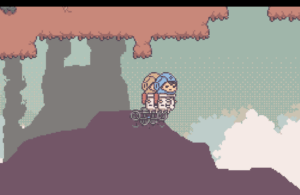
The way in which BOKURA introduces subtle incentives to prioritize yourself is fascinating. By using personal incentives and emotional motivations, the game almost sets up moments where one player’s information seems more valuable than their partner’s.
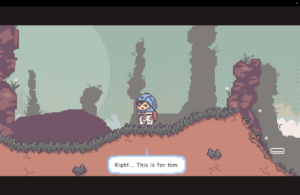
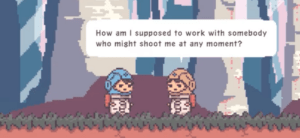
In theory, it does mirror the Prisoner’s Dilemma explored by Axelrod and Hamilton. They suggest that in a purely self-interested strategic model, “the selfish choice of defection yields a higher payoff than cooperation”. BOKURA instills these temptations by presenting players with hidden information/objectives that they are explicitly told to keep secret from their partner. Also, at points, the game tells you to “push” the other player off certain ledges, which leads to their death (and often your death as well). Note: As players, we weren’t sure if this was intentional or a glitch, but if it was intentional, it could be the game signalling the consequence of betraying (pushing) your “teammate”.
By keeping the individual goals secret, the game tests the fragility and nature of teamwork. The game being broken into small challenges leading to a larger goal arguably supports Axelrod and Hamilton’s claim that reciprocal cooperation only works when the individual players have a large probability of future, continued interaction. The players have to work together at each small step, because they know that a larger one is coming their way soon. In the high-pressure moments of gameplay, while an outsider might look on and claim that it fulfills the “Tit-for-Tat” strategy that the authors describe, the collaboration in the moment felt like an instinctual and empathetic response to a shared challenge. There were moments where it felt like one player had to push a button, let the other through, and wait for them to push a button, but other moments where a player volunteers to go up past the visual limits of the screen, to face an unknown risk for an unknown cost. These are the moments that push against the idea of transactional interactions, as one is committing a risk without knowing if their co-player is doing the same. In fact, when we played, it was often Aanika who went up/went down and me who stayed at the same position.
Thomas Nagel emphasizes that conscious experience has some sort of “subjective character”, where there is a highly specific reality of what it would be like to be a given organism, and that any objective attempt to analyze these experiences would fail. BOKURA seems to enforce a similar idea by restricting the player to their own visual reality and then forcing them to rely on flawed descriptions to communicate with one another. By sitting next to Aanika, and maintaining an immediate empathetic connection, we went beyond this barrier. While I couldn’t see through her eyes, the shared human experience let me understand when she was feeling/going through, when she was distressed, and vice versa.
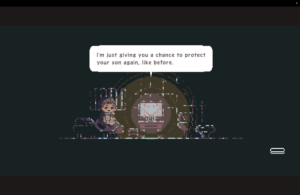
The game’s ending does try to break this built trust by introducing the inescapable narrative betrayal, when we find out that one player has been an alien parasite the entire time, and ends up killing the other player (when we played, my character), and steals their body to escape the planet. This twist does model Axelrod and Hamilton’s theories on how cooperation can be fragile, that when the probability of future interaction is gone, the optimal strategy is self-perseverance. The parasite’s instinct to backstab its partner to find its own kind overrides the reciprocal teamwork framework.
Thus, in conclusion, even if the game’s bleak ending and two papers highlight the isolation and self-interest in individual existence, our playthrough showed that the shared presence of another conscious being can help bridge the subjective gap, allowing genuine empathy and collaboration to occur.
