Game: What Remains of Edith Finch
Developer: Giant Sparrow
Platform: PC and console (I played on my Macbook)
Target Audience: Teens and adults, players interested in narrative driven games, mystery fans, exploration game fans
Some gamers like to dismiss walking simulators as games where “nothing happens,” but What Remains of Edith Finch challenges that assumption by making walking itself the primary storytelling system. Rather than relying on combat or puzzles, it uses movement through space as its core mechanic, one that proves extremely immersive and narratively rich.
My personal experience playing WRoEF reinforces this. I have a difficult time playing first-person games because I get bad simulator sickness very easily. So, I have to play POV games in short 20-30 minute chunks with long breaks in-between. However, WRoEF was so engaging, I kept pushing myself to keep playing and once, I pushed myself too far and got so nauseous that I threw up and had to lay down for an hour (lol). With other first-person games, be it Minecraft or Valorant, I’m fine with taking breaks, but WRoEF was so effective at using walking as narrative delivery, that I could not bring myself to stop.
Formally, the game is centered around environmental exploration, fragmented storytelling, and constrained player agency. The core mechanic is to simply move through the Finch house and interact with objects. This produces dynamics where players piece together stories by navigating physical space. The house itself is an example of narrative architecture. Each room functions as an embedded narrative, communicating the life of a specific family member through artifacts, layout, and visual detail. Progression is defined by moving through space rather than completing objectives.
Walking tells the story because it forces the player to experience these embedded narratives at a human pace. Unlike games where the story is delivered through cut scenes, in WRoEF, walking determines when and how information is revealed. The game uses environmental cues like glowing white indicators, lighting, and spatial framing, in order to guide players through the space. For example, when you first arrive at the Finch house and cannot open the front door, the design of the environment naturally funnels your attention toward the garage, where the visible cat flap signals the correct path forward. These cues create dynamics of guided discovery, allowing players to uncover the narrative without breaking immersion.
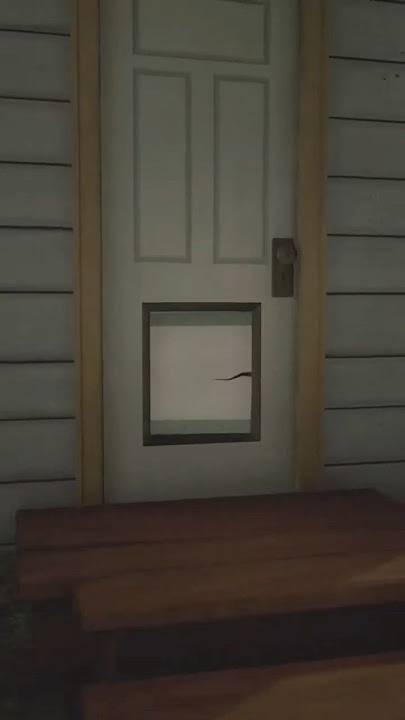
Image: the cat door you enter through
One of the strongest demonstrations of embedded narrative design occurs in Molly’s sequence. As she imagines transforming into different animals, the mechanics shift between movement systems: jumping across branches as a cat, gliding as an owl, swimming as a shark, slithering as a tentacled monster. Each mechanical change reflects a different perceptual framing of the same underlying space. Movement is not just interaction but perspective/narrative. The resulting aesthetic combines curiosity, disorientation, and gradual realization, as the player learns to interpret shifting control schemes as emotional states.

Image: Molly’s story from the perspective of a cat
A similar use of movement-based storytelling appears in Calvin Finch’s swing story. The repetitive motion of swinging builds toward an inevitable conclusion. Because the player must continue interacting through motion, they are placed in a position of embodied anticipation. The result is not shock, but gradual recognition of a grim inevitable end, where meaning emerges through continual movement rather than a single narrative loop.

Image: Calvin’s perspective swinging off the swing.
Through the lens of the MDA framework, the game’s mechanics (movement, interaction, environmental cues) generate dynamics of exploration, reconstruction, and interpretation. These dynamics produce an aesthetic experience centered on emotional immersion rather than challenge. Importantly, the game’s constraint of limiting interaction to movement and observation amplifies narrative clarity by removing competing systems. In contrast to other games that maintain consistent interaction loops, Edith Finch frequently changes its mechanics across chapters, reinforcing the idea that each story requires its own form of embodiment
From an accessibility perspective, the game has some flaws. The inability to adjust FOV or camera sensitivity made the game more physically difficult for me to play. While the fixed FOV and camera movement contributes to the intended aesthetic, they do create real barriers for players like me. I appreciate the ability to turn a reticle on, though.
In my search for cures, I dove deep in Reddit and found a comment that suggested wearing a cap (because the rim of the cap in your peripheral vision provides you a constant stable point of reference). I did this and it helped a little bit, but I do think a missed opportunity in the design is to provide these customizable settings that preserve the aesthetic while making the experience more accessible. This is especially important given that the article we read frames walking simulators as accessible entry points for new players. In my case, I’ve struggled to engage with many games outside of genres like MOBAs specifically because of motion sickness, so these kinds of design decisions can determine whether the experience is playable at all. However, I think my fervor to find a workaround speaks to how immersive this game was and how badly I wanted to keep playing it.

Image: Me with my hat trying to find ways to continue playing the game through nausea.
The absence of traditional gameplay systems also limits agency. Some players may feel more like observers than participants. In my case, motion sickness further reduced my ability to explore, so I prioritized reaching key moments quickly rather than engaging deeply with the environment.
Ultimately, What Remains of Edith Finch demonstrates how walking can function as a narrative system through embedded storytelling and environmental architecture. The Finch house is not simply a setting but a structured archive of meaning, where each space encodes story through design. By aligning mechanics, dynamics, and aesthetics around movement, the game transforms walking into an act of assembling narrative through space rather than consuming it linearly.
Ethics
WRoEF offers an interesting contrast to games that center violence. In many games, violence functions as a primary mechanic, something we repeatedly perform to progress (like in FPS’s or even in MOBAs like League of Legends). Here, violence is pretty absent as an action the player controls. Instead, death/tragedy are presented narratively in ways that feel inevitable rather than interactive. This changes how the story is experienced. The player becomes a witness to actions instead of feeling responsible for them.
This matters because in violent games, mechanics often create emotional distance; repeated actions like combat can desensitize players or frame violence as a tool. In WRoEF, the lack of violent mechanics removes that distance. Because you cannot intervene, the stories feel more personal and reflective. Walking through each space becomes an act of remembrance rather than control. The absence of violence as a mechanic reinforces the game’s themes of mortality and memory, making its emotional impact more.