
Walking, Talking, Matchmaking: Oxenfree as Narrative Architecture
Oxenfree, by Night School Studio, is a supernatural narrative-adventure game aimed at teens and young adults raised on paranormal dramas like Stranger Things. It’s single-player, roughly 4-5 hours long, and available on PC, PlayStation, Xbox, Nintendo Switch, and IOS. My older sister played it years before I did and wouldn’t stop recommending it- she kept saying the conversations felt less like a video game and more like eavesdropping on a group of teenagers arguing on a beach. I played it on my laptop (PC), as the character Alex. I tried to quietly steer Alex’s dialogue to push her best friend Ren toward Nona- and earned the Matchmaker achievement at the credits.
My central argument is that Oxenfree’s walk-and-talk dialogue system functions as narrative architecture. By forcing the player to commit to relational choices while physically moving through a designed space, Night School built a game in which friendships don’t unfold as scripted outcomes but emerge as spatial, temporal performances. The Ren-and-Nona arc best shows both the strengths and limits of this system.
The Walk-and-Talk as a Formal Procedure
As I played, I noticed an important design decision that was made- the refusal to pause the game for dialogue. Conversations surface as timed speech bubbles over Alex’s head while the player is still steering her through the island. You cannot stop to weigh a response; if you hesitate past the timer, Alex stays silent and the scene moves on without her. The opening boat scene makes this pressure visible right away. Alex is given options like “Ahhhhhh, stop!,” “Best buds, clearly,” and “How I’ve tried to forget,” which range from playful embarrassment to sarcasm. Because these choices appear in speech bubbles above the characters rather than in a separate menu, this game mechanic makes dialogue feel like part of the physical scene instead of a pause from it.
That one procedural choice collapses two formal elements most narrative games keep separate- movement and dialogue selection. This made me think of the framework that designers are narrative architects who sculpt spaces that carry story; Oxenfree pushes the idea further- the space isn’t just a vessel for narrative, it’s an input device. The radio mechanic makes this even clearer: when Alex tunes to the correct frequency, hidden clues surface through sound, numbers, and environmental changes. Where Alex is walking, what frequency she tunes to, and which dialogue bubble she selects all shape what parts of the story become visible. The designer chooses the geometry, the player chooses the timing, and the scene is produced between them.
The Matchmaker Arc as Emergent Narrative
I enjoyed Ren and Nona’s pairing because it was player-made, and not prewritten. There is no cutscene in which Alex sits Ren down to talk about his crush. Instead, the system seeds opportunities: a flustered joke as the group walks toward the beach, Nona lingering near Alex at a specific overlook, a private exchange that only becomes available if the player routed their movement through a particular territory earlier. When the possibility of Ren and Nona comes up, Alex can respond supportively with options like “Sounds great” and “Good for you,” or undercut the moment with lines like “Really, Nona? Him?” and “How can you even think about that!”
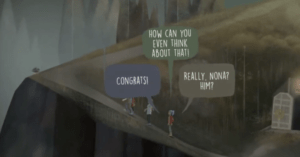
These choices show that matchmaking is not framed as a formal quest. It happens through tone, timing, and whether Alex chooses to encourage or embarrass her friends.
A player who doesn’t catch those moments will never see them, and the designers never tell the player they exist. The Matchmaker ending is the cumulative shape of many small walking-and-timing choices, plus a willingness to nudge rather than deflect. I believe this is where the game’s territorial design earns its story. Edwards Island’s zones- beach, forest, radio tower, abandoned military fort- function as evocative spaces, placing the player in an atmosphere where quiet, low-stakes teenage yearning feels obvious, and trusts them to hear it.
The Matchmaker Arc Deserves Better Plumbing
The matchmaker thread is one of the most human parts of Oxenfree, but it is mechanically thin compared to the supernatural main plot. Ren and Nona’s pairing is built through emotionally varied dialogue choices, where Alex can be warm, sarcastic, dismissive, or apologetic, but it is resolved mostly through credits text and a brief epilogue rather than a playable or environmental payoff. Since the game already uses embedded narratives like radio logs, letters, and gravestones for its 1940s submarine backstory, a small detail like a later letter from Ren or a hidden radio frequency from Nona would have made the friendship arc feel just as meaningful and a lot less pointless. I believe that treating the friendship thread with the same density as the main-story would have respected the player’s emergent work and honored the game’s central thesis- that walking is how the story gets told.
The Design Meaning of Refusing Violence
Compared to the violent games we’ve talked about in class, Oxenfree’s ethics are legible in what the design refuses to include. There is no enemy the player can defeat. Supernatural antagonists are negotiated with or outlasted. Violence exists in the fiction- a drowning, or hostile ghosts- but the player never performs it.
I believe that subtraction is a relocation, not a softening- what Oxenfree takes from the player’s hands, it gives back to them through dialogue. Every timed speech bubble carries weight, and each character exists in multiple branching versions depending on what was said and when. The game makes this clear when characters remember Alex’s earlier tone. Even the visible options carry emotional stakes: Alex can say “Are you kidding me!,” “I tried,” or “I’m sorry,” turning conflict into a matter of speech rather than action. The player is not choosing attacks or defenses; they are choosing whether Alex escalates, justifies herself, or repairs the relationship.
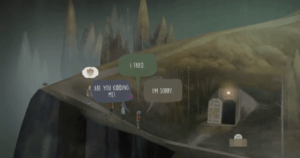
To me, that makes the game scarier than most shooter-games, where death is loud and recoverable. In Oxenfree, the threat isn’t that Alex dies; it’s that a friend ends up hating her, or gets left behind on the island because of something she said three scenes ago and can’t take back. The fear is psychological, not physical. During my playtest, the same dialogue system I used to push Ren toward Nona could have just as easily turned the group against Alex- speech isn’t just conversation, it’s consequence.
By denying the player a violence mechanic and amplifying the consequences of speech, the creators make grief impossible to resolve through skill. Walking, in Oxenfree, is how we learn to listen. And matchmaking, it turns out, is one of the quieter things listening lets us do.