
Night in the Woods (2017), developed by Infinite Fall (Alec Holowka, Scott Benson, and Bethany Hockenberry), is a digital walking simulator that handles mature themes of the uncertainty of navigating post-high school life, dropping out of school, a cult-like small-town atmosphere, and more. It is appropriate only for older teens and adults with a firm grasp on their own reality to not be subconsciously emotionally influenced.
The game follows Mae, a black cat who has dropped out of her sophomore year of college and returned to her hometown of Possum Springs; while wandering through town, she interacts with many characters from her past to figure out what happened since she left and what she wants her life to become.
Through the mechanism of walking and the dynamic of finding stories in passing, NITW offers an authentic experience of both aimless and systematic exploration, replicating a real human’s interaction with their environment. As a result, the story behind the game unfolds at a natural pace rather than being forced.
When structuring a walking sim that permits exploration in a pre-established world, designers need to make a choice regarding whether they want to set aside time at the beginning of the game to offer some opportunity for setting up context that may be helpful to proceed with. This game uses the first night and first full day to do this. Now, I should say that I was only able to play the game for about 1.5 hours – I played during Board Game Night using Butch’s Nintendo Switch (thank you, Butch) – and almost all of this time was spent on this introductory period. It felt slightly time-consuming, but it was, in fact, very effective in establishing a sense of nostalgia – I thought it was particularly notable that the game began at night rather than in the morning to set an emotional stage right from the beginning and construct a mood of unfinished business and unofficial beginnings.
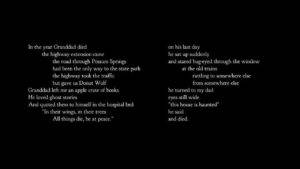
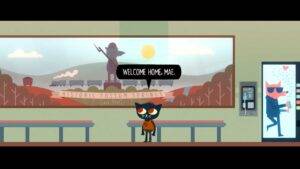
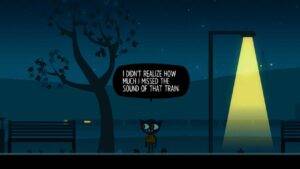
At times, I felt the medium created some friction with the flow of the story. This was my first time using a Switch, so I was unfamiliar with the controls, and this being a walking sim, I was not expecting to need to jump. In the video below, you can see me attempting to move forward in the game, and only being able to do so once I discovered that the B key on the switch would allow me to jump up on the rock. While some of this struggle could be attributed to my unfamiliarity with the interface, I would argue that since walking sims focus the majority of their interaction design on the walking mechanism, there are two things that are necessary: (1) incorporation of clear visual affordances in the space (e.g. the rock being emphasized more than the background), and (2) an easily accessible instruction sheet. Here’s unfortunately where NITW fell short – no rules, no guidelines, just go. This is a point where the game should have deviated from reality slightly to avoid breaking the narrative to focus on technical details.
Based on this, I’d ask: when a designer chooses low agency as one of their core mechanisms, do they have a responsibility to make that constraint legible to the player? Given the gravity of the central themes of aimlessness and instability, I’m worried about the mental impact of the design decision to have no set rules on the player, regardless of whether it was a deliberate choice or something that wasn’t analyzed. With my own experience in the jumping situation, I didn’t feel confident to be able to move forward in the game on my own. The long term effects of this learned helplessness and struggle in a game that tells a story around those same concepts could be quite damaging, and I think it might have been more prudent to break the reality of the game here to offer that necessary support.
The game is an epitome of the Narrative aesthetic, but also includes a great deal of Discovery and even Sensation, and falls squarely in the category of embedded narrative, with a large degree of environmental storytelling. Mae’s world is rich with little nuggets of information everywhere as you walk by storefronts and passing characters. When dialogue cues appear as recognizable signifiers, you instinctively know that there’s something worth learning there, but it is ultimately your choice which ones to discover first. Sometimes the narrative needs a little coaxing – like having one interaction before another to unlock some secrets – but everything is there for the taking at the player’s pace and pleasure. Separately, but on the note of pleasure, the world has been exquisitely crafted through art and music (though contrary to the overall tone and mood of the story itself).
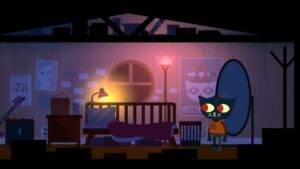
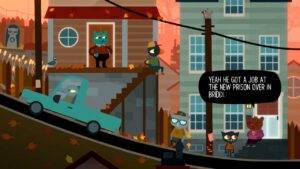


The art struck a personal chord with me in recalling the style from one of my favorite animated films, Song of the Sea; I was constantly delighted by the novelty of the sceneries and even how reaching for objects and having conversations could feel relatable, as you can see in the video below (“*gasp* That’s cuuuuuuuuute!!!).
NITW is a beautifully constructed embedded narrative filled with adventure and whimsy, and walking makes the player invest, physically and emotionally, in the depth of the story.