I played Paperbark by Paper House studio for this critical play. It is a short but charming walking simulator where you control a small wombat, walking through the wilderness of Australia, surviving a bush fire, and eventually napping at the doorstep of what I purported to be a ranger’s home. Throughout the journey, you forage various plants and insects, and meet a variety of other wildlife who are also trying to survive the relentless bush fire. The game feels more like a showcase of Australian nature than a thrilling narrative drama, but nonetheless there are a few mechanics that I really appreciated.
The first mechanic in the game that surprised me is the “war of fog” where areas you haven’t traversed through are covered in a layer to watercolor-like white fog, and you have the option of dragging your cursor through the fog to see it temporarily. Compared to the typical first/third person view, where everything is revealed to the player unless purposefully hid away by the game designers, the fog mechanic adds a sense of anticipation for the journey ahead, incentivizing players to walk around more and explore the map. This emphasis on exploration is further supported by the use of collectibles in the game, some of which are scattered throughout the main path of the map but some hidden away and only accessible via disguised entry points (like fallen tree trunks). As a result, I find myself often wandering close to the edge of the accessible areas, trying to find if there are secret areas that can be revealed.
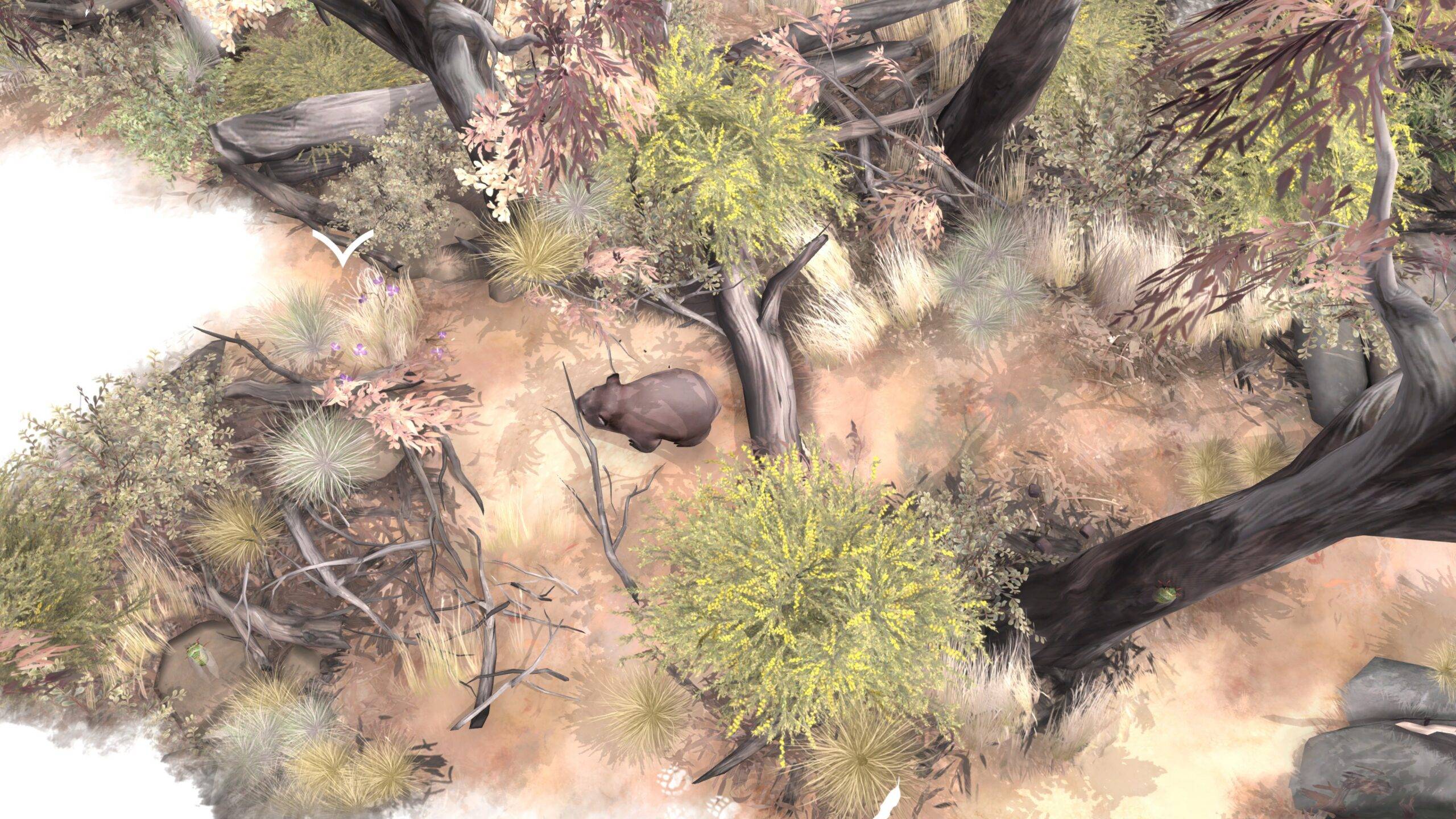
White fog obscures the road head, while the marker notifies players of collectibles
The fog mechanic plays a further narrative role during the bush fire chapter, where the fog, now turned into grey smoke, covers the entire screen and revealing only the immediate area surrounding the little wombat, adding to the sense of emergency of the scene. The shift in the map colors, the ember particles effects, along with the sound of fire crackling, creates a very immersive experience for the player as if you were situated right in the burning Australian outback.
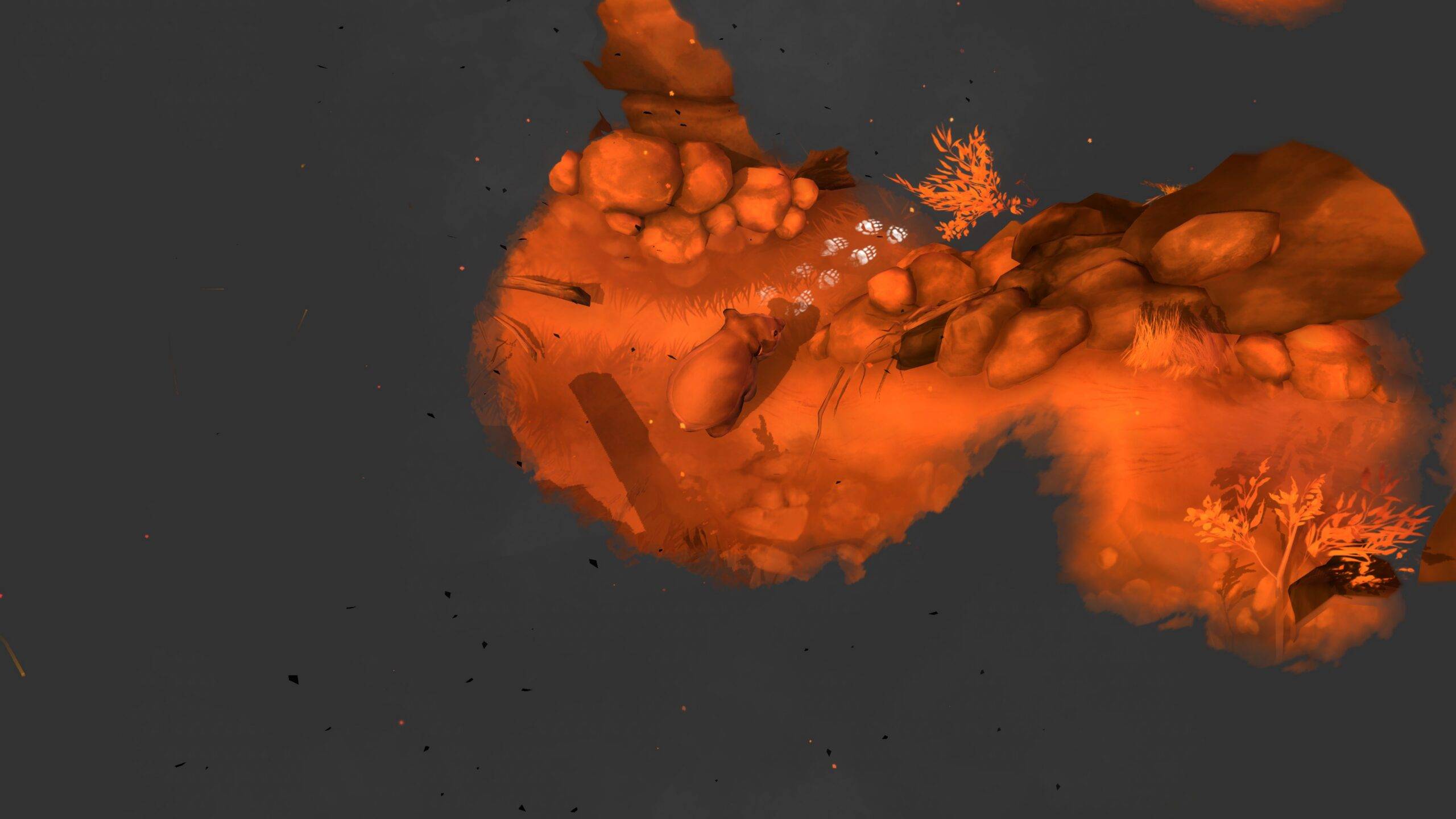
White pawprints on the ground serves as a hint for the player
Walking through different environments – forest, wetland, burnt landscape, and the ranger’s home – is the backbone of storytelling in this game, which closely relates to the concept of spatial stories and environmental storytelling discussed in Henry Jenkins’ Game Design as Narrative Architecture. This is a typical way of how walking can tell a story – by enacting the story through the journey. The game has a broadly defined goal of finding the wombat a new home, but within each chapter there are localized incidents such as meeting new wildlife and responding to bushfire that pushes the narrative forward. Environmental elements in these games not only presents the story as is, but can also act as foreshadowing. For example, after the wetlands chapter, sparks of ember began to appear on screen, and I immediately realized even without narration that a wildfire is coming. In the final chapter where the wombat stumbles across a human house, I first saw the fences, followed by car tracks on the ground, a small truck, and eventually the house, and despite the game never explicitly said whose home it would be, a fire risk sign in the yard hinted, at least in my opinion, that it likely belongs to the ranger. The story proceeds through player’s spatial exploration throughout the map, and on game designer’s end, the story is translated to a spatial path that the player travels through. The central types of fun typically found in walking sims are therefore “discovery” and “narrative”, as new discoveries drive the narrative of the game.
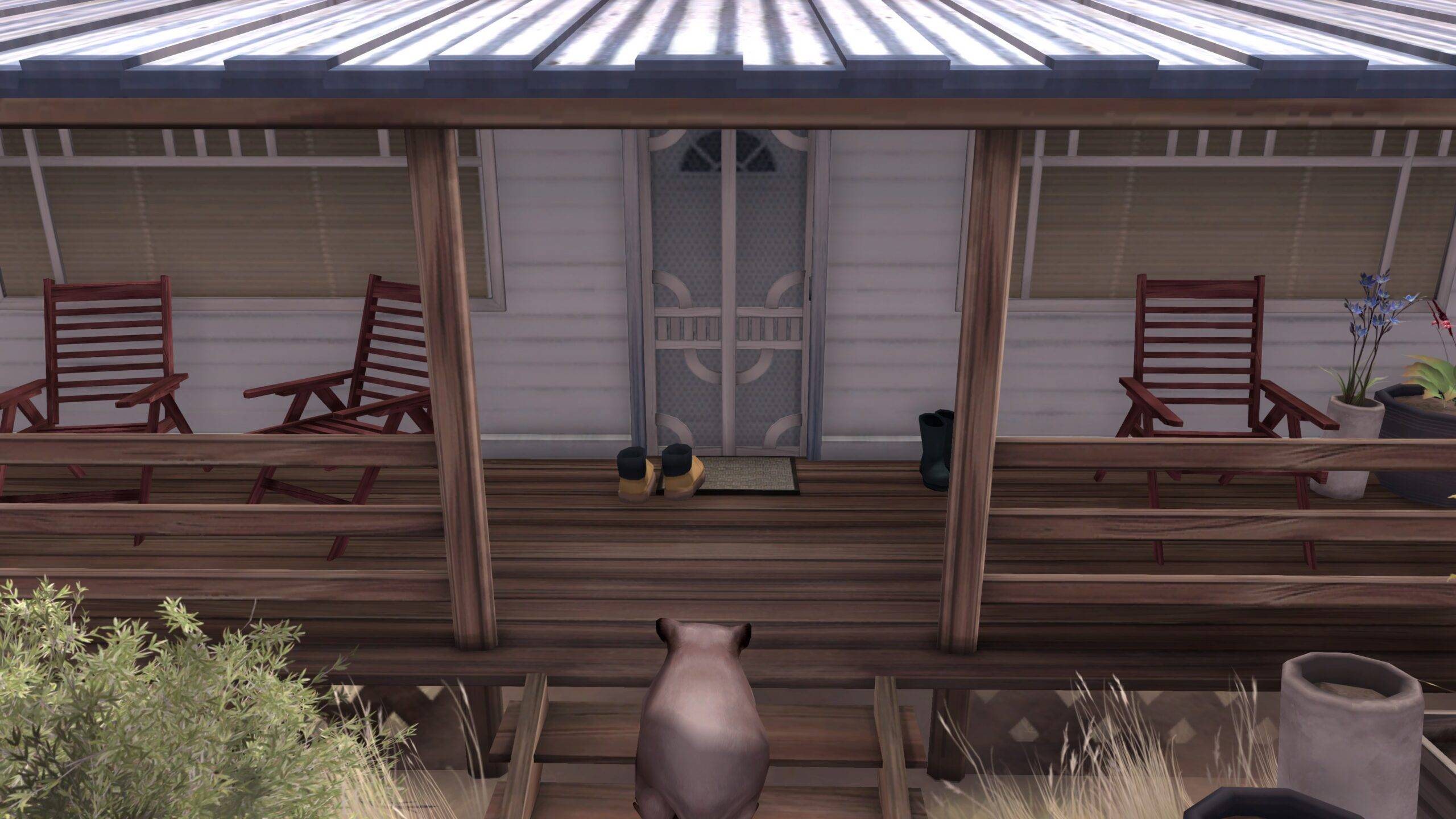
Finally, a new home
However, I think Paperbark nonetheless is a relatively simple walking sim and some mechanics can be improved. The collectable items in the game are meant to encourage the players to pay closer attention to the map and add an element of challenge to the game. However, this mechanic feels disconnected to the game, and apart from some achievements, they add nothing to the narrative of the game. For example, despite coming across multiple instances of spoonbills and kookaburras in the journey, it is only when you meet one specific individual, often hidden in the peripheral area of the map, that the species gets added to the in-game journal. When you find them, there’s no additional interaction between the little wombat and the wildlife, nor any additional narration. While finding them gives a small sense of achievement, when you realize you missed something as you finish a chapter or get to a point-of-no-return, the frustration can outweigh the sense of achievement. In contrast to this is A Short Hike, which is the best walking simulator I have played. A Short Hike also features a lot of collectibles, such as Golden Feathers, shells, money, and fish. However, these collectibles drive NPC interactions and mini arcs in the game, revealing new information and adds an element of embedded narrative to the game where collecting items unveils the pool of information that the game has to offer. In this way, the collectible mechanic feels much more natural, engaging, and rewarding.
Ethics discussion:
Neither Paperbark nor A Short Hike features violence; Paperpark is more like a documentary or a piece of artwork, showcasing the nature and wildlife of Australia, whereas A Short Hike is a whimsical exploration game with a sentimental twist at the end. Narratives are typically structured around conflicts, and in my experience of playing narrative games with violence, violence serves to externalize conflicts in the story, for example, the conflict between the Van der Linde gang, the O’Driscolls, and the Pinkertons in Red Dead Redemption 2. In violence-free games, conflicts are still present, but they shift it inwards to the characters themselves or to the environment. For example, the main conflict in Paperbark is the little wombat’s search for a new home as the bush fire engulfs its old den, a conflict between a character and the environment. In A Short Hike, we eventually understand the protagonist Claire’s internal conflict and motivation to scale the mountain as her concern for her mom, who underwent a surgery without telling the protagonist first. Resolution of conflict in these games is therefore not as simple as defeating the enemies, but something that’s achieved by the player’s exploration, interpretation, and emotional engagement with the characters.