This week, I played The Sailor’s Dream, a single-player mobile walking simulator game by the Swedish indie game studio Simogo. The target audience is older gamers (15+) who want a calm but mysterious story experience.
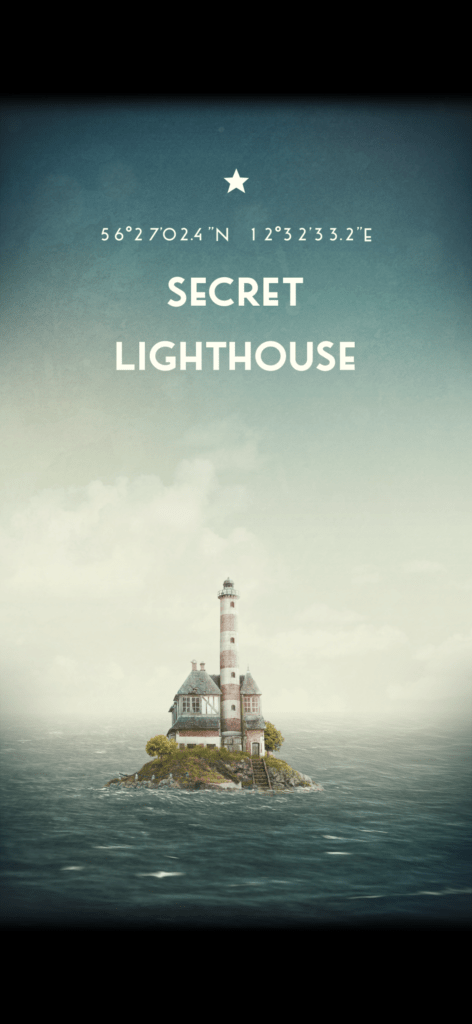

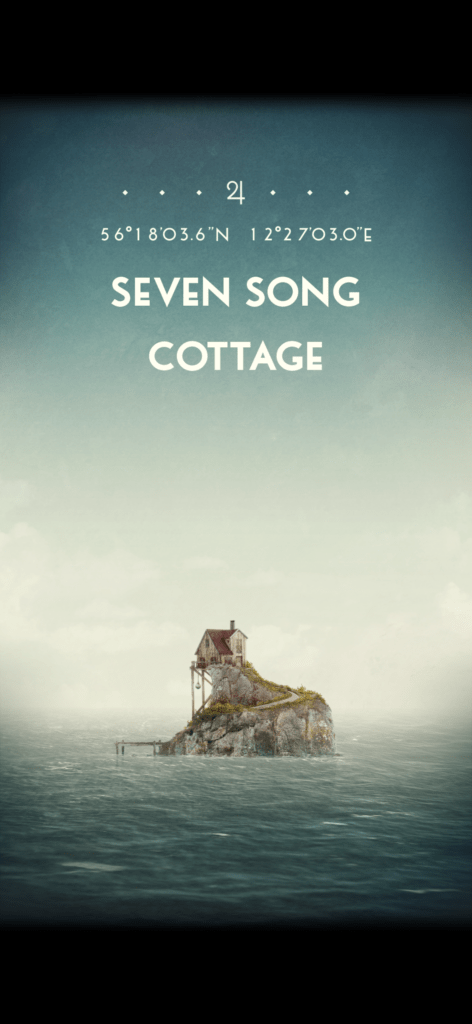
From the beginning, the player drives how the story unfolds. You are presented with various islands to “set sail” to, like the Secret Lighthouse, Transmission Horolodge, and Faraway Ruins. To choose an island, you use the mechanic of swiping to move right continuously, so islands appear somewhat linearly, but you still choose the order. At one point, I found a “hidden memory” that caused a star to appear above the Secret Lighthouse, which then triggered a bottle on the selection screen, leading me to a distant island labeled “4” (series pictured above). Moments like this suggest some structure without limiting player freedom.
As seen in the video above, each island contains a set of connected rooms that you “walk” through. Some rooms include objects that reveal short pieces of text that slowly build a larger story, leaning heavily into the embedded narrative style, where the player unveils a story through the disparate collection of its parts. For example, one line describes “strangers carrying the empty coffin,” implying a death where the body was never recovered. The game never explicitly explains what happened, but instead, relies on the player to connect the dots. The mechanic of free movement creates the dynamic of curiosity-driven exploration, which leads to the aesthetic of confusion and intrigue as you uncover more of the fragmented story, as well as the childlike curiosity that mirrors the experience of the main character (a little girl). If the game forced players along a fixed path, this sense of discovery would be much weaker.
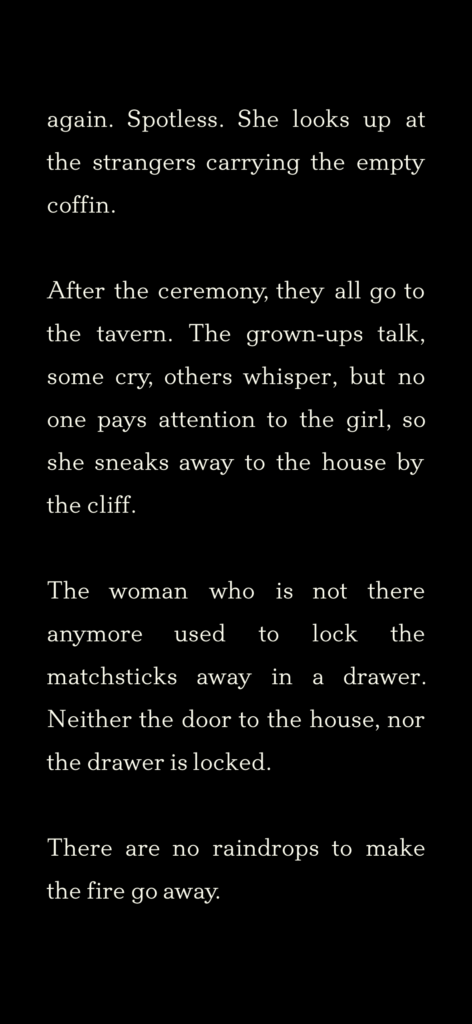
After exploring, you see that the spaces are tied to the memories of a little girl named Sailor, who is processing a traumatic event involving a fire. The open exploration mechanic reinforces this perspective. Mechanically, there are no guides, no objective markers, and no clear directions. This creates the dynamic that you uncover painful memories and memories from a traumatic time non-linearly, and your emotions are whipped around as you find joy and despair one right after the other. Aesthetically, I felt like someone revisiting childhood trauma that was never processed and perhaps ignored for many years. It felt like I was left to unpack memories on my own as I explored the memories in the game. So, with the lack of a guide and open exploration mechanic, the player steps exactly into the role of the little girl, who, at the funeral (story pictured above), “no one pays attention to.”
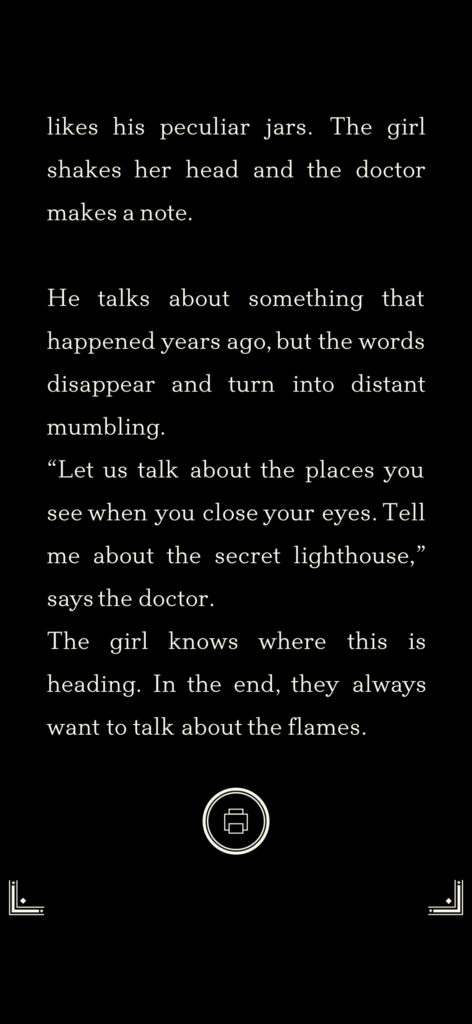
At one point, I found a memory (pictured above) suggesting that Sailor, the little girl, is in a psychiatric appointment where “they always want to talk about the flames.” This memory (which I almost missed) reframes the entire game as a mental reconstruction during therapy. The mechanic of optional exploration means players are not required to see every piece of the story, which creates the dynamic of incomplete understanding. This supports the aesthetic of having fragmented memories, but it is also risky, since players can miss key context. A small improvement could be to subtly guide players toward key narrative spaces without removing their freedom, perhaps with more items that guide players like the floating bottle (the only explicitly guiding object I encountered).
The game also uses sound to strengthen its storytelling. In certain rooms (eg, video above), you might suddenly hear a little girl laughing or a voice speaking. The mechanic here is simple audio triggers placed in specific locations. This creates the dynamic of unpredictability, since players cannot anticipate when these sounds will occur. The resulting aesthetic is that certain memories feel more vivid and immediate, almost like you are briefly inside them instead of just observing them. More broadly, the combination of sound, soft visuals, and inconsistent details builds a dreamlike aesthetic where it is never fully clear what is real and what is imagined, reflecting how memory and trauma often work.
Ethics:
The role of violence in this game is very different from what I experienced in other games. In class, we played Krunker, an online first-person shooter where players are blocky figures who disappear when shot and quickly respawn. Even though you are constantly killing other players, it feels disconnected from real violence because the characters are anonymous and replaceable. In The Sailor’s Dream, there is no direct depiction of violence. You never see blood or bodies. However, the story includes violence-related events like a fatal fire and a funeral with an empty coffin. Despite the lack of visual violence, these moments feel much more impactful. The difference comes from how the game connects these events to human experience. In Krunker, the characters have no identity or relationships. In The Sailor’s Dream, just two sentences about a funeral suggest grief, loss, and a community affected by that person’s death. The violence is indirect, but it feels real because it is tied to people and memory. By removing violent mechanics and direct details, the game shifts focus from action to aftermath. Walking through empty spaces makes you feel the absence and distance from the event itself. While blood, gore, or direct details of the violence are sometimes necessary to evoke a certain reaction from a player, this game’s exclusion of them makes you feel the intended emotion (a heavy weight) much more, showing that those details are not strictly necessary, nor the most effective.