

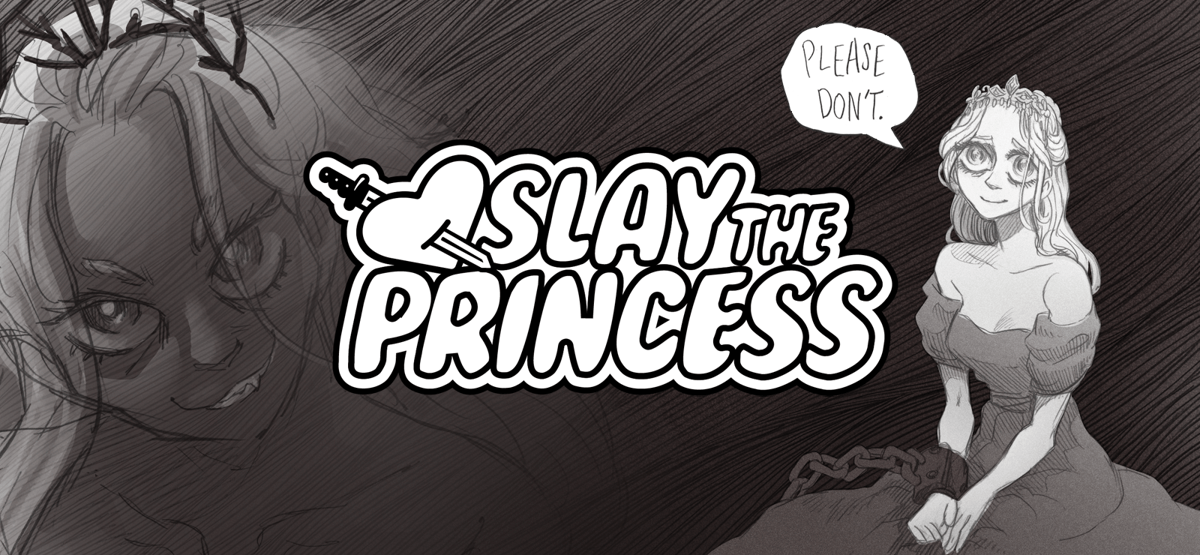
This week, I played Slay the Princess, which is a psychological horror visual novel created by Black Tabby Games. The game opens with a narrator telling you there is a princess in a cabin, and that she will end the world if you let her live, and your job is to kill her. The premise sounds simple, but the Slay the Princess takes your expectations of a typical hero’s story and flips it upside down. I argue that Slay the Princess shows evil as something produced by framing and repetition rather than something naturally belonging to the Princess, using psychological horror to make the player feel complicit in that process.
One of the most unsettling things about Slay the Princess is how little your mission is explained. At the start of the game, the Narrator tells you that it is imperative to slay the princess, but not in a way that provides any real moral certainty. Following these instructions, you descend into the basement and meet the Princess, who, depending on the route you’re in, is described and illustrated in ways that range from powerless and frightened to manipulative and monstrous.
[Image of meeting the princess for the first time in two different runs, scared vs. monster-like.]
In the first few chapters, I found that no matter the choices I made, be it towards rescuing the princess or towards slaying her, I was always pushed to kill her and it inevitably backfired, leaving me dead. For example, if you enter the basement and try to be sympathetic to the Princess, there is a scene in which the Narrator begins describing your actions before you have chosen anything, leading you to stab her in the back.

[Image of automatic narration in the story before you’ve made any choice to kill the princess.]
As the game progresses, it begins to feel more disorienting as you are constantly steered towards murder, both for the narrator’s murky reasons and because as a player you inherently hope to produce change or break the loop. That tension makes decision-making especially difficult, as in many scenes the Princess appears vulnerable, or even afraid, so killing her doesn’t feel morally justified, yet refusing the Narrator doesn’t feel like a clear solution either. This dynamic connects closely to Tom Parkin’s argument in “How Evil Should a Video Game Allow You to Be?.” Parkin suggests that games are ethically distinct not simply because they depict violence, but because they actively require players to carry it out. I believe Slay the Princess is powerful because it does exactly this: its gore and violence are not there to make the player feel dominant or heroic, but to make them feel implicated. Even when the Princess does become terrifying, the game resists the simple logic of, “here is a monster, I should kill it.” Instead, it tells you to kill first and understand later. For example, in one of the game’s paths, even if you enter the basement without a blade and with the intention of saving her, a blade conveniently finds its way downstairs and the Narrator locks you in. Thus, the game’s structure corners the player into performing violence while stripping away any humane alternative.

[Image of the blade entering the scene out of nowhere.]
In this way, I found that the horror of the game is not the gore itself, but the feeling that you cannot break the cycle and are being made complicit in the Princess’s suffering regardless of what the Narrator claims about her. This relates to Sarah Stang’s essay on agency, where they argue that games often offer an illusion of agency rather than true authorship, and that though interactivity feels empowering, player action is often bounded by constraints by design. I feel that Slay the Princess does this in an interesting way, as it gives many dialogue options from the beginning to create the illusion of agency, but in further runs, your past options are no longer available and you know you can’t decide what you actually want for the story.
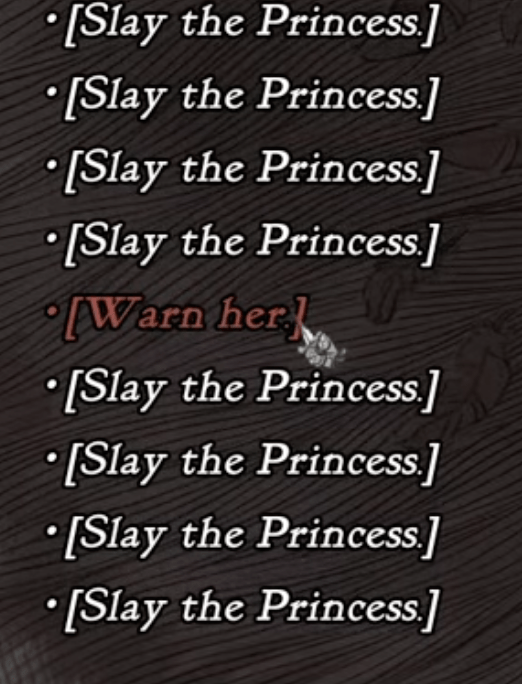
[Image of dialogue choice screen where there are primarily negative options.]
As a player, you know you are trapped in an endless loop, with voices from your past attempts shaping your future actions. At one point, the Princess even says, “you’re not trying to kill me this time,” a line that feels almost like it breaks the fourth wall by suggesting that she, too, remembers the previous loops. This is part of why I think the game handles evil so well. The real horror lies in trapping the player in repeated, coerced acts of uncertain violence. In a more conventional game, a villain looks evil, acts evil, and therefore seems to justify violence against them. In Slay the Princess, however, evil is unstable. The Princess can seem menacing in one moment and vulnerable in the next, and often her apparent danger feels shaped as much by the Narrator’s framing as by her own actions. Even the “Voice of the Hero,” which would normally provide a clear moral anchor, becomes suspect in this game.
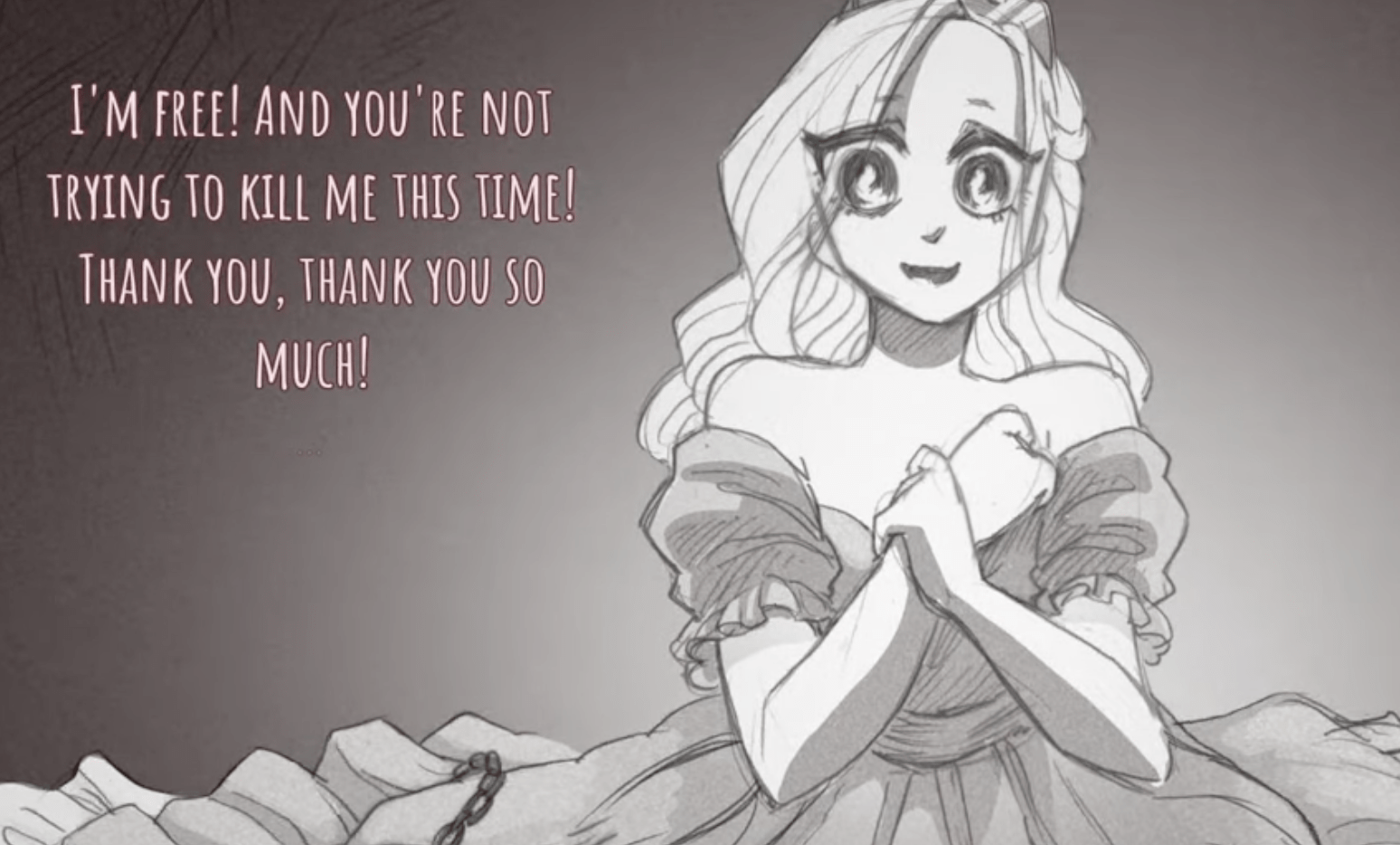
[Image of princess saying “you’re not trying to kill me this time,” breaking the fourth wall.]
Taken together, the readings and the game suggest that the real ethical question is not simply whether violent or disturbing content appears, but how the game positions the player in relation to it. I believe Slay the Princess does a great job thinking about this because it understands that player complicity is something to design for. Its interface, narrator, looping structure, and even its warnings all shape the player’s moral experience. Evil in this game is not just what the Princess might be, it is also the system that keeps demanding acts of violence from the player with certainty, when certainty is impossible to reach.
