For this assignment, I played Clue. Clue is targeted towards families with children who are 8 and older. It was originally a board game created by Anthony Pratt. The version I played was on PC via Amazon Luna, and was developed by Marmalade Game Studio Ltd. Clue and The Murder Game share the same premise: a murder has occurred, and it’s up to the game’s players to determine who did it. Beyond this premise, which also informs the primary visual aesthetic of the games, the similarities end. I argue that, when examined alongside my team’s concept for The Murder Game, Clue offers great inspiration in the areas of atmosphere and immersion, but falls short by being bogged down in its cumbersome notetaking mechanics, and lack of discussion-based gameplay.
Let’s first discuss the areas where Clue succeeds. The atmosphere created by the game’s environment and character design excels at helping players become immersed in the world of the game. This is paramount for achieving strong core aesthetics of fantasy and narrative. To enjoy a fantasy, players ought to feel like it has come to life. The detailed 3D environments of Clue contribute immensely to this feeling, as do the striking character designs.
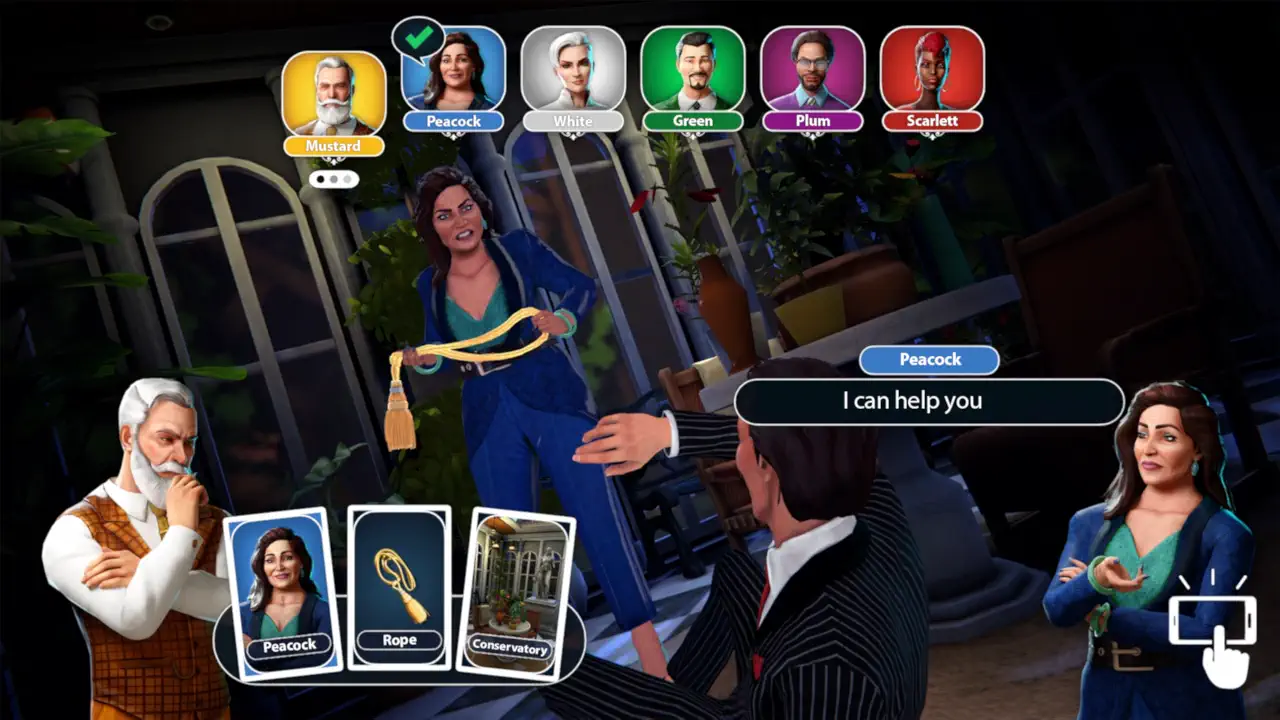
As you can see here, the elements of the game (character, weapon, and location) have seemingly leaped off of the game’s 2D cards and sprang into action on screen.
The art contributes to the narrative as well. The characters in the game could have easily been distinguished only by color and name; that is, “Mustard” would serve the same function in gameplay were it only the name and background color. In designing characters with unique appearances, styles, and professions, the designers of Clue created a simple way for players to become immediately more invested in the narrative of the game. The weapons and locations are similarly useful. It’s bland to say “I think player Yellow used item one in room three”, though that is how the game works. It’s far more narratively interesting to say “I think Colonel Mustard used the candlestick in the kitchen!”, and having visually interesting representations of Colonel Mustard, the candlestick, and the kitchen creates that interest.
As a result of Clue‘s success in these areas, I believe that it’s essential to provide players with visuals to help immerse them in fantasy, and become engaged with the narrative. For The Murder Game, this might look like creating unique characters with interesting designs for everyone to play as, rather than just “Killer”, “Witness”, etc.
Let’s now discuss areas where I felt Clue fell a bit short; the notetaking and the lack of discussion. The primary gameplay of Clue involves suggesting potential murderers, weapons, and locations. If someone else in the game has any of your suggestions in their hand, they reveal it to you. With so many different options, you must keep track of not only what is revealed to you, but also what is suggested by other players, and who reveals cards to whom after suggestions are made.

As you can see from the grid on the right, there are quite a few things to keep track of.
The version I played included a gameplay option keep track automatically of what cards were revealed to you and how many of each other player’s cards you’ve seen, but even with this enabled, it felt more like a chore than a game. Additionally, this raises more concerns for versions of the game (such as the original) that lack this feature. The notetaking mechanic incentivizes paying attention to the game, but it is tonally at-odds with the stellar atmosphere, and this problem is exacerbated by the visual presentation being so in tune with the narrative (as discussed). While playing, we found that the notetaking kept us occupied, but at the expense of fun and communication with each other. We largely played without talking to each other, and the game actually doesn’t need players to communicate at all to progress. So, the gameplay largely consisted of people guessing random combinations and then noting down the results (whether a card was revealed by a player, etc). It felt far more like guess-and-check than any kind of actual deduction was occurring. Perhaps this was a skill issue (maybe more experienced Clue players can deduce more from the game’s happenings) but players won’t get the chance to become more experienced if their initial plays are boring. I would suggest incentivizing players to communicate and trade information; perhaps some information is only accessible by combining info two players start with, for instance.
As a result of these shortcomings, I feel that we are right to focus on discussion and evidence-based deduction, which hopefully keeps gameplay entertaining, and to minimize the amount of information players must keep track of.