Why Lie? Coup, Bluffing Games, and Incentivizing Lies
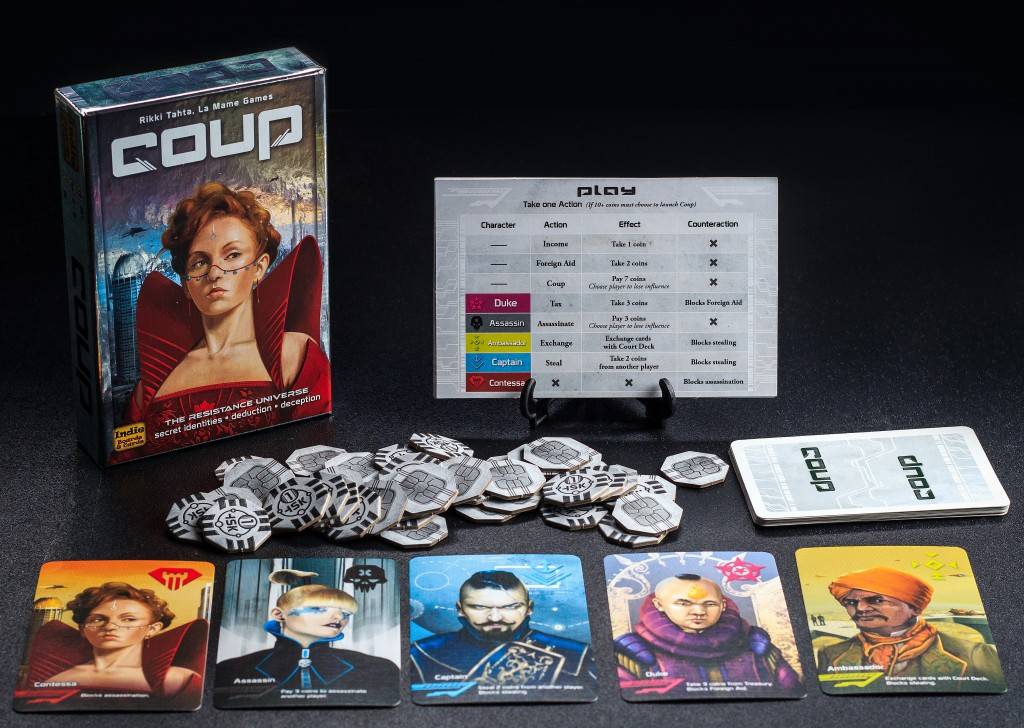
For my first critical play, I played Coup, a 2012 card game created by Rikki Tahta and published by Indie Board & Cards and La Meme Games. Coup is designed for players ages 14+, and is a party game and social deduction game built for groups of 2-6. In the game, players draw two character cards that define what abilities they have. They then take turns taking actions, trying to kill other players by correctly calling bluffs, assassinating, or inciting coups until there is one person left.
Coup is built around the goal of fast gameplay, bluffing, and calling bluffs. I played it for one round, going in with no knowledge of the game and what a “good” strategy was. That experience really highlighted for me the type of persona that I tend to take on within a group game that builds upon lies. In similar bluffing games, I tend to act safely, laying low in the beginning and careful deliberating moves. However, in playing Coup, I believe my default playstyle was actually counterproductive to the intended playstyle of Coup, and led to a slower and less-fun experience than I could have otherwise had.
When playing that one round, I didn’t bluff a single time, and often told the other players that I was “going the honest route” and that I was “confused more than anything.” While it was true that I genuinely was confused and acting honestly because I was trying to figure out the game, this is also a strategy I often take in bluffing games, where I act as clueless as possible and don’t say much in the beginning as I try to listen more than act. However, in most other bluffing games, once I get a lay of the land, I start to lie with more certainty (when assigned a lying role).
However, Coup never encouraged me to actually lie. In other bluffing games such as Mafia, Secret Hitler, and Among Us, players are encouraged to bluff by being given a role that requires bluffing to stay alive (Mafia, fascist, imposter). As I somehow always get the lying role when I play these games with friends, I’ve accepted the stress of the role to end up having an enjoyable time learning to “lay low.” In Coup though, players are never required to bluff—you choose to take a chance bluffing to improve your shots of winning. Within that structure, I never even felt an actual incentive to bluff (since bluffing causes me stress), and ended up in second place from playing a completely honest round anyways.
This leads to one of my main critiques of the game, which is that the mechanics of bluffing are disincentivized. Some of the first people out in our game were people who called bluffs on others, were wrong, and were very quickly killed. This taught me early to not risk calling bluffs on others, and I never did throughout the rest of the game. By having the mechanic that incorrectly calling a bluff leads to your own character dying, the stakes felt too high to convince me that it was ever actually worth it over relying on a safer way to kill others (such as using a coup). If the game had had different incentives for calling bluffs and bluffing (ie abilities to bring back a character if you correctly call a certain amount of bluffs, or the ability to grab extra coins when you bluff and it goes undetected), then I would have been more encouraged to bluff and call bluffs.
This issue relates to the formal elements of the game Coup. When the objective of the game is to stay alive as long as possible, then it becomes less meaningful to call bluffs because the possible impact of losing a character is so strong. Meanwhile, by having procedures that never actually require anyone to bluff, it becomes possible to play safely and never lie at all (as I did).
Overall, I expect that playing Coup would actually feel more fun if there had been more bluffing and calling bluffs, bringing about more of an aesthetic of competition. Nevertheless, I still had fun playing a slow, thoughtful, honest round. One of my favorite moments was in fact forming an alliance with Shuci, where I told them that if they didn’t kill me, I’d kill anyone they wanted next round. In a game about bluffing and calling bluffs, that moment of trust and fellowship stood out. Even in environments full of uncertainty, honesty was still a meaningful and productive choice. Thus, there’s all the more reason to reconsider: what are the mechanics that will genuinely incentivize people to choose to lie? I don’t think Coup has quite found that sweet spot, but it does ask us to pause and reconsider. In games where nobody has to lie, what become the incentives to do so?

[Shuci and I after forming an alliance! Sadly… they died the very next round :,)]
Ethical Reflection:
Lying in games has always been one of the most difficult tasks for me. As I mentioned above, I somehow always end up with lying roles when I play these kinds of games. Flipping over a card, sensing a tap on my back, or seeing my screen alight with “imposter” has always filled me with a slight sense of dread amidst the excitement. When I ended up with the Mafia role twice in a row during last week’s class, I had to ask to be the narrator instead (my heart rate was already high enough after playing as Mafia once already!). Nevertheless, as difficult as it is for me to play the liar in one of these games, it is extremely fun when I’m able to do well. I don’t necessarily enjoy the action itself, but it sets up a fun, agreed-upon dynamic within the structure of the game.
Even with my own difficulties playing as a liar though, I don’t believe that lying as a game constitutes a wrong action. Games provide a magic circle and boundary where rules from the real world become different. In lying games in particular, I personally am able to gain the aesthetic of fantasy from being encouraged to lie and act dishonestly, something that comes very unnaturally to me in real life. Games provide a chance for us to explore alternate social dynamics, play as characters, and engage in fantasy for the name of fun. That very last part is the key—I enjoy lying in these games because it’s fun to attempt, and I enjoy uncovering lies in these games when I’m on the other side as well. Players agree that within the boundaries of the game, lying is permissible for the sake of fun. It is only when lying occurs outside those boundaries, or when it is not actually promoting fun even within the scope of the game, that it becomes something that must be addressed and altered.