

Critical Play
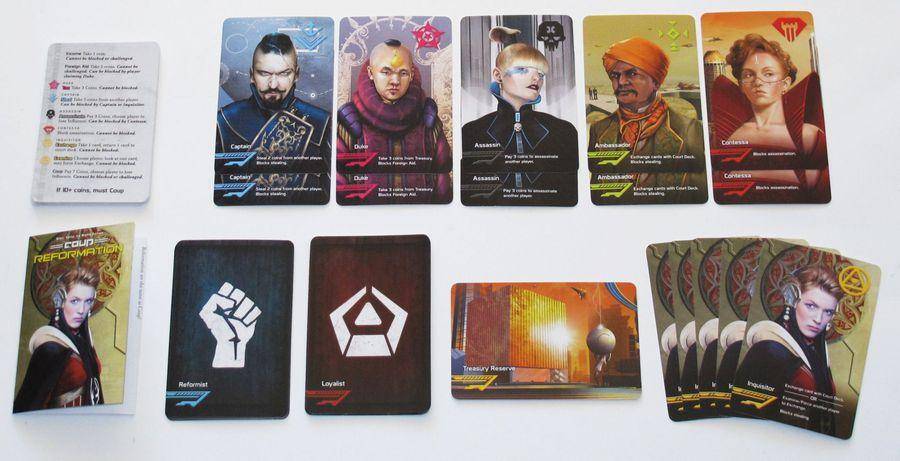
For this week, I played Coup, which is a social deduction styled game created by Rikki Tahta and published by Indie Boards & Cards and La Mame Games. It is specifically a physical card game that is designed to be played with anywhere from 2 to 7 people. The game generally seems more tailored towards adults rather than kids, and even if your group is not close, the game can still be fun.
Coup is a flexible, role-based game which encourages bluffing and deception to an extent through a balanced mix of shared and unshared knowledge. This balance fosters situations where it can be optimal to lie; this is engaging as it tests one’s decision making in a manner that is typically seen as hostile in a real world setting.
The mix of knowledge and unpredictability in Coup can both encourage and discourage deception. Because Coup is a fellowship game– specifically a game as a social framework– lying becomes more engaging if it isn’t always the correct thing to do, as making that decision on the spot is a part of learning the strategy of the game. For instance, in our first Coup game, two ambassadors were revealed.

There are three of each of the five roles in the deck overall; moreover, because two of the ambassadors are public to everyone, it made others in our group less likely to bluff about being the ambassador, adding an element of strategy to the game. Without this, it would make the game lean further in the “unknown” direction, which would make the game feel more random in my opinion. This public element allows us to see noticeable patterns within Coup and even allows for pretty sweaty strategies if you can keep track of the face down pile as well (given that ambassadors can see parts of the deck), which avoids a key element of boredom and keeps the game interesting.
Coup is also flexible and can be modded in natural ways to add a tailored experience for a group. For instance, in the original game, on a steal from the captain, you are only allowed to accuse people of bluffing the captain role if they steal from you; however, one of the first things I “mistakingly” did was prevent Tray from stealing coins from Kwasi. This was a conflict/challenge mod that Noe actually stated was a common mod people did, so we ended up just rolling with that for our two games (this led to another quite funny situation where Noe called out Aanika on false claiming Captain when she blocked a steal, but she actually was Assassin, even though she had fully convinced herself she was Captain. This was definitely one of the highlights of our first game, and this can be seen below):

Lastly, Coup encourages deception and makes it so people will make decisions in ways that benefit them, even if they are ultimately lying to do so. The obvious example of this is the existence of the assassin role, which only needs 3 coins to kill instead of 7. This encourages cooperative play– or at least perceived cooperative play. To illustrate, in the second game, Shuci and another player (I forgot their name) formed an alliance as the other player was an assassin, and Shuci did not want to be killed.

Thus, they made a pact (which lasted the entire game as neither won); however, I can just as easily envision another scenario where one of them betrayed the other to set themselves up better in the endgame.
This ultimately highlights a key element of decision making that brings out others’ playstyles; do you play more aggressively and make false claims to eliminate players early, or do you make allies to stay alive longer? I generally played pretty aggressively (which I tend to do in social deduction-styled games), but because I hadn’t played with anyone in the group previously and had not played Coup before, I tried two different playstyles in Coup– I won the first game where I played pretty passively, but lost early in the second game where I got two faulty false accusations. Though the sample size was only two games, a playstyle I usually don’t try worked better, though this could be changed if more unshared information was added.
Overall, the number one thing I would change is to add more cards to the deck and add a little bit more uncertainty, as it became far too easy to kind of just know what cards other people had by deduction, especially in the endgame (2 or 3 players remaining). Maybe 4 cards of each role could work better instead of 3. This would also make people even more willing to lie about their role, which I personally think will create a more fun dynamic even if the balance of shared to unshared information is more skewed than before.
Ethics Paragraph:
I think lying as a part of a game is completely permissible if everyone acknowledges that it is a core aspect of the game. If the lying and deception aspects are entirely within the game and stay within the game, it is entirely fine. Where this can become dangerous is if a person in a friend group really finds out that they enjoy lying from a social deduction game, or even worse if they find out that they often get away with lying, and then apply it to real world situations, unable to distinguish between the game and the real world. An adjacent scenario can occur in games that have ranked ladders, where gamers often will rage at themselves in frustration when they lose. This is acceptable, but all too often it results in them raging in other scenarios in their lives (specifically at other people, which is not fine).
Specifically, if lying is contained within the magic circle of a game, it is an excellent tool that adds another layer of depth to a game, as the game builds an atmosphere where something typically discouraged in “real life” is now encouraged. This key distinction is what I think makes games like Among Us, Secret Hitler, Mafia, Coup, and so much more both special and successful. It is fun to find limits of what you can and cannot get away with in order to work towards an ultimately harmless objective; while still treating this objective as serious. These games can still teach you elements of other people’s personalities which I find intriguing: I often learn what really gets people going, who people tend to side with, who people tend to avoid, and how people they tend to strategize.