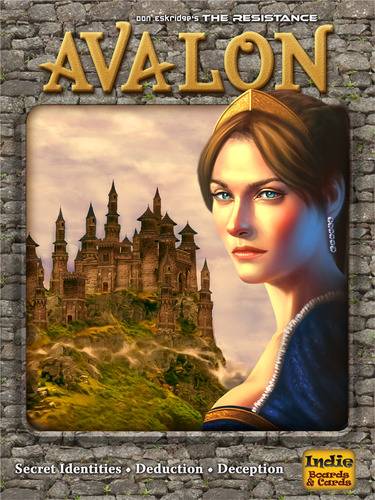
I have never considered myself a good liar. Growing up, honesty was something I valued deeply — lying felt uncomfortable, almost physically wrong. So when a group of people in CS246G sat down one night to play Avalon online, a hidden role game designed by Don Eskridge, I quickly realized I was out of my depth. This post explores what that discomfort revealed about my communication style, decision-making, and role within a group.
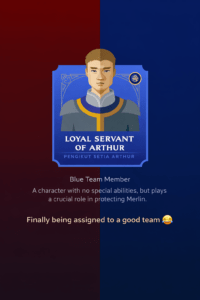
Avalon splits players into two teams: the loyal servants of Arthur and the hidden agents of Mordred. The good team doesn’t know who the evil players are, while the evil team knows everything. As an evil player, your job is to sabotage missions while convincing everyone you’re on their side. The game doesn’t just test your ability to lie. It forces you to confront how you communicate under pressure, and in doing so reveals aspects of your personality that everyday life rarely exposes. For me, that meant discovering that my hesitation and my discomfort with deception were not just personal quirks but active communication liabilities.

In my first few rounds as an evil player, my hesitation was my biggest enemy. I paused too long before answering questions, avoided eye contact, and gave vague answers where a confident player would have been assertive. I was suspected and voted off missions early. Rather than taking an active role in shaping the group’s decisions, I defaulted to passivity, waiting for others to lead discussions and only speaking when directly questioned. The game showed me exactly how that discomfort manifested in my behavior in real time.
As the game progressed and me kept losing, something shifted. The desire to win became stronger than my discomfort. I started committing more fully to my role. I became more prompt in confronting challenges head-on. I even began to take ownership, cueing the flow of conversation by redirecting suspicion and framing how the group interpreted ambiguous votes. I wasn’t a natural liar, but I was stepping into a leadership role I hadn’t anticipated, learning to influence group dynamics under pressure.
What surprised me most was that lying in Avalon is far more complex than simply saying false things. The real skill is dual communication, deceiving your enemies while simultaneously signaling your allies without being obvious. A carefully worded accusation, a vote that seems neutral but carries a hidden message. This layered communication is genuinely sophisticated, and it made me realize how much of real-world communication happens beneath the surface of what is literally said. It also revealed that effective decision-making in a group is not just about what you decide, but about how you shape the conditions under which others decide.
Comparison with Spyfall
Compared to Spyfall, another hidden role game we played the same night, the communication demands are quite different. In Spyfall, all players except the spy share the same location, and the non-spy players must describe it vaguely enough that the spy can’t guess, but concretely enough that teammates can confirm your identity. The communication skill there is precision and calibration: finding the exact middle ground between too much and too little information. Avalon, by contrast, demands outright deception and persuasion. Where Spyfall rewards subtle linguistic control, Avalon rewards social confidence and emotional masking.
MDA Analysis
Using the MDA framework, Avalon’s core mechanics like hidden roles, voting, and mission selection generate rich dynamics of suspicion, alliance-building, and misdirection. The aesthetics that emerge are precisely challenge and fellowship: players simultaneously cooperate within their hidden team while competing against the other side. Don Eskridge’s clever design decision is making the evil team asymmetrically informed: they know everything, while the good team knows nothing. This information asymmetry is what creates the tension and makes every conversation feel loaded with meaning.
However, one design flaw that impact player’s experience is the power imbalance between characters. Some roles like Merlin are central to the good team’s strategy, while others feel largely passive. As a less powerful character, I found myself eliminated from meaningful influence early, which was frustrating. A potential improvement would be giving weaker characters revival mechanics or situational abilities that activate under specific conditions, keeping all players engaged throughout the game rather than sidelining them after early mistakes.
Ethical Reflection
Lying is generally considered morally wrong, but I don’t think playing Avalon changes that fundamental calculus. In real life, we already engage in a form of deception daily: as adults, we mask our emotions, soften our true feelings, and present versions of ourselves tailored to different social situations. This kind of emotional concealment is widely accepted as a normal part of social life. Lying in Avalon operates in a similar register: it is a tool, not an act of malice, and the goal is never to genuinely harm or manipulate someone outside the game’s boundaries.
What makes games special is the magic circle, the shared agreement that what happens inside the game operates under different rules than real life. When you sit down to play Avalon, you implicitly consent to being lied to, and so does everyone else at the table. Lying here is for friendly competition and it creates tension, excitement, and the sense of achievement that comes with outsmarting your friends. The lie is a mechanic, not a betrayal. That said, I think the line becomes ethically complicated if someone uses the game as cover to manipulate others emotionally, or if players carry the deception beyond the magic circle. As long as everyone leaves the table as friends, the lying stays where it belongs.