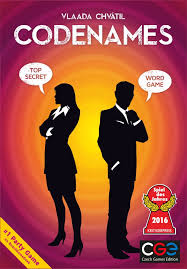
One of my go to games for a party or family get-together is Codenames. The rules are simple enough that you can invite new players in and every game feels like a new challenge. The first set of mechanics that comes to mind as a core part of the gameplay is the clue giving framework. The game is turn based, and each turn a clue giver comes up with a clue for their team. This clue is very limited in that it consists of one word and one number.
Some resulting dynamics for the clue givers are that these limitations force you to think abstractly and compress meanings into one word. They also force you to think strategically about risk and reward (a more ambiguous clue may connect more words, but it will be harder for your team to guess). For me, this creates a sense of “challenge” fun as a clue giver. The limitations lead to more creativity and a huge sense of satisfaction when you pull off an excellent clue.
These same mechanics emphasize another kind of fun for me on the guesser side of the game. Since this game is often played in a group, you are forced to work together as a team to deliberate which words the clue giver might be referring to. I find that with my family we have very different ways of thinking, and we can use that knowledge to our advantage if someone on our guessing team thinks similarly to the clue giver. At the same time, the other team can trash talk or misguide you by making side comments about possible words. Overall, this leads to a sense of “fellowship” fun, where the main driver of the enjoyment is the interactions with the people around you.