


I decided I’d analyze a game we played in class for this week’s assignment – Wingspan, designed by Elizabeth Hargrave. Wingspan, as we learned in class, is an incredibly involved game, with many moving parts that take a good 30-45 minutes to fully grasp. However, after putting our brains together and finishing the first round (of four) in just over an hour, I can confidently say that Wingspan is a game about collecting birds from different habitats and regions all over the globe.
Following the MDAO methodology outlined in Heather Browning’s Mechanics, Dynamics, Aesthetics, and Outcomes (MDAO) Framework, we will take a top-down OADM approach to analyzing Wingspan.
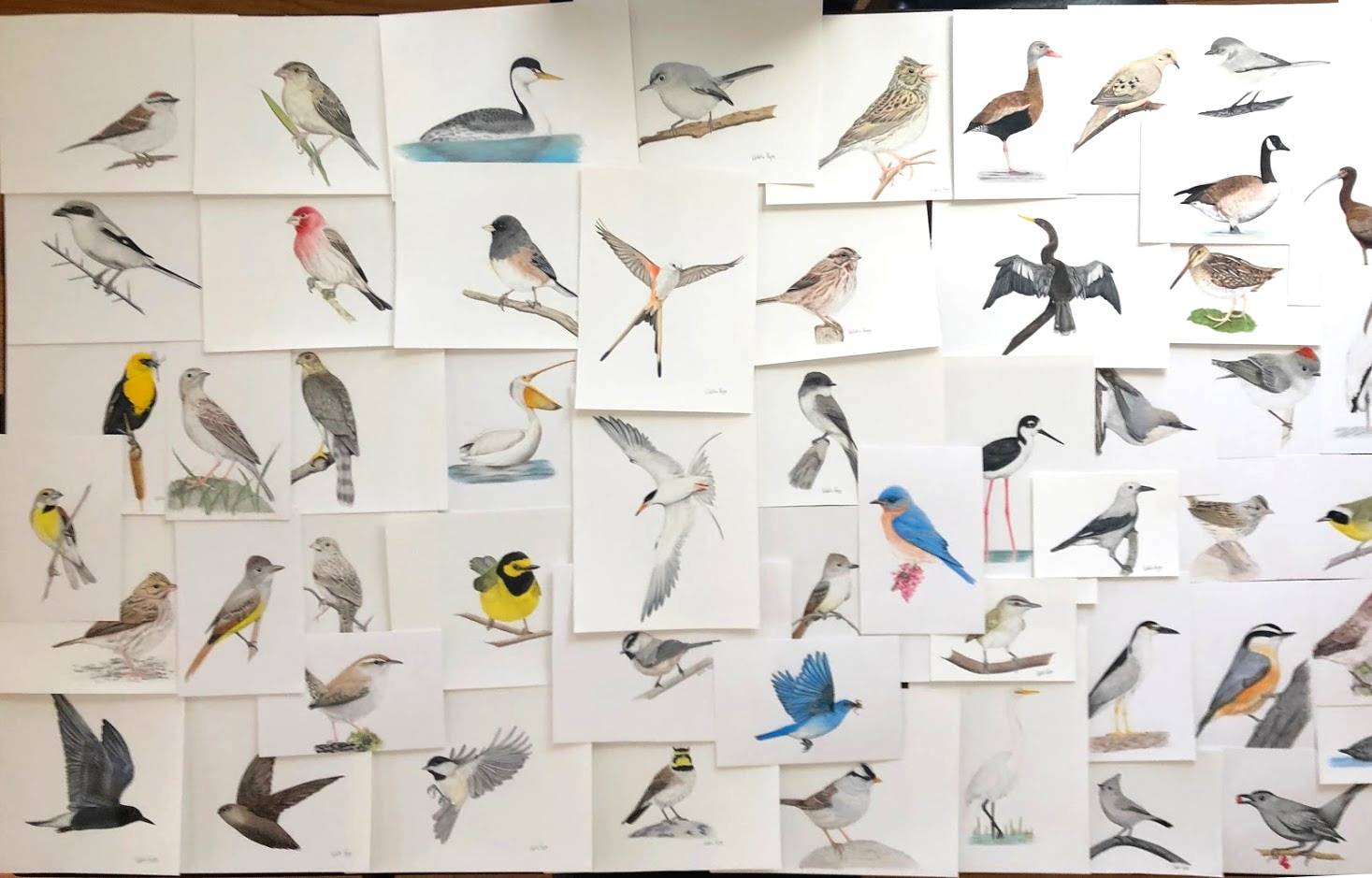
First, mission and intervention. Elizabeth Hargrave has said in interviews that the impetus behind her creation of wingspan was that there weren’t enough board games that were about things she was interested in as an amateur birder. Hargrave’s love of birding created the mission I observed while playing Wingspan, which is to share the wonder and excitement she feels when observing and cataloguing the beautiful birds of the world. This is emphasized through the game’s stunning illustrations of birds (Fig. 1), blurbs of information about each bird on each card, and mechanics on many birds that were inspired by her direct observation of their behaviors.
Next, an outcome. Motivated by this intervention and mission, a desired outcome for Wingspan by Hargrave could be that it motivates players to learn more about different birds from all over the world, as well as a little about their habitats and diets as observed through the interactions of game systems such as the round bonuses and nest types (Fig. 2).

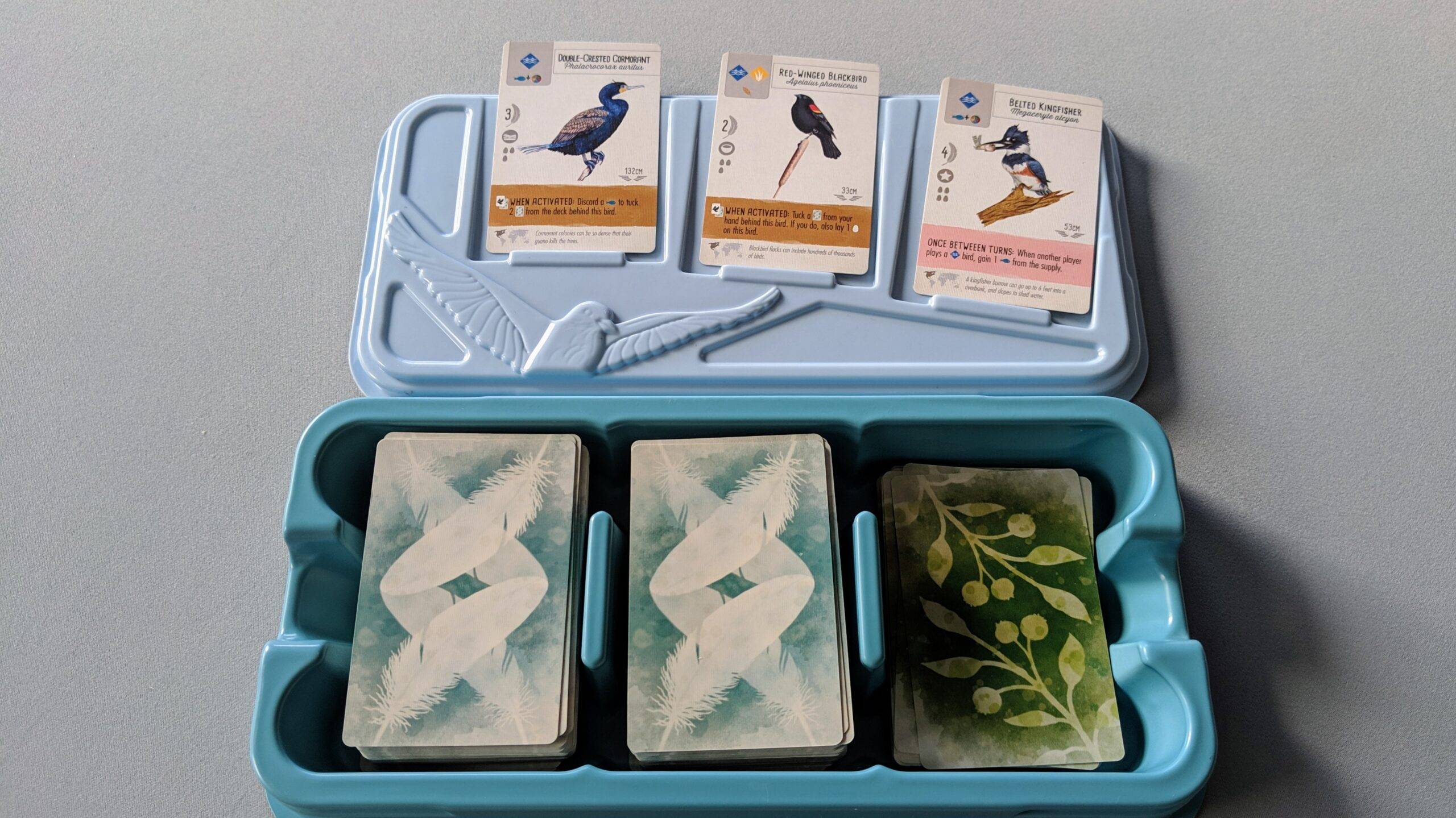
After outcomes, we can consider the aesthetics of Wingspan. The primary aesthetics I observed while playing were fantasy, challenge, and fellowship. I experienced fantasy by trying to actively engage with the game’s ornithological theming and challenge by trying to optimize my action economy. However, I found the fellowship aspect of wingspan to be the most interesting, as although players aren’t necessarily interacting directly with other people’s boards (e.g. removing others’ resources), certain resources can be denied by a forward-thinking player. I often found myself staring at others’ boards, trying to predict their next bird as well as drawing bird cards from the supply (Fig. 3) to deny their benefits to other players.
Penultimately, dynamics. Some dynamics that I noticed were collaboration (helping other players with rules questions and suggesting next moves to improve their action economy), competition (taking cards or resources from the supply to potentially prevent others from taking them and improving their boardstate), collection (looking for birds from similar regions/habitats/with similar diets), and resource management (collecting food, collecting eggs, drawing cards, spending actions) (Fig. 4).

Finally, mechanics. It took us almost an hour to get started with Wingspan, so as you can imagine, the list of mechanics could probably go on forever. However, I’ll give an abridged list with some of the more interesting mechanics that really helped achieve the above dynamics, aesthetics, outcomes, intervention, and mission.
- Symmetrical play. All player’s boards were exactly the same and all player’s game started indentically, the only differences being 1) the bird cards drawn and 2) the bonus cards drawn. This helps players understand their relative position within the game, allowing them to make more informed actions, encouraging competition.
- No interaction between boards. As mentioned previously, no player can remove birds from another’s board, preventing players like the Killer from ruining other’s plans. This indirectly promotes collaboration, as making suggestions to other players won’t ruin your own boardstate.
- Habitat/diet matching. Players learn (albeit very broadly) the habitats and diets of each species of bird, moving towards the mission goal.
- Bonus cards. Players are given bonus cards to match cards from certain regions or certain attributes, teaching players even more about each birds’ attributes as well as giving them a short introduction to categorizing birds like a birder.
- Nest types. Many round bonuses depend on nest types. For some, this is simply a “suit” to match with the round bonus, but I know that after playing multiple times I would certainly learn more about each birds’ nest types, further increasing my interest and knowledge of birding.
Overall, although many of the mechanics do familiarize players with birds, their diets, and their habitats, there still exists some ludo-pedagogical dissonance that makes it difficult for players to fully achieve the desired mission of enamoring players with birds and birding. This is apparent through the repackaging of Wingspan into two other games — Wyrmspan, which is about collecting dragons, and Finspan, which is about catching fish. These games are almost identical to Wingspan, with some small mechanic changes. Although the beautiful birds and engaging mechanics bring you into the game, very little of the game encourages you to engage directly with birding as it can be picked out and replaced with dragon collecting or fish catching, unfortunately not reaching its ultimate mission.
image creds:


