

For this assignment, I chose to play Stop Disasters — it was co-created by UNDRR (United Nations Office for Disaster Risk Reduction) and Playerthree. This is a game that teaches players how to build safer villages and cities against natural disasters, including hurricane, wildfire, flood, earthquake, and tsunami.
Stop Disaster uses a single-player-against-game play where players perform construction on villages and cities to protect them from a natural disaster that comes at the end of the game’s time limit. The game presents multiple maps, each with a different type of natural disaster.

Different maps with corresponding natural disaster challenges
Within the map, the player can choose different difficulty levels that correspond to different construction budgets, community population, and construction time limit. The player’s objective is to house all the population, fulfill building goals (e.g. build 2 schools), fulfill map specific missions (e.g. cover the wells or anchor the ships), and minimize financial damage and fatality when disaster hits—all while staying within the given budget.

Different difficulty levels within each map
After selecting a map and difficulty level, the player is presented with a grid based map of the community. I selected the Eastern/Central European map with valley flood plains and played it twice. With each tile, players are presented with the following mechanisms (M in MDAO):
- Build new housing facilities.
- Build special building types (e.g schools, hospitals).
- Build mission specific structures (e.g. well coverings).
- Build defense structures (e.g. sea walls).
- Remove an existing housing structure or natural landscape structure.
- Add protection to existing buildings.
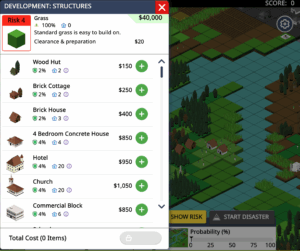
Construction actions for housing structures
Players are presented with a risk map view that shows tiles in different colors based on the level of risk it’s at. The player sees the time limit as a “disaster probability” bar at the bottom of the UI, but they can also start the disaster early if they feel ready with the construction.
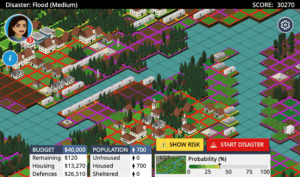
Risk map view: purple is highest in risk, then red
The player objective and given mechanism led to a couple immediate dynamics in my play: I prioritized defense mechanisms on the highest risk tiles closest to residential areas and infrastructure. I prioritized fulfilling the “hard quota” of housing population, finishing building goals, and achieving map specific goals, leaving the defense construction as a secondary action. I also tend to place new housing structures in the safest tiles and would move existing housing away from high risk areas.
These dynamics emerged from my first two plays, but treating defense as an after thought did not turn out to be a great strategy for budget and safety. Since I was striving to fulfill the housing requirement as soon as possible, I also tend to choose larger but costier housing, which may be a room for improvement. For a more experienced player, there might be more nuanced dynamics that balance progression in all the goals equally and is more budget friendly.
On the Aesthetics level of MDAO, I experienced Narrative and Challenge. The game felt like a progressing narrative that I was participating in — as I was making construction decisions, I was actively contributing to the fate of the community when the disaster hit. Challenge is more straightforward: the player is required to fulfill a given mission while satisfying many given constraints.
As for Outcome, I felt the following three types:
- Attitude: Stop Disasters highlighted the importance of mitigative resilience by showing players the horrible consequences that might happen if resilience is not done well. This can change a player’s attitude about the urgency of investing in mitigation infrastructure from early on.
- Information: This game made me more aware of the different tradeoffs that go into urban planning for disaster resilience. I am also more aware of (1) how natural landscape affects risk distribution and (2) different methods for mitigating disaster impacts.
- Aesthetic: The time limit made climate risks — a concept that can come off as abstract and intangible — feel much more urgent because you see the consequences immediately. This game made me feel more anxious about the climate and how we should start taking action immediately.
Overall, I would say that the game was effective in the three outcomes that I described, but I’m not sure if the impact would carry over to become a behavioral change. I did not feel growth in self efficacy over how I can take action—both my attempts were terrible failures, and the game provided a more limited scope than its description: it did not involve any evacuation plan mechanisms despite including it on the introduction website.
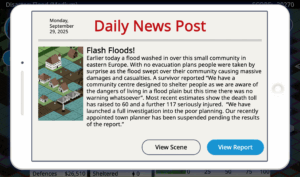
Me failing the game
