Title of Game: Spent
Author: McKinney
What it’s about: Spent is a game about the realities faced by low-income families in America.
What kind(s) of play it uses and how does the MDAO framework apply to this game?
The game focuses on role play as its main type of play, offering simulated scenarios that situate players in what it’s like to live a month in the life of an adult from a low-income background. Though there is no formal set of rules and the game is designed for single players, it follows a rigid structure: a common scenario faced by low-income individuals is presented first, then the player is asked to make a decision, followed by the results of that action.
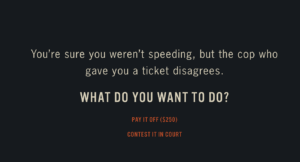
The core mechanics of the game require players to read and process the scenario and make a decision based on how they wish to proceed. For example, the following images demonstrate these mechanics:
-
Scenario: “You’re sure you weren’t speeding, but the cop who gave you a ticket disagrees.”
-
Decision-making: “What do you want to do? Pay it off ($250) or Contest in Court.”
-
Result: “You get the ticket dismissed, but you had to spend the whole day in court and pay a $50 court fee.”
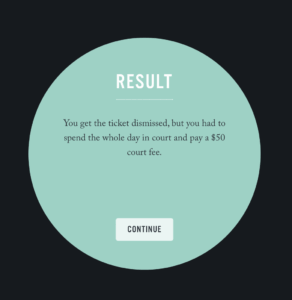
While players are given the agency to choose from the available options, they will not immediately know the consequences of their decisions until the results are shown.
Considering the dynamics, as the game progresses, players become more strategic about where and how they choose to spend money—given the unpredictable nature of certain scenarios and the available decision-making options. Personally, as a player, I felt the need to be more meticulous about knowing when and where to allocate my financial resources as the game went on. I also became more attuned to categorizing events that take priority or precedence (e.g., priority: choosing to spend money on groceries vs. non-priority: spending money on new clothes).
When considering the aesthetics of this game, the main elements that stood out were challenge and narrative. While the designers created a world that felt “separate” from reality through its simulated nature, the fact that it was so intrinsically tied to the real-life struggles of many low-income people made it feel more connected to, and less divorced from, real life. Additionally, the main challenge of trying to make it through the month with only $1,000—while the budget numbers and number of days were visibly displayed on the left and right sides of the interface—highlighted a sense of urgency and distress. This simulated the emotional state constantly felt by many low-income individuals on a daily basis.
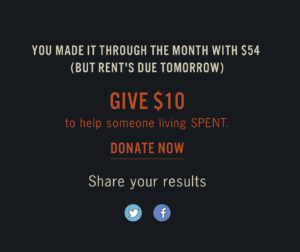
Regarding the outcomes, the most evident change I experienced was a shift in my attitude toward low-income communities. This game helped me gain two new areas of understanding as a player. First, backed by statistics and research findings, the game educated me on the many real-life struggles faced by low-income families. Second, it added emotional value by helping me develop a more empathetic lens when trying to understand those from low-income backgrounds. This deepened empathy and understanding of the challenges faced by this community play a significant role in making players feel compelled to want to help, and when prompted by the final message to “donate $10,” I can imagine many players will feel incentivized to contribute to the greater good.