For this week’s critical play, I played Tomb Raider (2013), a gritty and mature action game developed by Crystal Dynamics and available on PC, PlayStation, and Xbox. I had tried it about three years ago for maybe four hours, but at the time, I was mostly there for the stealth mechanics and bow gameplay. I didn’t think much about the story, and I wasn’t familiar enough with the older games to see how this one differed. All I knew was that she used to be much more sexualized, which, for many people, took away from her potential as a feminist icon. For others, though, it proved that women could play the narrative role of the masculine protagonist in an action game without sacrificing femininity. But after reading Shira Chess’s Play Like a Feminist and reading some articles on the reboot, I started thinking about how Lara’s “seriousness” is actually doing a lot of quiet narrative work. The game strips away the old hypersexualization, but it also burdens her with a constant emotional weight, and never really lets her be free.
Visual Progress That Plays It Safe
The most obvious update is Lara’s appearance. Gone are the absurd proportions and skin-tight shorts, a change that Forbes described as a shift from “pneumatic” to athletic. Instead, she’s muddy, bruised, and dressed like someone actually fighting to survive. That was a smart move. Plenty of players still complain that she’s “less hot” now, but that misses the point. The redesign doesn’t make her better by erasing sex appeal; it works because it fits the story. A character can be sexy and serious, but Lara’s old design mostly served to please the player, not reflect her situation. The new look shows that the devs were paying attention to the legacy they inherited. They didn’t just update her style—they rethought her role. It’s a good example of what Shira Chess calls “de-centering the presumed male player.” But even a stronger visual design can only do so much if the player still isn’t given control over who she gets to be.
A Competent Hero Stripped of Choice
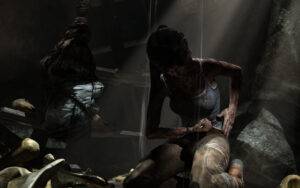
The frustrating part is that the story still doesn’t trust the player with real agency. Lara is clearly capable. She climbs, fights, shoots, and survives from the very beginning. But the game goes out of its way to show her hurting. She grunts, screams, and cries, and the camera lingers on her pain. Additionally, her motivations are never her own. She’s trying to save her friends, or fulfill her father’s legacy, or recover from trauma. This lines up with what Chess refers to as “controlling for femininity.” Lara’s power has to be softened, explained, or earned through suffering. She doesn’t just want something and go for it, like in the old games, where she hunts relics for excitement and philanthropy instead of basking in her riches. In the reboot, she has to be pushed into action by external forces like duty, guilt, or loss. As a player, you’re following her breakdown more than shaping her path. The story asks for empathy, not self-expression.
Shared Tropes, Gendered Weight
One could say that male game protagonists also deal with trauma, like Joel in The Last of Us or Geralt in The Witcher. However, Chess describes underlying patterns in games showing that it’s not the same. Joel and Geralt both make difficult choices about who to help, but Lara doesn’t get that range. She’s defined by her trauma; her strength is shown as something she earns by enduring, not something she owns from the start. There’s no space in the narrative for her to be selfish, sarcastic, or unsure. This reflects a larger pattern: female characters are often allowed to be strong only if they’re also nurturing or broken. They can’t just be complicated, and in games, that means their stories are more often about healing than choosing.
What Feminist Play Could Look Like
Shira Chess writes, “Ask not what games are for women, but what kinds of play can be feminist.” That means giving players room to shape the story, not just watch it unfold. In Fallout: New Vegas, you can be kind, cruel, indecisive, power-hungry; whatever feels right to the player. Lara doesn’t get that; her path is locked, and her emotions are always tied to pain or duty. Feminist play is about making space for complexity, not making things gentler.
Conclusion
The 2013 reboot is better than what came before, but it’s still narrow. Lara looks more human, but she doesn’t get to feel fully human. Playing like a feminist means noticing not just what the game includes, but what it leaves out: agency, ambiguity, desire, and silence. Tomb Raider avoids old mistakes, but it’s still afraid to let Lara be someone we haven’t already decided she has to be.
Sources:
https://www.forbes.com/sites/carolpinchefsky/2013/03/12/a-feminist-reviews-tomb-raiders-lara-croft/