Before taking Design Serious Games, I knew little about “serious games” and struggled to distinguish them from regular entertainment games. My experience with popular titles like League of Legends, Honor of Kings, and PUBG, along with my background as an esports commentator and host, gave me a solid understanding of game mechanics. Naively, I thought designing a game would be relatively easy, assuming the biggest challenge would be balancing mechanics. The key point is that even seasoned experts can struggle to balance game mechanics, let alone a novice like me in game design. Therefore, I approached the course with both excitement and trepidation.
At the start of the course, I expected to jump straight into game design, but the first task was to create a sketchnote. Initially, I was biased against sketchnotes, as my usual note-taking involved copying text or taking photos, rarely handwriting or drawing. Adapting was challenging and felt time-consuming, requiring me to read all the materials, organize a logical framework, and plan the sketchnote layout. My lack of drawing skills led to frequent revisions, further adding to the effort.
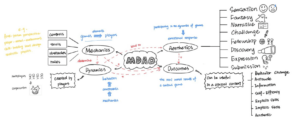
As the course progressed, I came to appreciate the value of sketchnotes. They helped knowledge stay in my mind longer than my previous methods. When writing project reflections, I often referred back to my sketchnotes and found them far more effective for locating key points. Now sketchnotes have become an essential and practical tool for me. The sketchnote I revisited most was for the MDAO Framework (Mechanics, Dynamics, Aesthetics, Outcomes), which became foundational for my subsequent game designs.
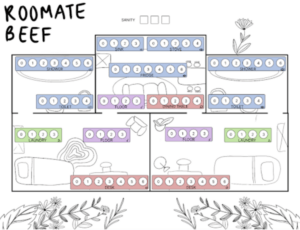
My first game design project was Roommate Beef, a board game that marked my initial attempt to apply the knowledge I had learned to practical design. This game requires two players to work together to complete household cleaning tasks and avoid conflicts, teaching them how to collaborate effectively with roommates.
In this project, I was primarily responsible for designing and writing the game rules, which included detailing how action points are used, explaining the functionality of tool cards and personality cards, and defining the conditions for triggering event cards. Additionally, I led multiple playtesting sessions, collected player feedback, and adjusted the game mechanics accordingly. Finally, I handled the packaging design to ensure the overall style matched the theme of the game.
Project 1 was my first time going through the entire game design process, from rule writing and game element creation to playtesting and iterative adjustments, as well as designing maps, tokens, cards, and packaging. These valuable experiences not only gave me a deeper understanding of game development but also laid a solid foundation for my next individual project.
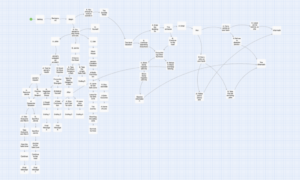
In Project 2, I designed an interactive fiction game called The Last Light, a nuclear apocalypse survival story where players navigate a post-disaster world, making critical decisions to reach the safety zone and survive. This game teaches players to navigate the complexities of moral dilemmas, human resilience, and environmental crises in the face of survival challenges.
When designing this game, I created a unique aftermath ending that introduces a small twist after the main storyline concludes. This design encouraged many playtesters to restart the game after their first playthrough, eager to explore other storylines and endings to see how different choices would unfold.
Designing this game taught me how to create engaging content that balances tension, agency, and curiosity. I learned the importance of crafting meaningful and enticing choices, ensuring that each option feels impactful. Watching players grapple with their decisions deepened my understanding of how to build a narrative that keeps them invested and eager to discover every twist and outcome. This project sharpened my ability to design games that not only tell compelling stories but also empower players to shape those stories through their actions.
In Project 3, I designed my first system-based digital game, which was both the most complex and educational project I’ve undertaken. The game simulates “enshittification,” the gradual degradation of an online platform as it shifts from prioritizing users to benefiting third parties, and ultimately focusing on profits, leading to a decline in utility and reputation. Designing this game gave me firsthand experience with the complexity of system design, especially the challenge of achieving balanced game mechanics. This made effective “playtesting” an essential part of the process.
In this project, I was primarily responsible for organizing and facilitating “playtests”. Compared to my approach in previous projects, I adjusted my strategy this time. In earlier projects, as a playtest monitor, I would introduce the rules and actively participate in the testing process, often providing suggestions if players encountered difficulties or struggled with strategies. However, this time I chose to step back after introducing the game’s content and rules, allowing players to explore independently. This change significantly improved the effectiveness of the “playtests”. Each session revealed new issues, and every playtester contributed unique insights.
Through this experience, I not only learned how to design a system-based game but also gained a deeper understanding of how to conduct meaningful “playtests” by maintaining an observer’s role. This approach allowed me to better analyze player behavior and feedback, providing valuable input for refining the game further.

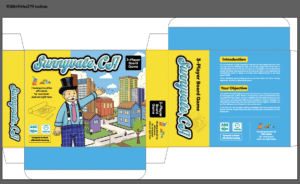
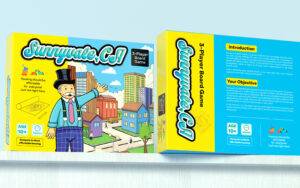
In Project 4, Sunnyvale, CA explores California’s housing crisis, with players as NIMBY activists blocking affordable housing projects. Managing a 6×6 grid, players balance tactics to influence housing placement, reflecting on how local opposition shapes policies and its broader consequences.
In this project, my primary responsibility was designing the game box and packaging. Although I had some prior design experience, I still learned a lot of new things through this project. For example, I learned how to determine the box dimensions and what elements should appear on the front, such as the game’s title, artwork, number of players, game type, age restrictions, playtime, and slogan. The back and sides of the box needed to include additional content, such as a brief game introduction and the players’ objectives. Designing the packaging gave me a deeper and more comprehensive understanding of the game design process. For instance, we hadn’t considered specifying an age range for players during the initial design stages, but this became apparent while working on the packaging. In reality, this is an issue that should have been addressed early in the design process, even before developing the game mechanics.
This experience not only improved my design skills but also provided me with a broader understanding of the interconnected aspects of game development.
In the future, when I design games, I will ensure that the target audience, including age restrictions, is clearly defined at the beginning of the design process. This will help make the game more suited to the intended players and avoid unnecessary issues later in development.
I will also pay close attention to how all elements of the game, including mechanics and visuals, work together to create a cohesive and engaging experience. Additionally, I’ve come to realize the importance of technical skills in game design, especially for digital games. Looking back, I wasn’t the technical person in my team, and technical contributors provided significant support, particularly in Project 3. I regret not being able to contribute more on the technical side, so in the future, I will work to improve my coding skills. My ultimate goal is to develop the ability to independently create a digital game.
Overall, this fall has been incredibly rewarding, and Design Serious Games has become one of my favorite courses. I’m deeply grateful to Christina and Amy for their understanding and support, as well as to my classmates for their encouragement!