

I really didn’t have much experience with interactive fiction before this project, with the exception of Black Mirror’s “Bandersnatch.” When I watched/played that episode, I found myself initially intrigued. But when I got to an ending, I was unfulfilled. I felt like I needed to keep exploring other paths. I initially had a completionist attitude: I wanted to watch every single path to fully experience the story. But I grew bored. Many paths were similar enough as to feel repetitive and others were fourth-wall breaking in a way that discounted the rest of the narrative. When I eventually gave up on it before seeing all it had to offer, I felt deeply dissatisfied.
I attributed this dissatisfaction to the fact that each path by itself felt unfulfilling and incomplete and that the entire body was internally incohesive. I felt similarly when playtesting branching fictions before this project.
But when I played the parser fictions, I didn’t feel that way. I found myself fully immersed in the stories being told, even though I often got stuck and was unable to make much literal progress. The mechanic of being able to choose where I walk, to retread covered ground, to poke around and explore at my own pace, amounted to discovery, fantasy, and narrative fun.
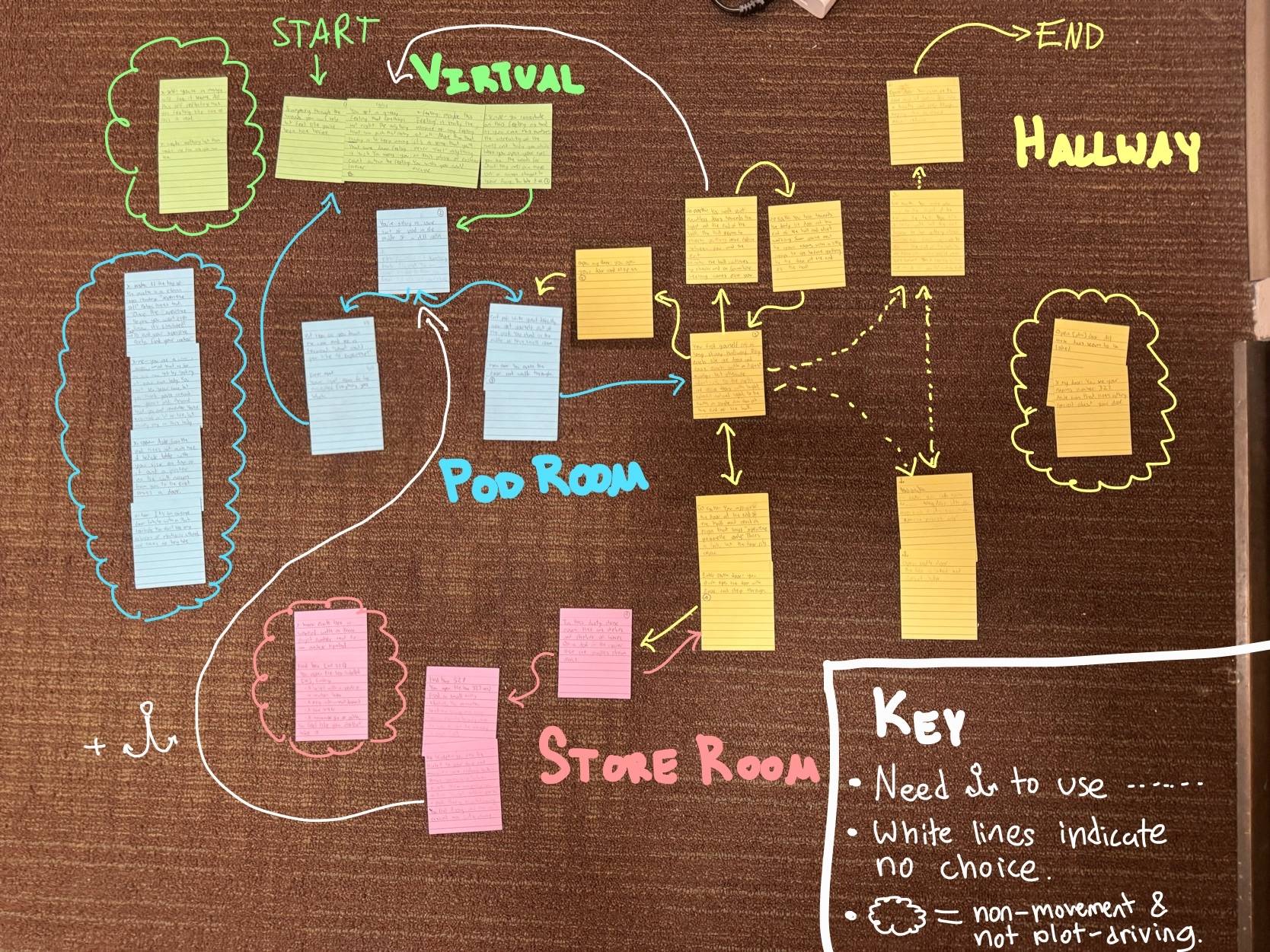
The best move I made in this project was completely reworking a branching fiction prototype into a parser fiction, wizard of oz prototype. Since a player has so much more freedom in an interactive fiction compared to a branching fiction, this forced me to distill my earlier prototypes into what actually mattered to the game’s themes. For the longest time, I was married to this one mechanic that I found excruciatingly difficult to cohesively weave into the narrative. Only when I fully committed to designing a parser fiction did I realize this component was unnecessary and distracting from the actual story I wanted to tell. Reducing the story’s scope gave the project the ability to be more atmospheric and explorative, better connecting with the dystopia I was creating.
I hope I was able to capture the same fun I found in the parser fictions I played–namely, discovery, fantasy, and narrative. I think the mechanic of being able to attempt any action you want at any time were imperative to the success of my game. I also hope I was able to craft an experience that was more beginner friendly compared to some of the parser fictions I playtested. When players were able to get past the friction innate to the parser fiction genre, it was extremely rewarding to see them make their way through the environment and try to make sense of the underlying story.
I will take two primary lessons away from this project. The first is the value of rapid prototyping–specifically wizard of oz. I’ve used these before in other classes, but in this project it was so extremely informative to the direction of my game and I think I have a better sense of how to do it right to get the best feedback possible. The second takeaway is that, if people don’t know how to interact with your product, it simply doesn’t matter how good it is. Since touch screens and trackpads are somewhat ubiquitous these days, this exact lesson feels less directly relevant to developing typical mobile apps or websites. But as technology turns towards virtual reality/augmented reality/spatial computing/whatever you want to call it, this will be one of the biggest factors determining whether these technologies are actually adopted or whether people will just give up.
