1. Identify the basic elements in a game of your choice (actions, goals, rules, objects, playspace, players).
Wingspan
Actions: On their turn, players can play a bird card, draw a new card, gain food tokens from the communal birdfeeder, or lay eggs on birds that are already placed down.
Goals: The goal of Wingspan is to get the most points from bird cards, tucked foods/bird cards, group round objectives, and secret bonus objectives.
Rules: Players can only do one action per turn and each round has a specific number of turns. There are certain food and habitat requirements to play birds and specific birds have unique abilities that can trigger only when certain criteria are met.
Objects: There are bird cards, food tokens, dice, egg tokens, player boards, round objectives, and bonus cards.
Playspace: The playspace is the player’s personal board that contains all the possible actions and habitats to put their birds down, lay eggs, and activate abilities. There is also a shared playspace with the main bird card deck, birdfeeder, and token piles.
Players: 1-5 people of 10+ play Wingspan and compete for the most points.
2. As a thought experiment, swap one element between two games: a single rule, one action, the goal, or the playspace. For example, what if you applied the playspace of chess to basketball? Imagine how the play experience would change based on this swap.
For this, I am going to swap the goal of Monopoly with Game of Life. In Monopoly, instead of the goal being to bankrupt all other players by acquiring properties, players would now try to navigate through different stages of life—such as going to college, starting a career, getting married, buying a house, and retiring. The properties on the Monopoly board could represent milestones where money is used not just for real estate but for essentially climbing up the social ladder and achieving these milestones. Regarding the play experience, the competitive nature would shift from financially defeating opponents to reaching life’s major achievements first. This would create a more light-hearted game that allows each player to have their own personal experience going through life achievements and removes the initial cutthroat aspect of traditional Monopoly.
The Game of Life would shift from being about moving through life stages to focusing on financial domination, as in Monopoly. Instead of choosing careers or going to college, players would focus on acquiring financial assets with the goal of bankrupting the other players. The play experience would now be more competitive and make the game require a lot more strategy and planning from each player. This means that it would not be the same family friendly game as before.
3. Pick a simple game you played as a child. Try to map out its space of possibility, taking into account the goals, actions, objects, rules, and playspace as the parameters inside of which you played the game. The map might be a visual flowchart or a drawing trying to show the space of possibility on a single screen or a moment in the game.
Uno
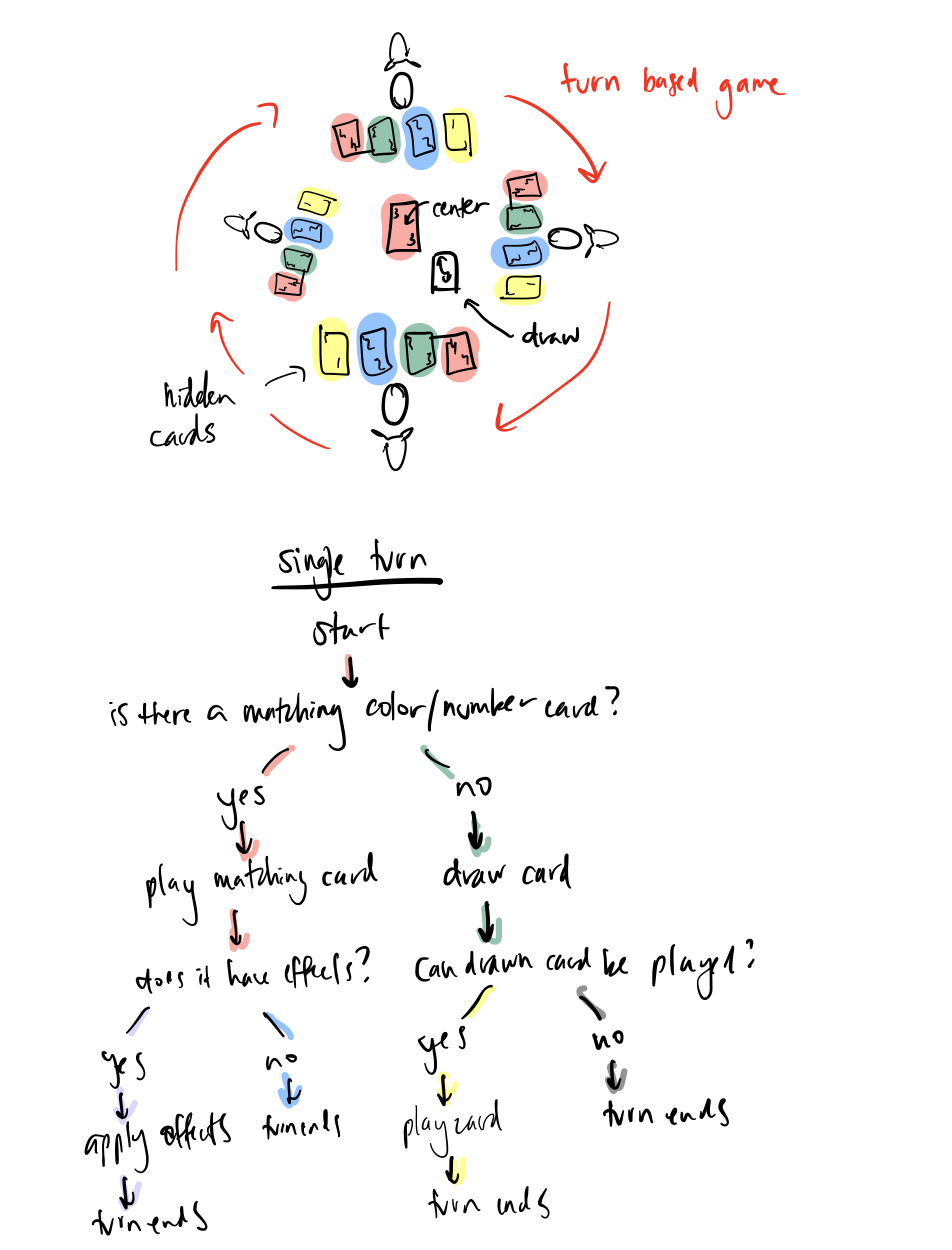
4. Pick a real-time game and a turn-based game. Observe people playing each. Make a log of all the game states for each game. After you have created the game state logs, review them to see how they show the game’s space of possibility and how the basic elements interact.
Real-time game: Happy Salmon
- Players begin with all cards in hand
- All players simultaneously look at their top card.
- Everyone starts calling out actions (“Fish Bump!” “Happy Salmon”).
- Player 1 and Player 2 complete a “High Five” and discard.
- Player 3 and Player 4 find a match and complete “Switch Places.”
- Players 1 and 3 call new actions, trying to find a match again.
- No matches for Player 5 “Happy Salmon.”
- Player 1 and Player 3 complete a “Fist Bump” and discard.
- Player 4 finishes all cards and wins the game, ending the round.
Happy Salmon’s game states change rapidly in real time since all players are constantly shouting and interacting with each other to find a potential matched card. The game’s space of possibility is shaped by the players’ current cards, their ability to match others, and their speed in completing the actions. The game is fast and chaotic, with cards being discarded, actions completed, and players shouting at the same time. Players who can think and act quickly have an advantage, and matches happen in any order at any time which creates a constantly shifting game state.
Turn based game: Fluxx
- Start of game, basic rules.
- Player 1 draws 1 card and plays “New Goal: 10 Cards in Hand.”
- Player 2 draws 1 card and plays “Keeper: Bread”
- Player 3 draws 1 card and plays “New Rule: Draw 2, Play 1.”
- Player 4 draws 2 cards and plays “Action: Everyone Draws 3.
- Player 1 draws 2 cards and plays “New Goal: Have Bread and Butter.”
- Player 2 plays “Keeper: Butter.”
- Player 2 wins the game
Fluxx’s space of possibility is constantly evolving due to changing rules and goals. The possibilities are dictated by the cards in play and strategic decisions made on each turn. Players must adapt their strategy based on new rules, goals, and the state of other players’ hands. They have time to think and change the flow of game to get them an advantage if it is working favorably for another player.