

Task 1: Identify the basic elements in a game of your choice.
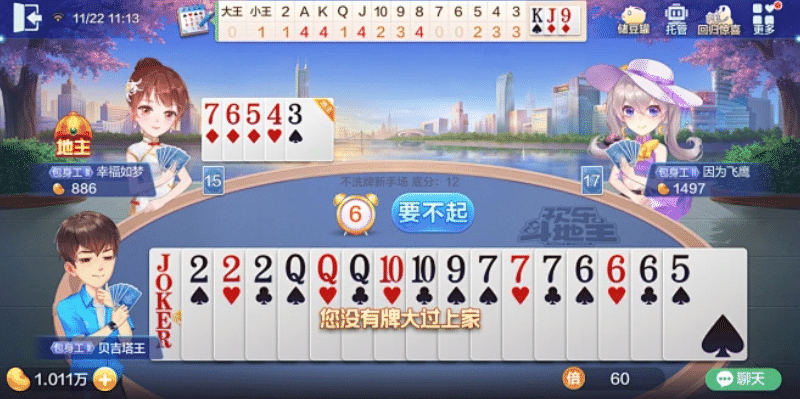
- Name: Dou Dizhu (Fight the Landlord)
- Actions: Decide one player is the landlord by any possible way. And then distribute cards based on rules. And then players take turns to play cards based on rules.
- Goals: The landlord wins by playing all their cards first. The two farmers win together if either farmer plays all their cards first.
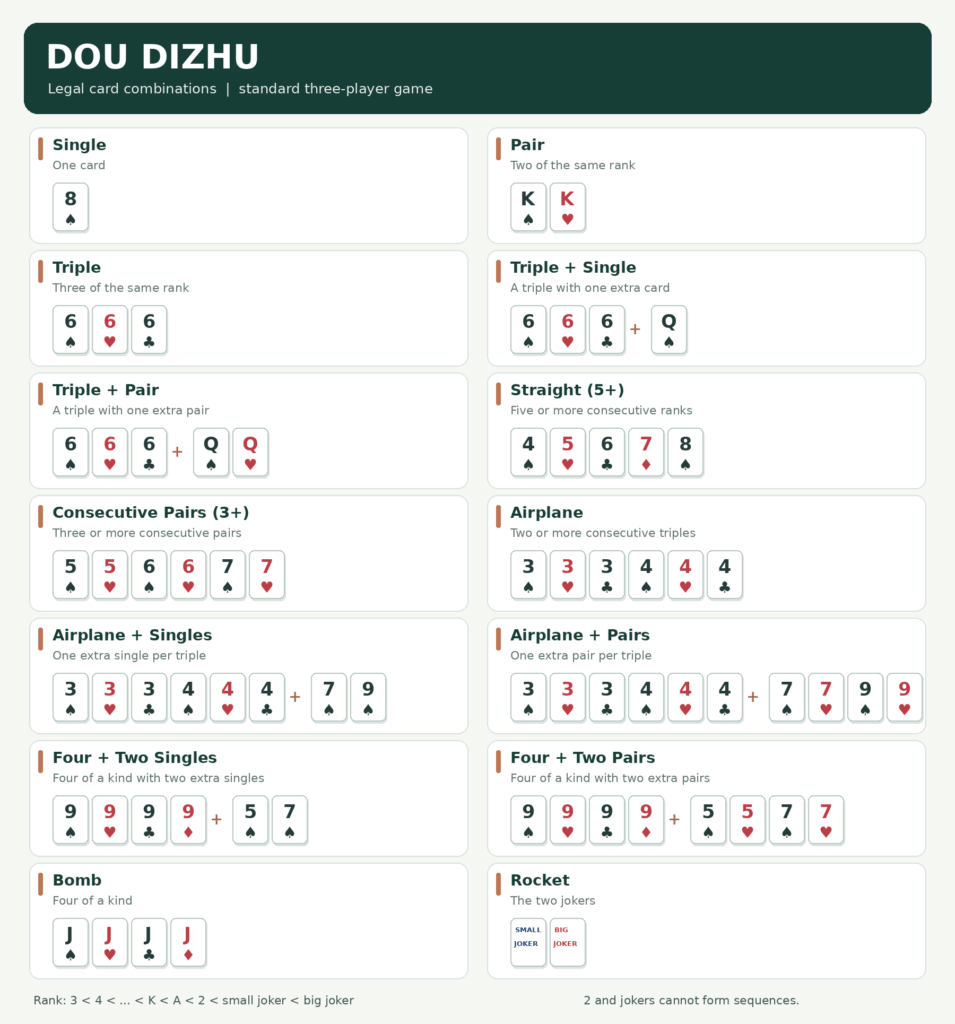
- Rules: Each player gets 17 random cards, and the landlord takes the remaining three and plays first. To beat the previous play, a player generally must play a higher combination of the same type and size. Bombs can beat ordinary combinations, and the two jokers together beat any other play. (The legal combination categories are shown in the picture below.)
- Objects: one 54-card poker deck
- Playspace: A shared area where players can see their own hands and the cards most recently played by others. This can be a physical table or a digital platform.
- Players: 3 players (1 Landlord + 2 Farmers)
Task 2: Swap one element between two games
What if Dou Dizhu used Mahjong’s goal of building a winning hand instead of getting rid of all the cards in hand?
In Mahjong, players can draw new tiles and improve their hands as they play.
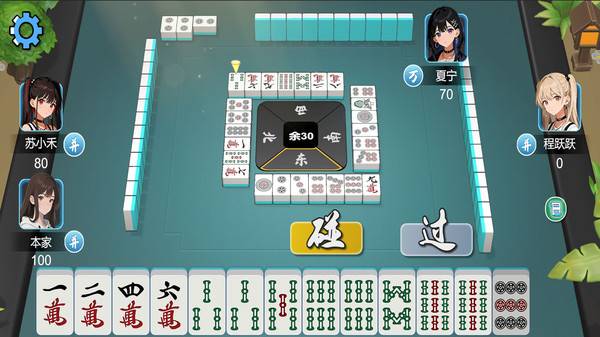
In Dou Dizhu, players can only play the cards they were dealt. If the goal changed to completing a Mahjong-style hand, they would mainly try to get rid of cards they did not need. And some starting hands might never be able to form a winning pattern. The result would depend much more on the initial luck.
In the original Dou Dizhu game, the goal of playing all your cards works together with the rules for card combinations and the actions of playing or passing. Players must plan when to use their combinations and respond to opponents. For farmers, working with their teammate is also crucial to success. These choices keep the outcome uncertain and make strategy matter other than the luck.
Task 3: Pick a simple game you played as a child and map out its space of possibility
- Name: Gomoku
- Actions: Players take turns placing one stone on an empty intersection.
- Goals: Be the first to form a line of five stones.
- Rules: Black moves first. Players alternate turns. A line of five can be horizontal, vertical, or diagonal.
- Objects: A grid board, black and white stones.
- Playspace: The board, either physical or digital.
- Players: Two players, one playing Black and the other playing White.
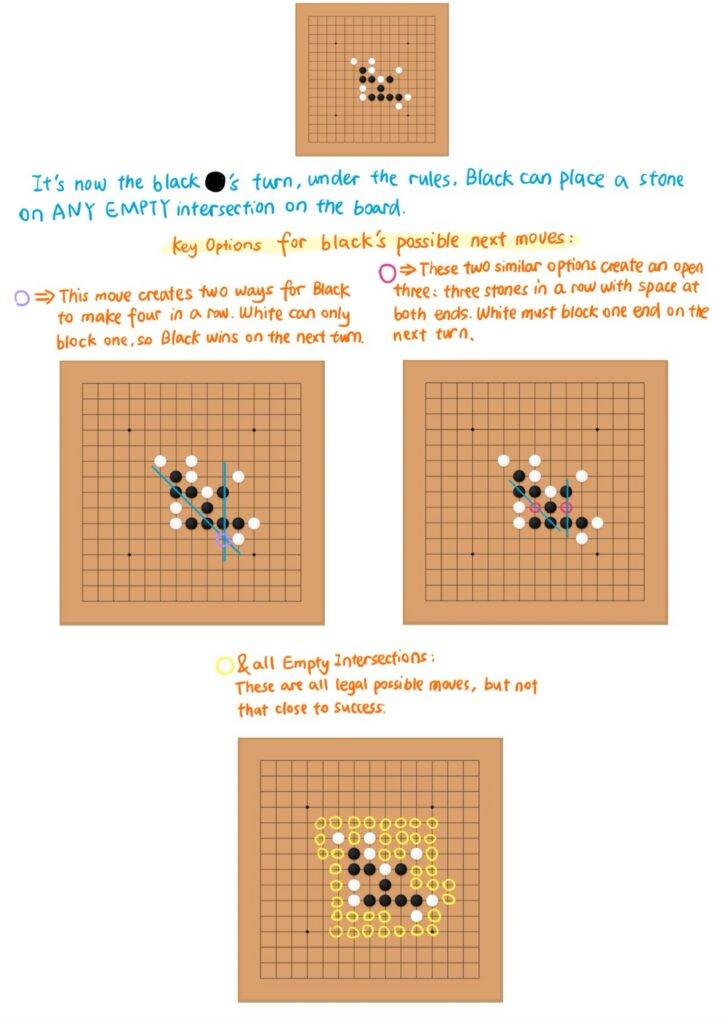
A basic principle of Gomoku is that an open four (four stones in a row with both ends empty) is usually a winning position: the opponent can block only one end in the next turn, which leaves the other open intersection for a winning move. The picture below shows possible moves for a certain moment in Gomoku.
Task 4: Real-time game vs. turn-based game
Log for a Real-time game: Tetris
| Time | Action or event | Game state |
|---|---|---|
| 0.0 s | A cube piece appears | The cube piece is at columns 5–6 near the top. The bottom row has a two-cell gap in columns 5–6. |
| 0.6 s | The cube piece going down | The piece falls without player input |
| 1.0 s | Player moves right | The piece is over columns 6–7. Dropping it here would miss part of the gap |
| 1.2 s | Player moves left | The piece is back over columns 5–6 |
| 1.6 s | Player hard drops the cube piece | The bottom row is completed |
| 1.7 s | Line clears | The completed row disappears |
| 1.8 s | A T-shaped piece appears | The T-shaped piece is at columns 5–6 near the top |
Log for a Turn-based game: Gomoku
| Turn | Action | Game state |
|---|---|---|
| 1 | B plays E5 | None |
| 2 | W plays E6 | None |
| 3 | B plays F5 | Black has two adjacent stones: E5–F5. |
| 4 | W plays D6 | White has two adjacent stones: D6–E6. |
| 5 | B plays G5 | Black has three in a row: E5–G5. |
| 6 | W plays C6 | White has three in a row: C6–E6. |
| 7 | B plays H5 | Black has an open four: E5–H5, with D5 and I5 empty. |
| 8 | W plays D5 | White blocks one end of Black’s line. I5 remains open. |
| 9 | B plays I5 | Black completes five in a row and wins. |
In Gomoku, the log moves one turn at a time. A player places a stone, the board changes, and the other player gets to move next. At each step, the player can consider all the empty intersections and choose a move that helps form five in a row or blocks an opponent’s line. A clock may add pressure, but the stones usually stay where they are while the player decides. In other words, the game states (except time) mostly stays the same between player actions in turn-based games.
In Tetris, the falling piece keeps moving between player actions. The log therefore needs to record what the game system does as well as what the player does. As the piece goes down, some possible positions become harder to reach. Moving it left/right or rotating it early will lead to a different result than doing the same thing later. The player has to keep evaluating the current situation rather than choosing from a fixed set of options (Turn-based games often have a fixed set of options).
Both logs show how rules limit what players can do and how goals make some choices more useful than others. The key difference is that in Real-time games like Tetris, the timing that a player acts also changes the available possibilities.
