

Basic Elements of Table Tennis
Players: The game can be played with either or 4 players, divided into two equal teams.
Objects: The objects used are a ping-pong ball and one table tennis racket per player.
Actions: Players strike the ball with their racket.
Goals: Return the ball to the opponent’s side of the table in a way that makes it difficult for the opponent to do the same. You score one point if your opponent does not legally return the ball back to your side of the table. Overall, the goal of the game is to score 11 points (or another agreed amount).
Rules: There are many rules and technicalities in table tennis, but I will list the most important ones that contribute to the flow of the game.
- At the start of a point, players must serve, hitting the ball such that it bounces once on their side of the table, then goes over the net, then on the opponent’s side of the table. A serve is invalid (called a “let”) if the ball comes into contact with the net, in which case the serve is replayed.
- After the serve, players must use hit the ball such that it bounces once on the opponent’s side of the table (note that each player’s side of the table is determined by which side they started on).
- The opponent is awarded the point if your return either does not go over the net or misses the top surface of the table entirely.
- The opponent is awarded the point if the ball hits another surface after bouncing once on your side of the table (i.e. the ball bounces twice on a legal return).
Playspace: The reason I chose table tennis is that the playspace is much broader than the name implies (it’s not just the table!). In professional matches, it is common to see two players exchange shots from incredible distances. Hence, the playspace is, at minimum, the space that is sectioned off via the barriers. It is also not uncommon to see players leap over the barriers to return a deep shot! See the figure for the typical boundary of a playspace.

Swapping Actions
Let’s consider an absurd example for swapping one basic action between two games: American football and checkers. Let’s take the action of tackling someone from American football and swap it with the action of capturing a piece by diagonally jumping over another piece in checkers. In this new version of football, a defender would get possession of the ball by diagonally jumping over the player holding the ball (thereby removing that player from the field!). And in this new version of checkers, your opponent would be forced to tackle you on the spot, if your piece was available for capture.
The resulting play experience is drastically different for both games. Football games would become shorter as players disappear from the field one capture after the next. Perhaps the attackers would strategically move in formation so that they never give the defenders an empty space behind the person carrying the football. It would likely limit the range of available strategies in football if this rule change were made. This is an example of adding an action that is so absurdly strong that it becomes a centralizing strategy and eliminates all other avenues of play.
In this new version of checkers, the game would not proceed, because the central action of capturing opposing pieces was critical for the progression of the game. This goes to show that some actions are core to the identity of a game and are irreplaceable. Not only that, but no one would want to put their piece up for capture and get tackled. I think.
Space of Possibility for Freeze Tag
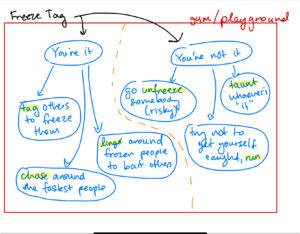
I chose Freeze Tag as my childhood game and drew a small possibility map for the two roles. The rules modify traditional tag by keeping a set of taggers/”it”, and the action of tagging is changed to freeze the runner in place instead of making them the new tagger. The players are either “it” or not, which informs the two branches of gameplay for each round of play. The goals are simply to tag someone, if you’re “it” and not get tagged if you’re not. The actions are to tag (if you’re “it) and run or unfreeze (if youre not). The simple nature of the goals and actions boils choices and strategy down to a couple simple choices for each side. The player who’s “it” may choose to lurk in an area or chase high priority targets. The runners may choose to get their fellow teammates unfrozen, or preserve themselves. The playspace being a confined playground forces encounters between the taggers and runners.
Game States for Two Games
For the real time game, I’ll analyze the offense of one possession of an NBA game.
Log:
- Tipoff happens, team A is able to hit the ball backwards towards their half of the court
- Player A1 grabs the ball and slowly dribbles down to mid court while his 4 teammates rush forward to team B’s side.
- Player A1 aggressively dribbles left and hands off to player A2 on the left side of the court.
- Player A2 and A3 exchange a couple of passes near the 3 point line of team B’s court.
- Player A2 dribbles into the paint and makes a jumping pass towards player A5 on the right edge.
- A5 finds a few dribbles while A2 repositions and hands A2 the ball.
- A2 finds a gap in the defense, shoots, and misses.
The sequence of events show how the rules inform how the offense is played. The players don’t blatantly run down the court with the ball in their hand and the defenders keep a distance instead of assaulting the attackers. When across the half court line, the attacker’s web of possibilities were to either pass to an open teammate, dribble inward, dribble outward, or take a shot. And all 5 players take choices that best optimize their chance of making the shot when they finally decide to shoot the ball.
For the turn-based game, I’ll use an example of the Scholar’s mate (which I observed by watching a beginnings chess coaching video from PogChamps). It is notated: 1.e4 e5 2.Bc4 (targeting f7) Nc6 3.Qh5 (adding another attacker to the f7-pawn) Nf6?? 4.Qxf7#. Or, as sentences:
- White moves a pawn to e4.
- Black moves a pawn to e5.
- White moves the light square bishop to c4.
- Black moves a knight to c6.
- White moves the queen to h5.
- Black, unknowing of the danger he is in, moves a knight to f6.
- White plays his queen to f7, for checkmate.
A short sequence like this showcases how the pieces interact with the rules to form a quick conclusion of the game. The rules about how pieces can capture each other is used by white to quickly mount two attackers on the weak f7 pawn (which is weak by the same rule, since only the king defends it). The space of possibility in chess is so large that most players are not able to consider every possibility. Instead, they can play off of known strategies, observe pressing threats on the board, or use heuristics to judge what is best. White played a well-known opening to trap beginners who aren’t well-versed in spotting threats against their weak points. Black used the heuristic of trying to develop their pieces, albeit incorrectly, to inform their decision to play the knights forward. White’s strategy was more concrete, and so they were able to win.
