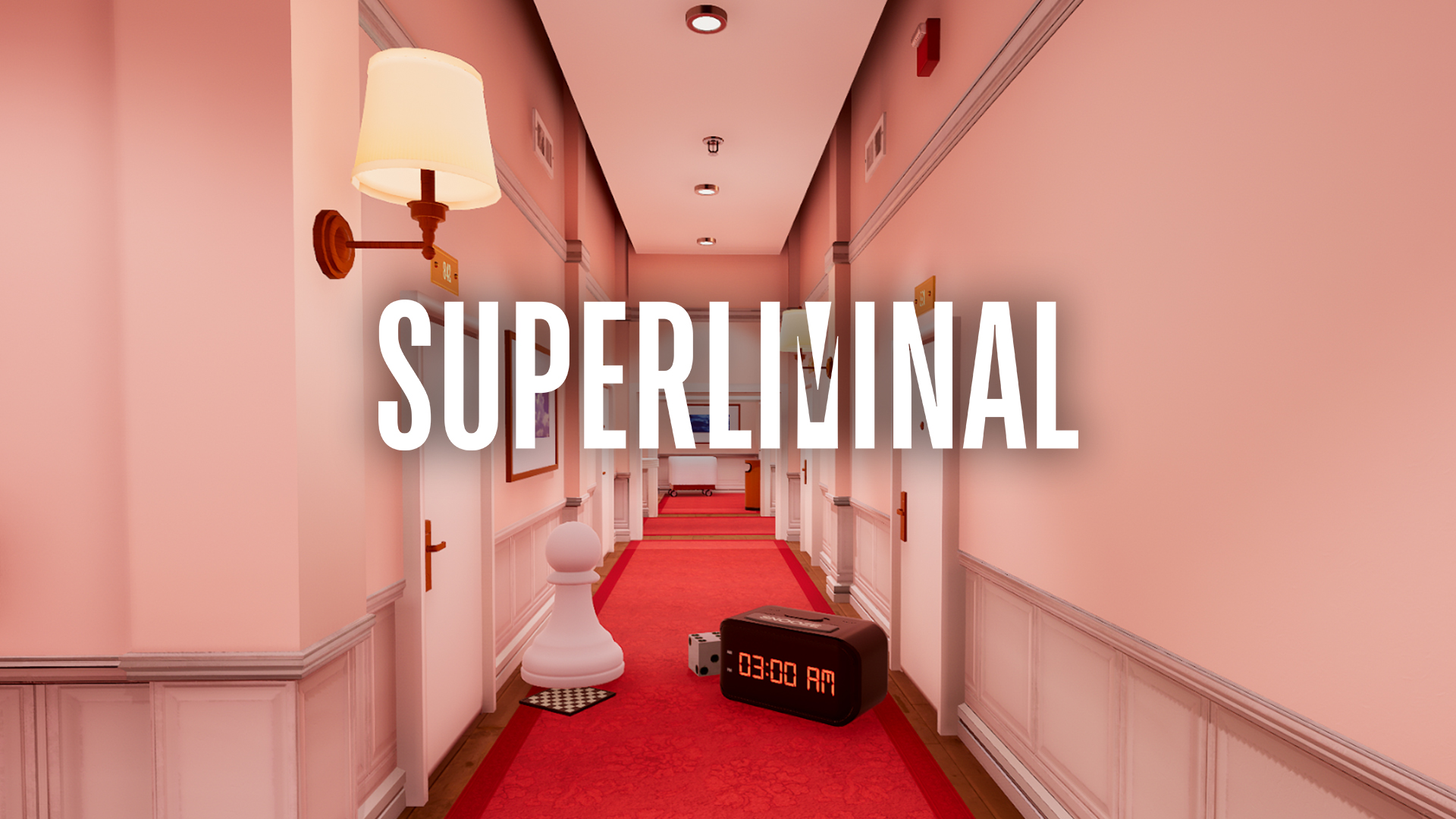
Superliminal is set in a dream world where your perception determines reality. The tools provided to you are your abilities to move, grab, and rotate objects. The puzzles within the game are mostly comprised of forced perspectives and optical illusions. In this game, the size of an object is whatever it looks like from where you’re standing. Pick up a tiny chess piece, walk it toward the camera until it fills your view, and it becomes room-sized when you set it down.
The game frames itself as a lucid-dreaming therapy program called Somnasculpt, guided by a calm, corporate voice that promises to help you “resolve your inner conflicts.” As you progress, the dream gets stranger and the setting gets more disturbing, until it’s clear the therapy itself has become a system that keeps you in the loop instead of helping you escape. With puzzles, the game doesn’t need a clearly written narration to demonstrate this, but instead let mechanics do it. Early puzzles would reward you for trusting instructions, like following arrows, whereas later puzzles breaks the pattern, forcing you to realize that the EXIT sign is just another object to be used, or that a room just loops back on itself and that the signs might not have any use at all. The player’s growing skepticism toward the world mirrors the protagonist’s growing skepticism toward the therapy program itself.
The puzzles do not act like obstacles in the way of the story; instead, it’s a tool used to give the players the perspective of the protagonist. In order to solve these puzzles, the player must go against the flow of what they’ve been taught through their real life; that scale, proportion, and “the way things are supposed to work” are just assumptions, not facts. The game is, structurally, a cognitive experiment put inside a funky optical puzzle.
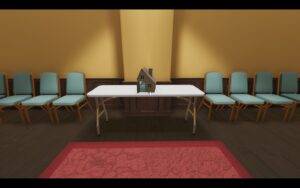
Perspective as a puzzle (it’s a tiny house, but only tiny from this angle)
So, here’s the question that we need to ponder: whose assumptions is the game actually breaking? Thinking puzzles like this only work if the player first holds the expectation that the puzzle is subverting, and that ‘normal’ expectation is never culturally neutral. Superliminal’s puzzles lean heavily on a specific visual symbols like exit signs, staplers, rotary phones, chess pieces, furniture, and English-based wordplay that relies on the language to hint at the answers. A player who didn’t grow up to recognize that particular office environment, or who isn’t a fluent English reader, loses access to several potential revelations entirely through no fault of their own. It’s not because they can’t think outside the box, but because the box they’re supposed to think outside of wasn’t the one they’d grown up in in the first place.
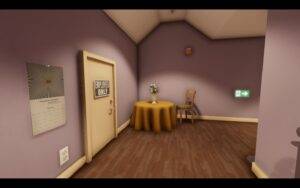
Office environment
And here’s another thing worth noting, though I believe it’s an inevitable byproduct of the very concept of the game: the disorienting scale shifts and trippy architecture are designed to induce a kind of vertigo, but that same design can possibly trigger real motion sickness or migraine symptoms in some players. It’s worth understanding that certain designs such as these can potentially gatekeep the experience by a bodily trait rather than a puzzle-solving one.
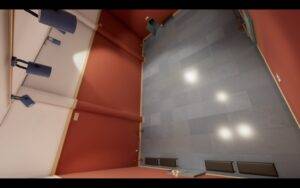
Motion sickness inducing scene
None of this is to say that Superliminal’s design choices are ‘wrong’. Every puzzle game has to assume some shared “box” so it has something for the player to think outside of, and Superliminal’s choice (American corporate self-help culture, the English language, mundane office space) is coherent and mostly self-consistent. However, it’s still important to recognize who that “normal” can exclude, because it narrows who gets to feel the game’s central insight. A designer’s assumptions about what counts as “common sense” are also assumptions about whose common sense counts. Even if the game’s argument is that assumptions and pre-existing expectations deserve scrutiny, that doesn’t mean that the game itself is immune to the same thing.