This is the first time I have played puzzle games, but I found this genre extremely fascinating. Typically, these games don’t have many words or lengthy explanations/prompts for players. Players need to figure out the hidden story by using visual clues or following hints on the map. Also, I have found that this type of game usually has unique and beautifully crafted concepts that are abstract, even religious or philosophical at times. It can express many concepts and thoughts that the creator wants to convey through basic game mechanics and aesthetics. For example, the game that I played was called Tengami Origami. It was designed by the British indie studio Nyamyam, founded in 2010 by Jennifer Schneidereit. Jennifer is a game designer, programmer, and creative director of Nyamyam. The game was developed with touch controls in mind and launched on iOS, but is also available on Wii U, PC, and Mac. The primary target audience is players who enjoy game aesthetics (hand-drawn art/very meditation-style music), storytelling with cultural aspects, and quiet problem-solving through observations, discovery, and independent thinking rather than team play or speed races. The narrative in Tengami was mostly woven into the game through its Japanese pop-up books-inspired paper-folding mechanics. The entire game is basically a massive pop-up book. Pop-up books are very interactive. And, unlike usual books, pop-up books bring a 2D world to 3D, which means it can be played, interacted with, and viewed in three dimensions. This unique form gives the game a very different dynamic, as players can now have multiple options at a single standpoint and can interact with one location in the game with a couple of possible solutions.
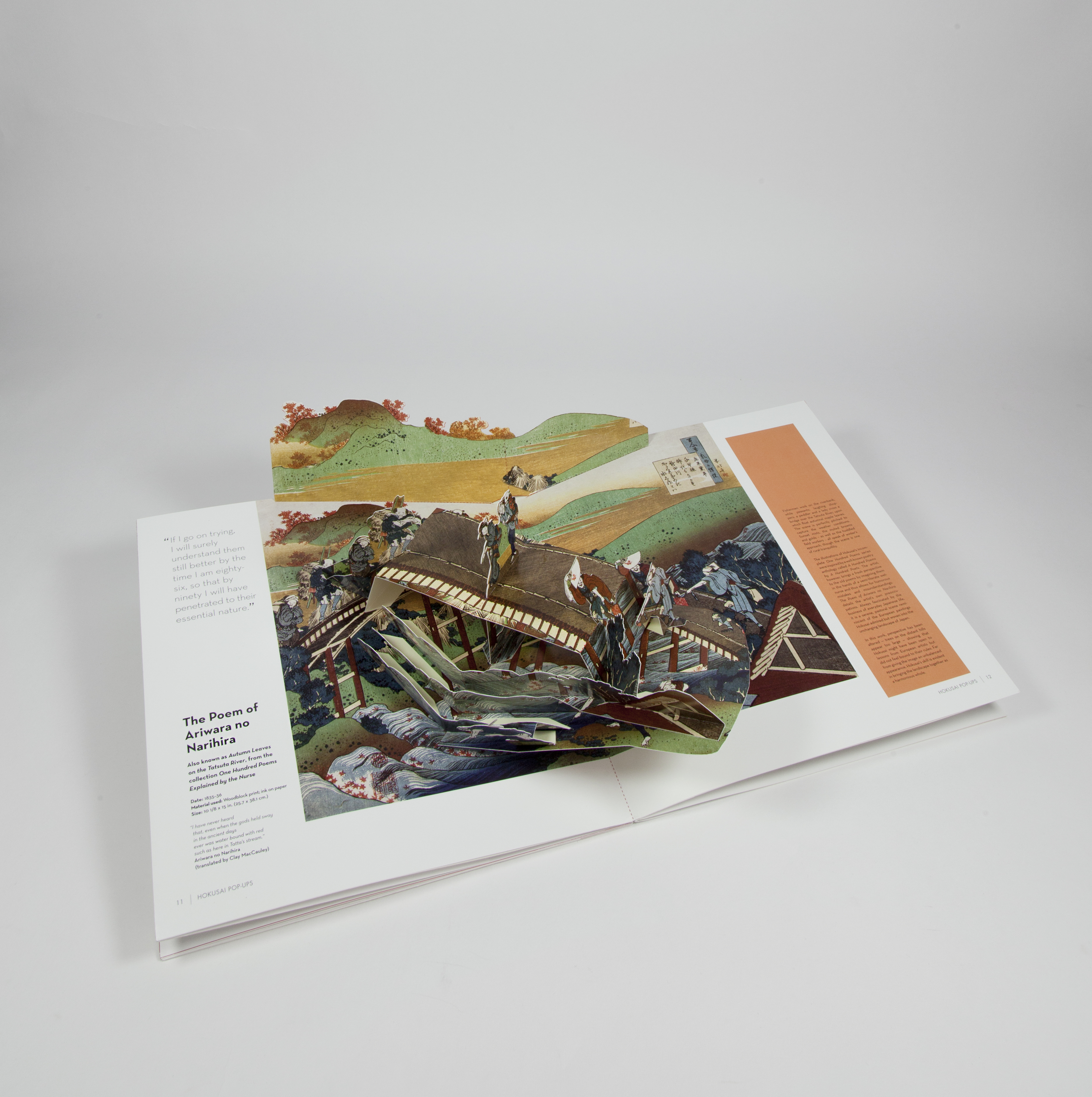
Example of a pop-up book
The mechanics are copied through the origami folding technique, which I felt was very intuitive because it uses people’s familiarity with paper. The game made obvious what kind of interactions were possible. This design also allows for a sense of immersion and playfulness, possibly because most of us have experienced pop-up books during our childhood. When I played the game, I felt like I was the origami master, folding these papers and creating a storyline through it.
The central game mechanic of Tengami is easy to understand. It is quite a clever design. Basically, this is a story of a Japanese warrior who goes on a journey of discovery and reaches Nirvana in the end (inspired by Buddhism). You navigate through a paper landscape and solve simple puzzles by flipping and folding parts of the world, like turning pages, triggering pop-ups, and sliding or pushing paper pieces. The flipping and folding can give you different options for the route and environment settings (e.g., changing the season from fall/winter/summer; on water, land, or in a cave), or zooming in/out on the same building, like a pagoda. When you explore, however, you cannot change your speed. You can only navigate at one speed.

Here you can fold/unfold the landscapes as you move through the map to get closer to or farther from a location.
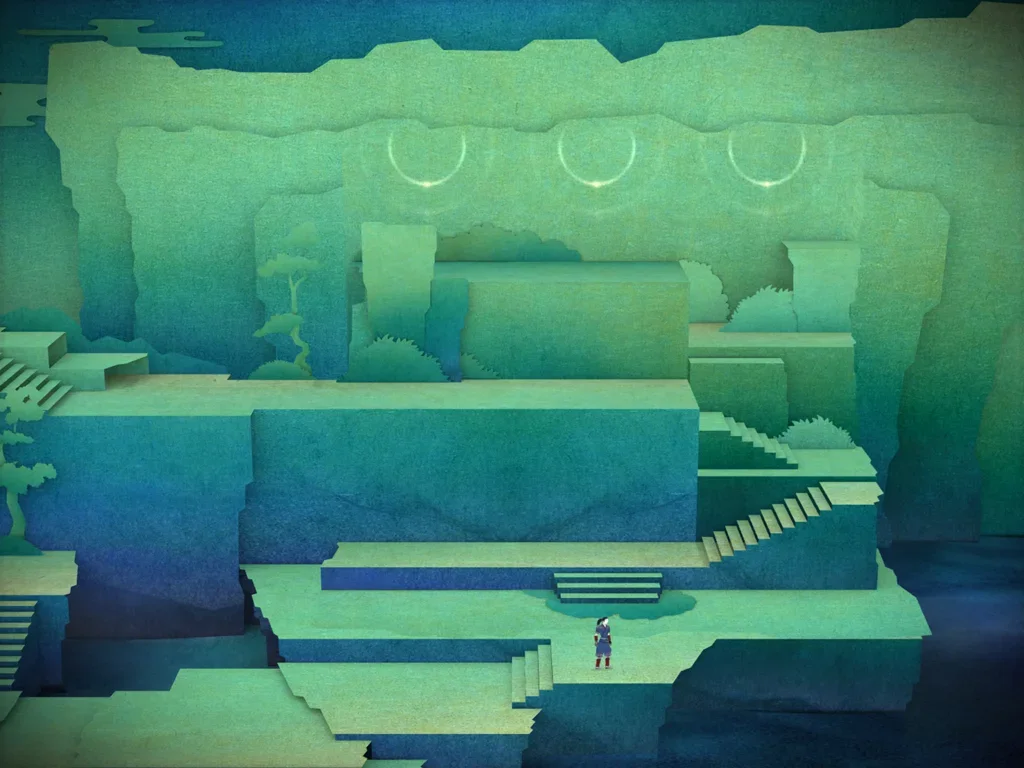
Here, you can drag down the lighted circles to explore different route options as you work to get to the top of the mountain.

Here you can click on the lighted circles to drag down that column to explore different options and make the riddles match left & right.
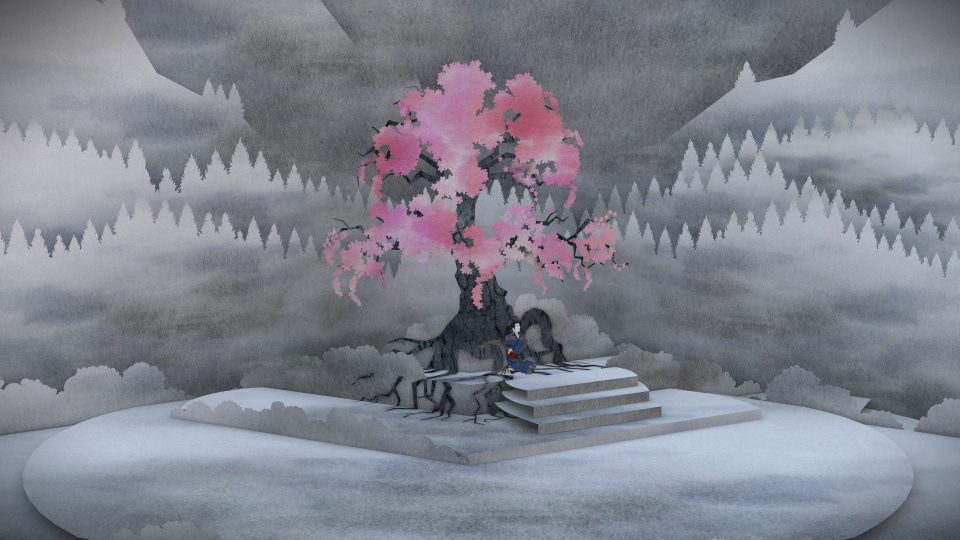
The “Cherry-Blossom” Tree. This tree represents your completion of the game. You need to complete four stages (collect four cherry blossom flowers) in four different settings to finish the game.
However, the game is different from the other game I played called Gorogoa. Gorogoa is a game about “frames”, as the player navigates through different frames by dragging the panels on screen to explore different layers of the picture and try to find hints in a “storybook”. As a result, Tengami is mostly focused on manipulating its environment in a physical sense, while Gorogoa is focused on visual connection and illusion.

Gorogoa moves through “frames” to uncover the story.
Aesthetic-wise, I have enjoyed Tengami mostly for its color/landscpae design and music. The music in this game is pretty soothing and has the Japanese characteristic to it. The game uses many traditional Japanese tones, including soft beige, light green, muted indigo, and gentle warm reds, which gives the world a delicate, handcrafted feeling.

Beautiful fall leaves

Traditional boat and the wooden fires
Ethically, I think the game has a few drawbacks.
First, when I first played the game, I had very few experiences with puzzle games. So I struggled with limited alternative solutions and unclear guidance, often relying on very short riddles or hints. The game gives you a few hints of where to go, but you have to figure out what you’ll need to do to move on to the next landscape by yourself. For example, in the beginning, I was confused about how to get downstairs of a pagoda and had to wander around for 20+ minutes before seeking guidance.
Second, the game is inspired by traditional Japanese culture. Developers assume that players already understand Japanese culture. For example, the riddles that I had to solve contain Chinese symbols. The “haiku” poems that the game gave you when you found the “cherry blossom” can be hard for foreigners to understand.

This is the final riddle/poem of the game. The game ended here.
The poem was actually called the Japanese death poems, known as Jisei. They are mostly written as a tanka (5-7-5-7-7 syllables) or a haiku (5-7-5 syllables).
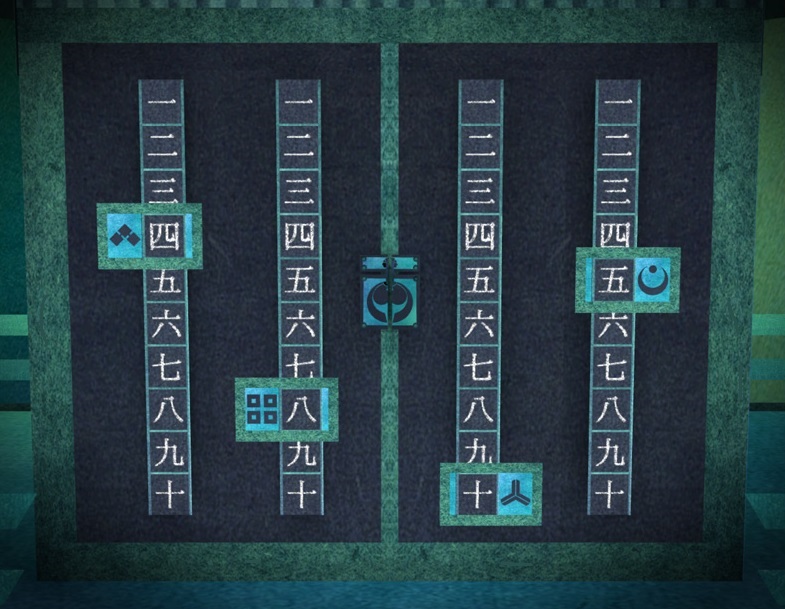
Chinese Symbols that raised many confusions
Overall, I think these ethical tensions have a little/mild effect on the game. While Tengami does not demand specialized cultural knowledge, its design still quietly privileges a certain kind of player, one who is already attuned to aesthetic and non-verbal forms of interaction. And this can limit how fully others are able to enter and enjoy its world.