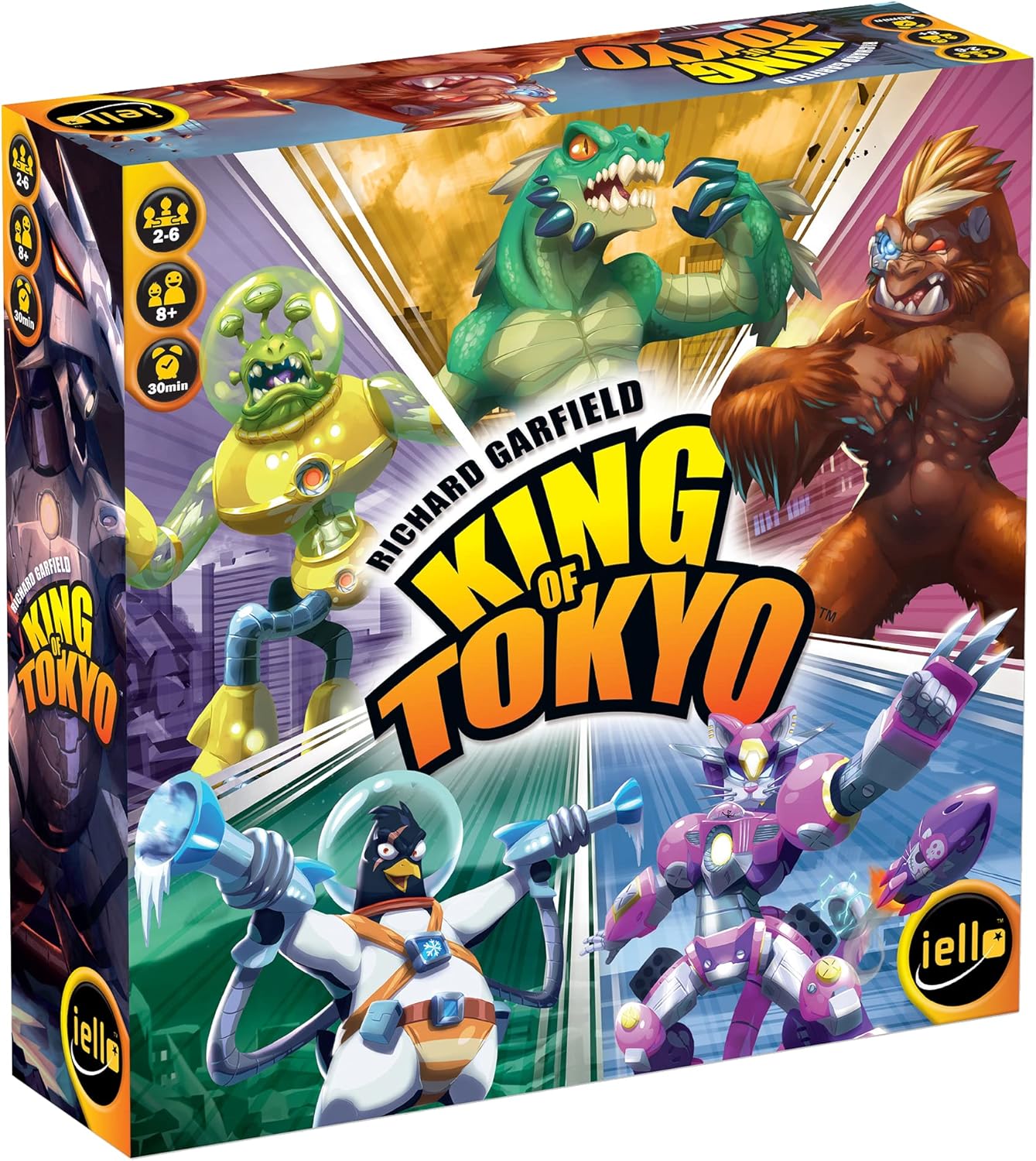
For this week’s Critical Play, I played King of Tokyo, an analog game published by IELLO and meant for 2-6 players. The game riffs on classic kaiju movies, and its cartoonish design and simple narrative suggest that its target audience is young people, particularly teenagers and young adults, who are old enough to make sense of its mechanics but who are still entertained by its art style and references. The game uses formal elements such as multilateral competition and the objective of defeating other players in combat to create a simple battle narrative. The game uses this narrative, as well as evocative designs and environments, to construct a world which the player cares about primarily because of the fun it creates through power, rather than because of any deeper emotional investment.
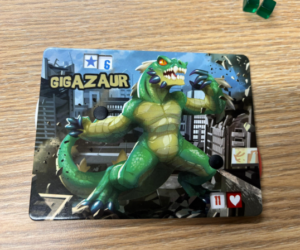
One of the most compelling aspects of the game is its use of evocative details to draw players into the magic circle and create investment in the game’s world. Consider the first image, which shows one of the cards that players use to visualize their monster and keep track of their health and score. The design here is eye-catching, full of evocative details like destroyed buildings and the monster’s reptilian eye. The design is clearly a riff on Godzilla but with a sillier name and a cartoonish art style that evokes the fun chaos of big, city-destroying kaiju battles. Evocative scenes like this, rich with embedded narrative elements, create an environment that is easily understood and helps immerse players in the monster battle royale that the game constructs. Another clever design decision was to give each player a depletable health meter, and to allow users to take health from other players based on how many “paw” icons they get in each turn’s die roll. This introduces a new objective to the game, in that players must keep their own health up while taking health away from other players, and I was reminded of other combat-focused card games, like Magic: The Gathering or Pokemon, although this game had the advantage of tying all of its details into a single, localized setting. This creates a dynamic in which players “fight” multilaterally in a vivid environment, creating fun through power and making the game’s world feel more realized and easier to connect with.
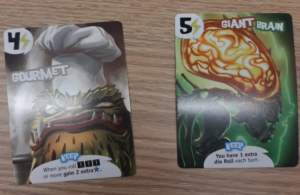
At the same time, the story being told is limited by these same formal and narrative elements, and it would be an exaggeration to say that the player is being made to “care about the world.” The objective of the game, for instance, is very simple: either score 20 points first or get the other players’ health meters down to 0. This makes it easy to approach the game and allows for greater appreciation of the environment, but it also limits the world’s scope and complexity, reducing the game to a simple story about monsters fighting each other and destroying cities. These limitations are exemplified by the mechanic of “Entering Tokyo,” which allows players to place their monster on a game board representing the city of Tokyo, shown in the second image. Despite the emphasis on Tokyo in the game’s name and rules, going there did not have many major consequences, other than a small boost in score. As a result, neither I nor the other player felt compelled to place our monsters there, which felt like a missed opportunity. Kaiju stories are at their most compelling when they emphasize the destruction these monsters wreak, and the way this destruction affects the population, but this element is absent from this game. Tokyo is a place that players can move their characters in and out of, but does not contain many enacted or embedded narrative elements in itself, and does not convey the sense of grandiosity or character that it could have. This is something that could be fixed through the card mechanic, introducing more cards that show the residents of the city and the events there, rather than the cool, but less narratively relevant monster-themed cards there are now, like the ones in the third image. This leaves us with a game that is mostly about cool-looking monsters establishing dominance by socking each other, which is fun, but lacks deeper enacted or embedded narrative elements that might create real concern about the world.
In terms of ethics, one clear concern is the aforementioned lack of narrative elements that depict how a large city like Tokyo (or New York, in another edition) would be affected by an Epic Monster Battle. We see on several of the monster cards that the monsters are destroying urban buildings, which are presumably occupied, but from the cards and environments that I saw, human beings are largely absent from the narrative. This is fine for the kind of simplified, cartoonish narrative this game is going for, but it is worth considering how these decisions might trivialize the violence inherent to this sort of story, and the implications about our ability to respond to disasters. After playing, I was left considering an alternate version of this game, one that engages more with the human cost of the players’ decision and showcases the consequences that the players’ actions have on the game’s world.