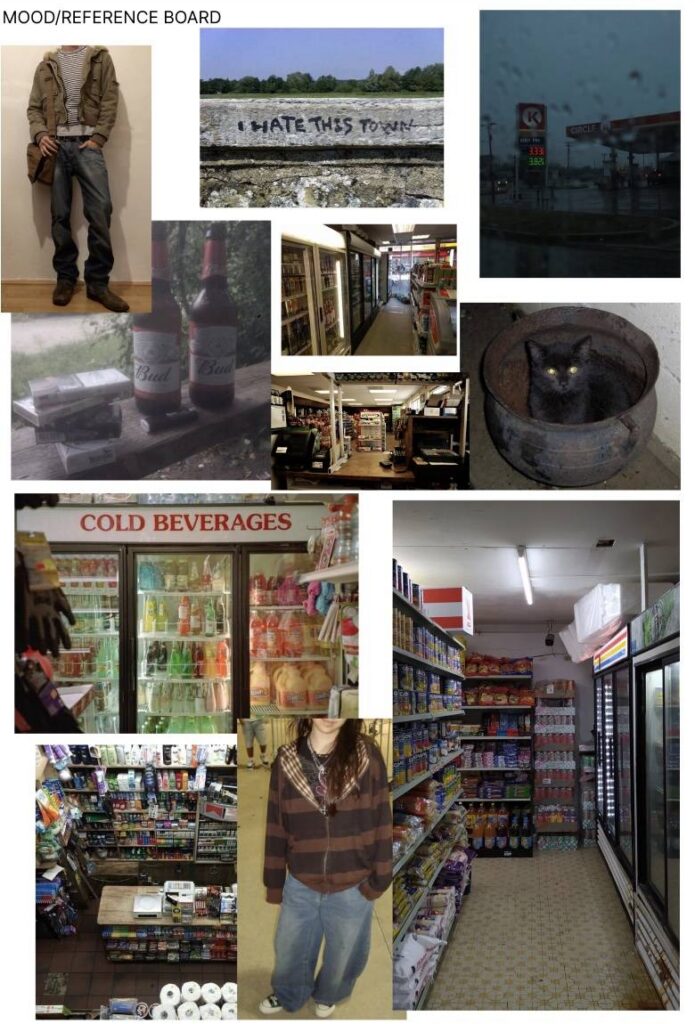
Moodboard
Directions
Based on our first playtest and my post-playtest ideation, I see three possible paths forward. Each direction prioritizes a different kind of fun and requires different narrative architecture.
Direction 1—Puzzle Potion (Discovery Focused)
The core fun is figuring out the right combination. Players are given a customer with a problem (e.g., “I can’t sleep,” “I’m blocked up,” “I want to be someone else”) and must deduce which three ingredients will solve it. Success is mechanical—the potion works, the customer is happy, the story progresses. Failure is soft—the customer says “What am I supposed to do with this?” and the player tries again.
Narrative Approach—Embedded narrative. The story is not told to the player; it is embedded in the ingredients, the customer dialogue, and the environment. Players discover the narrative by solving puzzles. This is closest to our current prototype.
Kinds of Fun—Discovery (finding the right combination), Challenge (deducing the solution), Fellowship (comparing notes with other players).
Risks—Players may feel like they’re guessing randomly. The “try again” mechanic could feel punishing if overused.
Direction 2—The Branching Narrative (Expression Focused)
In this direction, the core fun is shaping the story through your choices. There is no single “correct” potion. Instead, each combination of ingredients produces a different narrative outcome—some good, some bad, some weird, some funny. The game tracks your choices across multiple nights, and returning customers remember what you gave them last time. The Gorgon romance arc is one possible branch, but there are others.
(Where I see us most likely headed. This hybrid approach preserves the playful chaos of mixing anything, players seemed to love that in playtest, while ensuring that every meaningful combination advances the story in some way.)
Narrative Approach—Emergent narrative. The player’s actions create the story. The game provides a sandbox of ingredients and problems, but the specific shape of each playthrough emerges from player choice.
Kinds of Fun—Expression (shaping the story), Fantasy (being a potion-brewing clerk), Narrative (unfolding the Gorgon romance or other arcs).
Risks—Scope is lowkey enormous, lowkenuinely doable. Every ingredient combination would need a unique narrative outcome. We would need to dramatically reduce the ingredient pool or accept that many combinations lead to the same outcome (which risks player frustration). (Though I think we’ve already begun to troubleshoot this by doing some math in the back end for potions).
Direction 3—The Character Collector (Fellowship Focused)
Here the core fun is getting to know the customers. The potion-making is almost secondary—it’s a vehicle for spending time with weird, wonderful, deeply Midwestern characters. Each customer has multiple visits across the night. The first visit introduces them. The second visit deepens their story. The third visit resolves it (or doesn’t). The player’s goal is not to “win” but to see every customer’s full arc.
Narrative Approach—Evocative spaces + embedded narrative. The convenience store itself is the story space. The fluorescent lights, the hum of the cooler, the band next door—these create an atmosphere that makes every customer interaction feel loaded with meaning.
Kinds of Fun—Fellowship (bonding with characters), Narrative (unfolding arcs), Sensation (the vibes of the graveyard shift).
Risks—Potion-making becomes trivial. Players may feel like they’re just clicking through dialogue. We would need exceptionally strong writing and voice acting to carry this.
Spotify Playlist
Song Descriptions (to convince/tempt you to listen to my beautiful beautiful playlist)
“Pheromones” by Meth Wax is raunchy, sweaty, and very unashamed—the kind of song that knows exactly what it’s about and doesn’t apologize. This is the energy of the werewolf who can’t shit and the wizard who wants to embrace their inner fursona. The body is “gross”, the body is funny, the body is trying its best.
“I Fell in Love with Princess Peach” by Hot Mulligan captures yearning wrapped in a joke. It’s about something real—wanting to be chosen, wanting to matter—but the delivery is self-aware enough to wink at you. This is the clerk’s inner monologue: tired, a little bitter, but still hoping the next customer might be interesting.
“Scott Pilgrim vs. My GPA” by Mom Jeans is the anxiety of being a disappointment. The fear that you’re not doing enough, not being enough, and that everyone can tell. This is the 3 AM dread that creeps in between customers.
“c u in da ballpit” by Camping in Alaska feels like nostalgia for a version of yourself that maybe never existed. It’s messy, loud, and then suddenly quiet—the structure mirrors a customer interaction: chaotic arrival, strange confession, and then they’re gone and you’re alone with the hum of the lights.
“Fish Bowl” by Tiny Moving Parts is the feeling of being watched, of performing for an audience that isn’t there, of living your life in a glass box. This is the convenience store: the fluorescent lights, the security camera, the customer staring at you while you brew.
“Now THIS is Podracing” by Mom Jeans and Brond has a title that is a joke, but the song is not. This is the game in miniature: absurd on the surface, sincere at its core. A customer asks for a constipation potion. You brew it. They thank you. You pretend this is normal, cause it is in Plugs N’ Potions.