Henry Jenkins argues that the debate between ludology (games as systems of rules) and narratology (games as stories) is misplaced. Instead of choosing sides, he suggests that game designers should be seen as narrative architects (people who build the space where stories happen). He also suggests that games have a lot of narrative potential rather than linear plots.
There’s also a debate between the story and the system. Ludologists claim narrative analysis oversimplifies games, while narratologists see games as new storytelling media. Jenkins asks the questions “Are games stories” and “How do games create meaningful narrative experiences”. He says this to show that interactivity and narrative can coexist if we treat space and player movement as storytelling tools.
There’s 5 starting assumptions:
- Not all games are narratives (some are abstract and shouldn’t be forced into story frameworks)
- Many games borrow narrative elements (genres, settings, etc)
- Narrative analysis isn’t perspective
- Gameplay differs from storytelling (player choice, feedback and mechanics shape the experience)
- Games tell stories differently
Space is central to narrative games, which show meaning through design. A player explores and reconstructs story fragments through movement and observation. There’s four ways games integrate narrative and space:
- Evocative spaces (environments that reference familiar stories or genres)
- Enacting stories (players perform story events through action within space)
- Embedded narratives (story clues placed in the environment for players to discover)
- Emergent narratives (stories generated by systems and player interactions, as in The Sims)
Another thing is that even without full plots, games create micronarratives (brief, emotional events or surprises)
Even without full plots, games create micronarratives—brief, emotional events or surprises. These “memorable moments” anchor the player’s journey and provide rhythm. Designers use visual cues, pacing, and environmental changes to trigger curiosity or empathy, giving structure to otherwise open experiences.
Conclusion: Jenkins concludes that game designers are storytellers through space. By shaping environments, affordances, and interactions, they create conditions for narrative discovery. Good design doesn’t dictate a story. Rather it invites players to build one through exploration, action, and imagination.
I chose to play the game Coming Out Simulator, which was created by Nicky Case. The platform is on browser and playable through itch.io and the developers site. The target audience is primarily LGBTQ+ players and allies, educators, and others interested in personal and empathy driven narratives (suitable for a general young-adult audience). The playtime is roughly 45 minutes to 1.5 hours, and the link is here:
https://ncase.itch.io/coming-out-simulator-2014
Summary: the game is a semi-autobiographical “half truths half lies”. You play a character Nicky through a night of conversations (with a boyfriend and hyperconservative parents) where every line you chose can be remembered and rephrased later. The tension comes from different ways of saying things (you can choose between truth, lie, and a combination of both). Later in the game, you confront the consequences when people recall your earlier words. The interface emulates modern chat/text exchanges and a tight point-and-click flow, keeping focus on dialogue and tone rather than exploration or puzzles.
The 4 E’s and how they shape the aesthetics:
- Enactment. The narrative is done through your dialogue choices. The design uses small, granular choices so that the actual speaking becomes the main verb. In later scenes, you reference the early picks (often learning you to own up to your inconsistencies). The aesthetic that emerges is emotional realism: anxiety, anticipation, and the uneasy hope that comes from trying to say the right thing in a fraught moment.
- Engagement. The UI is lean: a messenger-style interface, spare backgrounds, and readable text. The focus of text bubbles and notifications creates a social-presence aesthetic. You feel like you’re live-texting, not reading a script, which makes the game very engaging. The lack of other mechanics (no inventory or no map) concentrates engagement on the text and selection.

- Embodiment. The embodiment here is psychological rather than spatial; you occupy Nicky’s perspective under pressure. The player’s body is basically the cursor over lines of dialogue, but that minimal embodiment is powerful because people “remember everything you say.” The game achieves a “what you say is what you do aesthetic”, where embodiment equals accountability. In other words, you are the pattern of what you’ve said and how it’s been received.
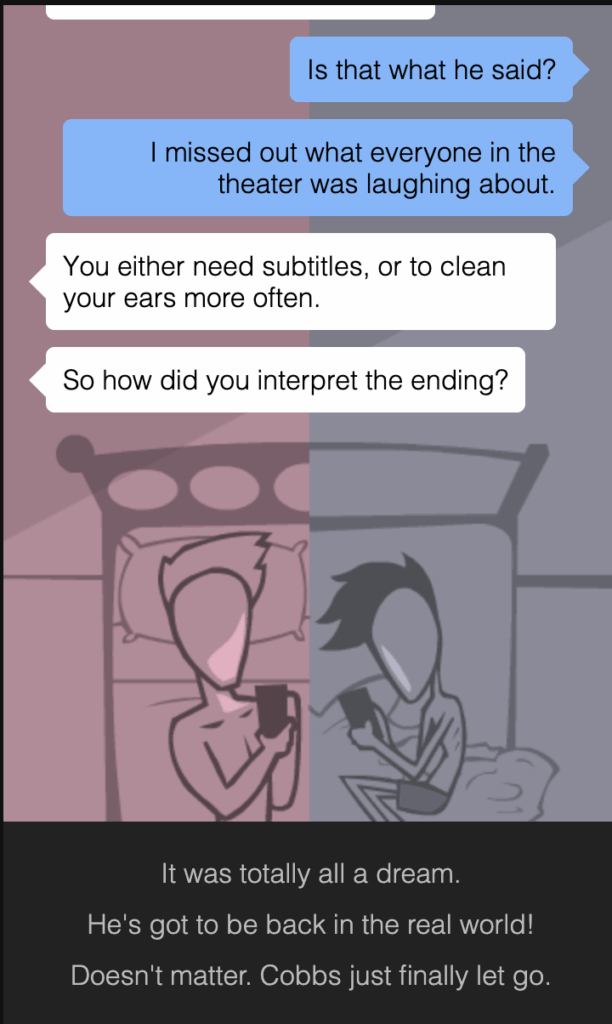
- Empathy. Empathy comes from fragility and friction since there’s no “optimal” branch that deterministically solves coming out. Multiple endings and epilogue notes foreground unpredictable aftermaths rather than set goals or “victories” (like other games). Also since we’re so involved, the intimate and vulnerable underscores the aesthetic of earned empathy.
Sub-genres: this game is at the intersection of choice based IF and visual novel-style conversation. It allows the following:
- Branching Dialogue as Core Mechanic: Branches mainly modulate tone/timing and consequence rather than showing longer paths. This keeps scope small but very meaning dense
- Conversation Memory: The “everyone remembers” rule allows subtle callbacks, which gives the game the same feelings that real social interactions do. Although mechanically its simple flags, aesthetically it’s a mix of trust and credibility.
- Low-Friction Access: Browser play and public code lower barriers to entry and enable classroom/club contexts, which allows more people to play the game thus strengthening its identity as a shareable empathy artifact.
What I’d borrow in my own writing
- Micro stakes with macro-impact relationship. I LOVED THIS!! Small tonal variations can really meaningfully change scenes later, so I’d use this tight feedback style to keep short IF emotionally resonant.
- Honest epilogues: the game’s end shows that real life isn’t a clean path/neat arc. We can get players to reflect after the game to validate their feelings without moralizing.
- Simple screenshotting the clean UI and readable chunks make quotable panels. I would structure my scenes with one “screenshotable moments” to really support the reflection and sharing steps
What I’d add:
- Some branches feel like they re-converge quickly. I’d explore a few mid-game hinge scenes where dialogue memories reconfigure the scene’s goal.
- I’d try to add 1-2 non-dialogue verbs and experiment with this. For instance wait, leave unread, etc to lead to silence and delay (this could change the game dynamics.
Empathy is primarily cultivated for queer youth negotiating truth, safely and (most importantly) love under conservative family norms. This game spotlights the stress and anxiety people face from being misread, saying half-truths, and the domino effects across relationships. Empathy is actually achieved in a few ways. Dialogue choices that are remembered create empathetic tension since we both feel the impulse to speak and the fear or repercussion. Also, the “semi-autobiographical” framing and developer commentary by the creator set expectations for an emotional truth feeling, inviting the player to watch rather than judge. Also the vibe was more of an understanding-based system rather than a “fix-it” approach.

I think this was incredibly successful since the overall design avoids the right answer morality. Instead by centering memory, tone, and family power, it models how tiny linguistic pivots can carry heavyweight outcomes. Very nicely done.