Paperbark is a walking simulator developed by Paper House (Ryan Boulton, Nina Bennett, Terry Burdak) about a sleepy wombat wandering the Australian bush and encountering various flora and fauna. The game is appropriate for players of all ages, rendered and narrated in a manner reminiscent of children’s books.

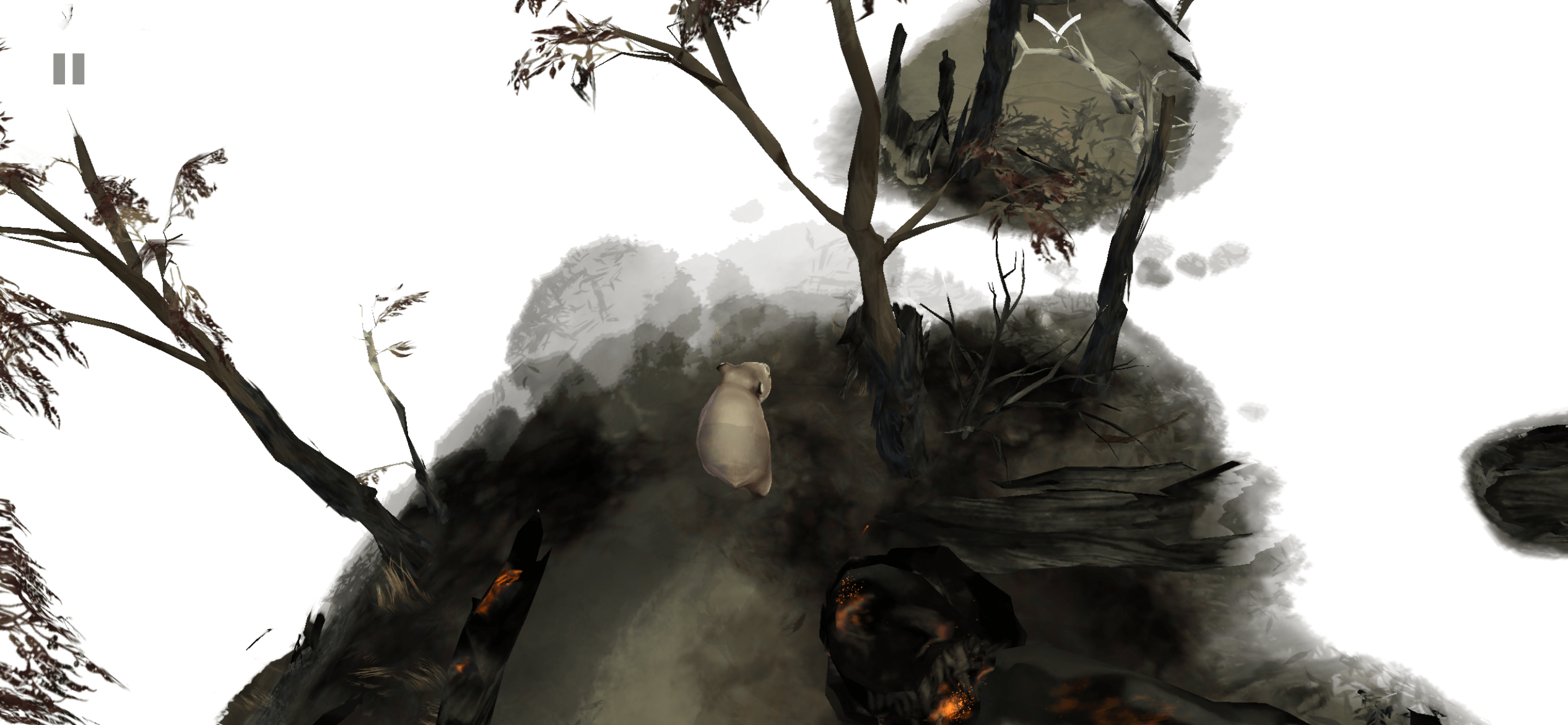
In this game, players tap on the screen to direct the wombat’s movement. But walking in this game is not simply walking—the wombat must climb across tree trucks, through branches, and over rocks, tasks that are made possible only by tapping on the screen multiple times in a row. A key element of this game is the fact that the player cannot view the entire landscape at once—the periphery of the screen is often blank, made visible only when the player swipes their finger back and forth over the area (see above). Even after the landscape is revealed, it will return to white unless the player swipes over it again. This makes traversing the landscape a more engaging physical exercise—the player must swipe and tap, swipe and tap. This motion is almost reminiscent of the chaotic scrambling one must perform to get through forest brush, hacking at branches, peering past leaves, and generally embracing the slight disorientation of being out in the wild.
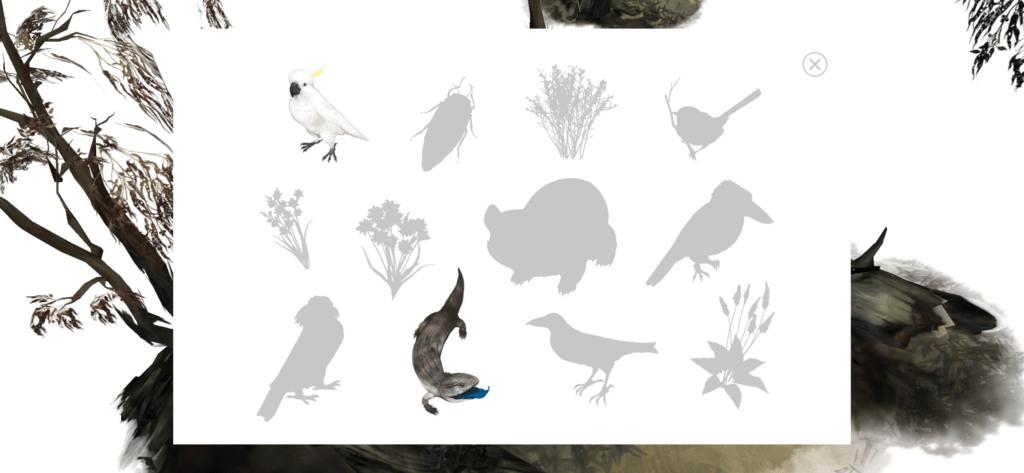
Although Paperbark is set up as an exploratory walking sim, it also follows an overarching plot. It takes us through the wombat’s origins in “The Paperbark Tree,” (Chapter I) then its habitat (“The Wetlands,” Chapter II), its cohabitants in its ecosystem (“The River Birds,” Chapter III), and environmental events such as “The Bushfire” (Chapter IV) and the aftermath of the fire (“The CoolChange,” Chapter V). These chapters are accompanied with picture book-like, succinct captions. These narrative elements, combined with the sensorial swipe-and-tap mentioned above, ensures that the player walks “in the shoes” of the wombat as it encounters various characters and plot events, allowing them to fulfill the fantasy and discovery game aesthetics. A “collection” mechanism (pictured below) encourages the player to take note of the various other tenants of the land—that is, to be in fellowship with the butterflies, beetles, and flowers that also make up the Australian bush—whilst the background sounds—the cinematic music that changes to accompany the tone of each chapter, the rustling of the brush and the crackling of bark and leaves underfoot, the chirping of birds—function as a mechanism that build up into a rich sensorial experience. These mechanisms aren’t perfect—the collection mechanism, in particular, is a little confusing. Some collected elements, e.g. purple flowers, carry over from one chapter into the next, while others are erased and replaced, with no indication of what happened to the collected items. Moreover, these items are unnamed (see below)—without identification of the various other inhabitants of the brush, the game falls short of its educational potential.
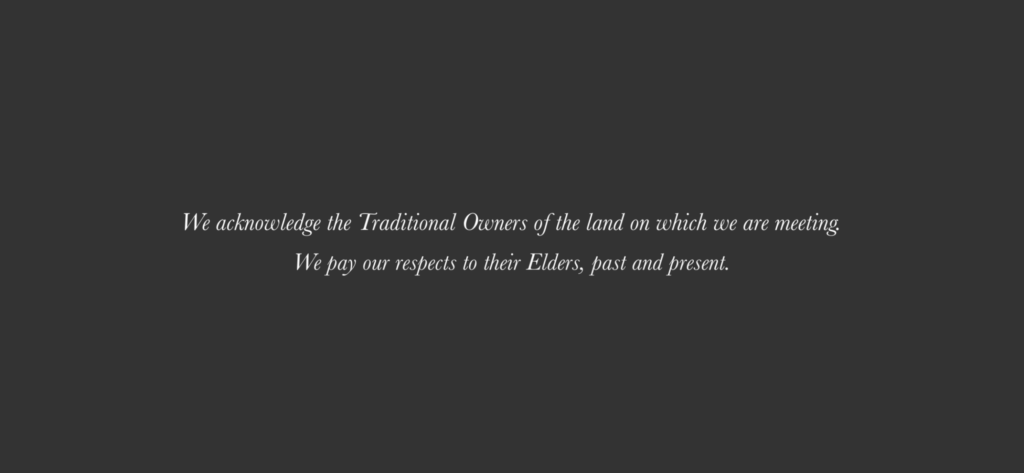
Two ethical considerations of the game include its land acknowledgement—“We acknowledge the Traditional Owners of the land on which we are meeting. We pay respect to their Elders, past and present,” as shown below—and its engagement with the bushfire chapter. The former raises questions of efficacy—while some might see any sort of a land acknowledgment as better than none, it is worth asking whether an acknowledgment is effective if indigenous peoples are referred to as “Traditional Owners,” a title that conceives of land as property to be owned rather than a living entity to exist in symbiosis with, or a relationship to tend to. This couching of rights in capitalist terms seems rather antithetical to indigenous values, although we might never be able to verify exactly what those values are because the exact “Owners” are not named—rendering them ultimately invisible. With reference to the latter ethical issue, the bushfire, the game fails to contextualize it in any positive or negative terms. It is unclear whether this is a natural bushfire, beneficial for the ecosystem in its rejuvenation of new growth, or whether this is a bushfire that has arisen from climate change. Without this necessary context, players are unable to determine for themselves the broader stakes, although the personal stakes are heightened by tenser, more dramatic music, narration describing danger to the wombat, and a landscape glowing red and grey with smoke (see below).