(Hi, this may contain spoilers! Also, shoutout to Eric for letting me borrow his computer so I could playtest and for being one of the last Windows users standing! Thanks Eric!)
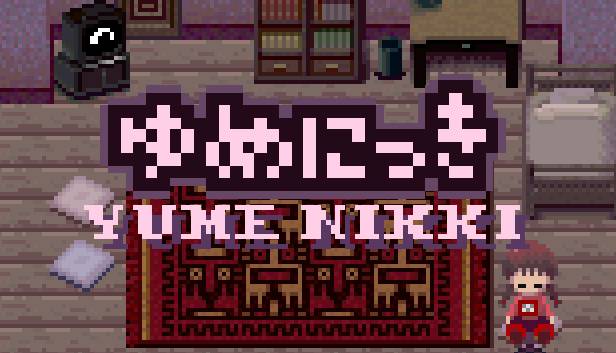
This week, I playtested Yume Nikki, a somewhat surrealist, somewhat dark (especially after I searched up the ending!) indie game created in 2004 by Japanese developer Kikiyama. The game was first released on Japanese forum 2channel, but was released on Steam in January 2018. (I used Steam, but used a friend’s Windows laptop to playtest, as a Mac user. The game sadly does not seem to be supported on Mac.) The player plays as a girl named Madotsuki, explores her dreams by walking, and is able to collect “Effects” from the dreams that she can equip to change her appearance. Although there is not an explicit age rating or target audience listed, it might be important to note that there is an unsettling atmosphere, dark motifs in a few of the dreams, and suicide if you reach the ending, so it seems that it may be better for a more mature audience who might appreciate a bit of psychological horror or an eerie atmosphere.
Yume Nikki’s mechanic of walking ultimately contributes to its dynamic of an unsettling and surreal atmosphere, main aesthetics— primarily discovery, as well as narrative.
In terms of design, although it was deeply frustrating at first, Yume Nikki’s very vague instructions also lend itself well to the game. (For a whole thirty embarrassing minutes, I was simply walking around and exploring the room in the real world, not knowing that it was the ‘real world’ or that I had to interact with the bed to sleep and transport to the ‘dream world.’ There is even a random mini game that you can access and play in the ‘real world,’ which contributes nothing to the ending.) Because the Tutorial is very brief and there is seemingly no objective, players are expected to wander aimlessly, and perhaps try to find the ‘Effects’ mentioned in the Tutorial. The vague Tutorial seemed like a design flaw to me at first, but ended up being clever, as it contributed to the overall aesthetic. The vague instructions and simple mechanics of walking and ‘interacting’ effectively encourages the player to “test.” Yume Nikki consequently exemplifies an embedded narrative that must be uncovered by discovery (“MDA”, “Narrative Architecture”).
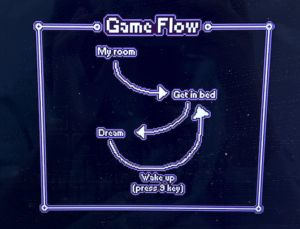
Figure 1: A very vague Game Flow that finally made sense to me, thirty minutes later
As someone who has much trouble with real-world directions and sense of space (as a junior, I still have to pull out Google Maps for directions on campus sometimes), Yume Nikki’s seemingly never-ending dream maps, as well as its many twists and turns were almost dizzying to me. If Madotsuki walked through a hallway or a door, the screen would fade briefly before allowing her to walk again, which led to a feeling of suspense. Additionally, some passages did not move along with the character, but rather stayed stationary as she crossed it, leading to a strange change of pace, which seemed to be clever design choices.
Although there are only twelve doors leading to dream rooms, the doors themselves led to various different rooms and passages, which potentially led again to other passages. The main rooms typically seemed to be infinite, however. Because of the constant walking set at a somewhat slow pace, especially through often unsettling areas, passing by bizarre graphics and NPCs, the player is forced to take in the strangeness of it all. Walking is the only thing a player can really do in the game besides equipping Effects and ‘interacting’ with NPCs (which is written in quotes, since you cannot speak to them.) As a result, the player simply wanders through the dreams, gets lost in passageways, or randomly encounters slightly disturbing and strange graphics, NPCs, or rooms, contributing to the unsettling atmosphere. There were also slightly less hallucinogenic and disturbing rooms (I particularly liked the one with snow as well as the one where I found the Umbrella Effect), but those two seemed to be the only ones that were relatively peaceful, and those rooms also potentially led to darker rooms, too.
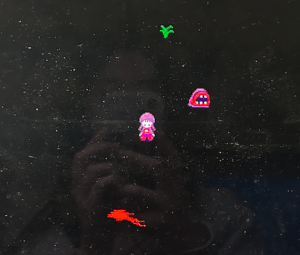
Figure 2: I said ‘Oh!’ aloud when I encountered this after walking aimlessly around this room. Interacting with one of the mouths gave me the Long Hair Effect, though.
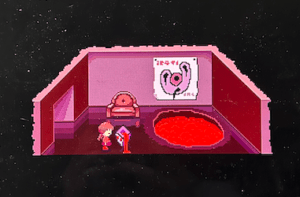
Figure 3: This was a (to me) very, very creepy room that gave me no Effects even after interacting (I also tried sitting in the chair.)
Ultimately, because the game is entirely exploration-based with a surrealist layer of hallucinogenic dreams on top of it, it is difficult to predict what will happen if a player chooses an action and like in embedded narratives, the user must “test” (“Narrative Architecture”). The ending (which I had to search up) is only revealed after the player fully explores the dream worlds by collecting all of the Effects and continues to “test” what they’re able to do, following a vague hint from the Tutorial that you can “drop Effects” in the “door room.” When the player uses an Effect in the room, the Effect is dropped from the player’s inventory. The player also must continue to test, by first pinching themselves, then walking, again, onto the balcony, where a set of stairs has appeared. If the player interacts with the stairs, Matsudoki simply walks off of it, and the screen fades to black with a splotch of blood (the same splotch that is used in some of the dream scenes.)
The game’s ending (although interpretable in different ways), also seemed a bit meta to me; one interpretation is that Madotsuki, after fully exploring the dream world, feels hopeless that there is nothing else to explore (on top of her probable sense of isolation), and thus the game ends as she commits suicide. Upon walking through the entire game, there is also no point of the player continuing playing, in a way. Walking, and so, exploring, is such a vital aspect of the game.
Nicole Clark’s article “A brief history of the “walking simulator” cites the game Oxenfree as an example, as its real-time dialogue and walking might make players stop and consider their actions. Similarly, Yume Nikki seems to gain much of its atmosphere from wandering aimlessly through dreams, not knowing where you are or where you’re going, and not being exactly sure of the objective.
Thus, through Yume Nikki’s simple mechanic of walking, there is a sense of anxiety and isolation; the map is very big, NPCs do not speak to you (and are often quite unsettling), and you are always walking through surreal and eerie places. Walking also allows for exploration, which uncovers the embedded, dark narrative.
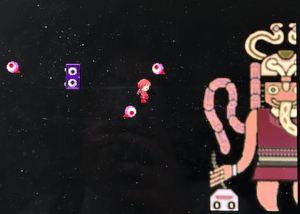
Figure 4: More unsettling design choices to wander through via walking
The role-playing game we played in section, Honey Heist, allowed for violence, but it wasn’t necessarily encouraged, or even suggested. It depended largely on the players to decide whether violence should be a means to reach the objective, whereas violence in Yume Nikki is more embedded in the game; for example, there is a corpse who had been presumably been run over in a traffic accident where the player collects a certain Effect, and the ending is also certainly startling. There is also potential violence inflicted on others; for example, one of the Effects that Madotsuki can collect (and must collect to reach the ending) is a knife. Although like Honey Heist, actually using the knife to harm others is not necessary to reach the ending, Madotsuki is supposedly able to do so (during my playthrough, I did not reach this Effect, but according to sources online, wielding the knife will cause NPCs to run away from Madotsuki, and Madotsuki can also use the knife to harm NPCs, and NPCs will react in different ways when harmed.) Unlike Honey Heist, however, whose rules are upfront, Yume Nikki is vague and encourages exploration, which can lead to unintentional violence. It is easy to imagine how a player might think that harming or killing an NPC with the Knife Effect might lead to some Effect or ending.
During my playtest, for example, I was lost in one of the doors, and encountered several long monster-looking creatures, and attempted to interact with them, since that is how I gained the Snow Woman Effect (by interacting with an NPC ‘Snow Woman.’) However, instead of gaining an effect, I seemed to hurt them, even without having the Knife Effect; pressing the button in front of them caused an expression of pain to appear on their faces before reverting back. Even though I hurt the first, I still went on and tried pressing some of the others, since the game is built on discovery and clues from past Effects gained. I ultimately hurt three, figuring that one of them might drop an Effect, before abandoning my search. Perhaps most drastic is the violence inflicted on Madotsuki, the player, herself, which— unless the player has seen spoilers, or guesses correctly what the stairs are for— is also completely unexpected, unintentional, and irreversible.
It is, as a result, interesting to consider the unsettling nature of unintended violence in Yume Nikki; a user’s innocent testing and following the game’s own structure can lead to violent and unintended (and in the case of the ending, horrifying) results.