
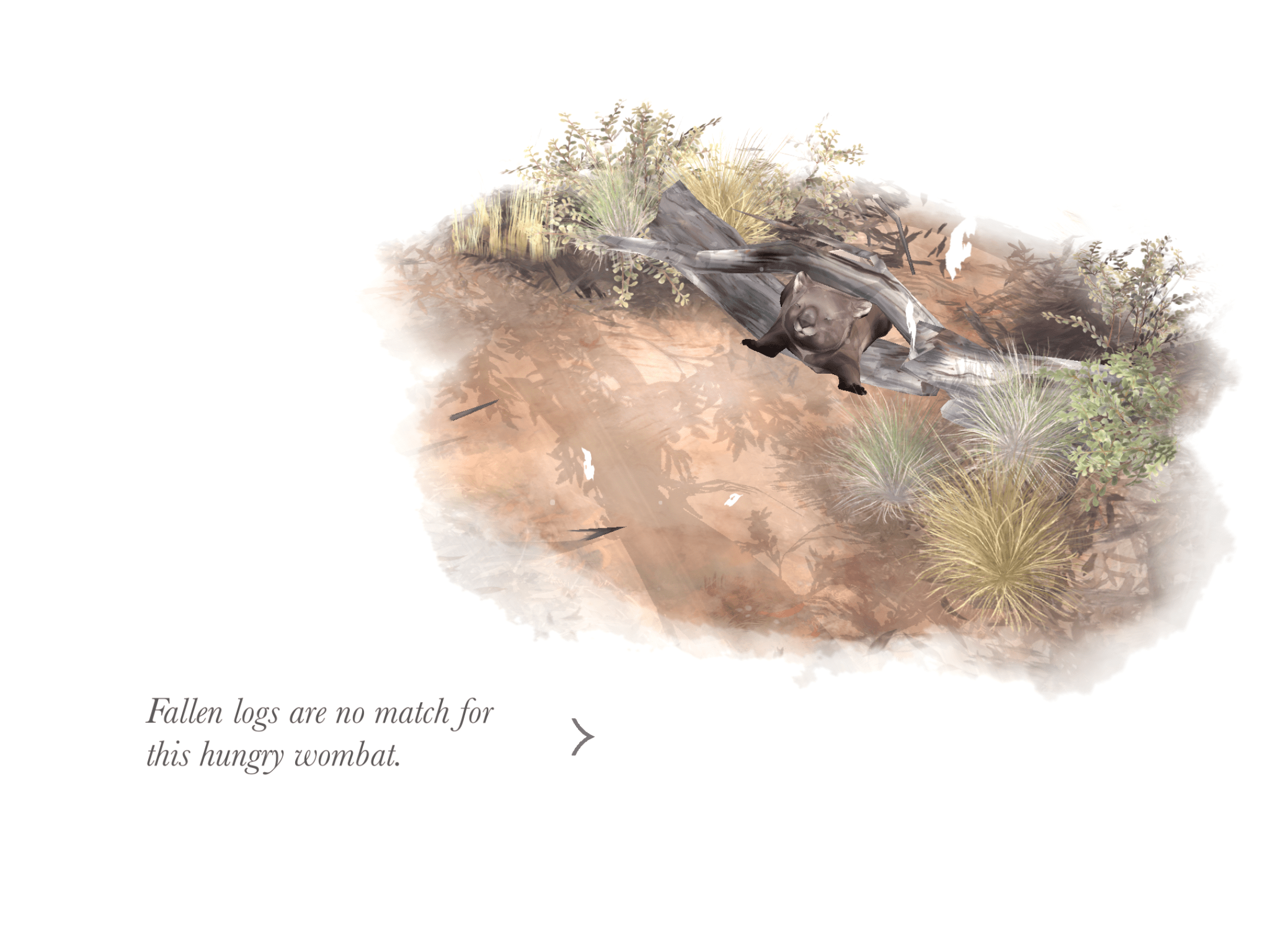
I played Paperbark, a walking simulator game following the perspective of a sleepy wombat who walks through a journey of finding food, finding shelter during a wildfire, and ultimately finding safety on the front porch of a human’s home. This game is for players ages 4+ and played on an iPhone, iPad, iPod Touch, or the Apple Vision mixed reality headset. It was created by Nina Bennett, Ryan Boulton, Terry Burdak and many others who contributed to the narrative, music, animation, and art (Paper House Pty Ltd.). The game was developed by Paper House Pty Ltd.
Paperbark allows players to walk in the footsteps of an adorable and sleepy wombat who experiences the stories of the different seasons – with the climax being the summer wildfires. Paperbark focuses on the narrative by targeting the sensation and discovery aesthetics through dynamics of immersive curiosity and intentionally slower pacing (Hunicke, Robin, Marc LeBlanc, and Robert Zubek). These dynamics are supported by its mechanics in single-click movements, hidden environmental visibility, interactions with other characters, and forgiving tasks of finding animals, plants, and bugs (Hunicke, Robin, Marc LeBlanc, and Robert Zubek).
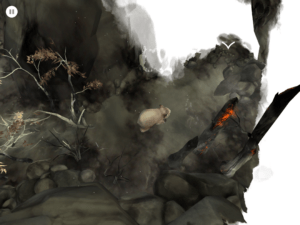
The game’s novel uses of “fog” or “smoke” creates an adaptable setting that integrates a story through calm springs, fiery summers, and cooling rainfall. With a low learning curve, novice gamers focus on the narrative over skill. Directly targeting their audience of age 4+, using simple actions like swiping to uncover smoky areas moves the plot forward.

Other simple actions include guiding and feeding the wombat with repeated taps – without fear of dangers like falling off cliffs. This addresses the no-death requirement for walking sims (Clark, Nicole). Additionally, each narrative chapter asks players to find a set of items while exploring the world. Finding the items was perhaps the hardest since many were well-camouflaged. However, this did not hinder the story because the game’s lenient design allowed players to advance in the story even with missing items.

The creators used natural “walls” like stones or logs to gently nudge players in the right direction. Similarly, creators used pawprints to guide players towards the intended direction. With these single-action inputs and artifacts, players solely focused on the narrative.

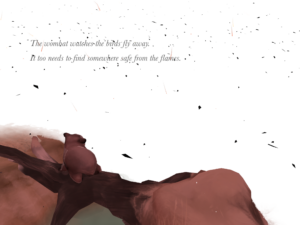
Although the theme of this explorative game is gentle, Paperbark utilizes other wild animals and environmental factors to foreshadow the wildfire – creating the sensation of urgency and building towards a climax. The narrative not only communicates the perspective and fears of the wombat, but it also directs the users on what exactly they should find in order to keep the wombat safe.

One aspect that this game could improve on, is shifting more agency to the player by embedding decision-making within the environment and interactions with wildlife. There seems to be no lasting consequences for any player decisions aside from the discomfort in hearing the buzzing flies each time the wombat walks through a pile of manure. On the other hand, lasting consequences like death of the birds may be too extreme for a game rated for ages 4+ (Clark, Nicole).
The narrative of a looming wildfire was paired with intentional environmental design to encourage player exploration. The once white clouds turned dark and became harder to clear. Players had a limited radius of visibility no matter how hard or far out they swiped on the screen. Although Paperbark is a discovery game, the limited radius mechanic built the challenge aesthetic without overpowering the story (Hunicke, Robin, Marc LeBlanc, and Robert Zubek). This clever adaptation of the smoke created empathy for the wild animals with some scenes showing a frightened wombat – clearly intended to evoke empathy and guilt over climate change.
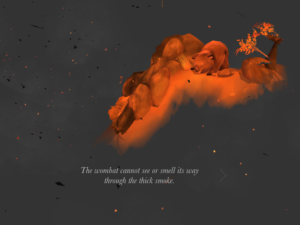
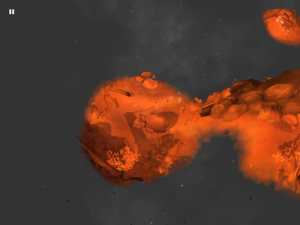
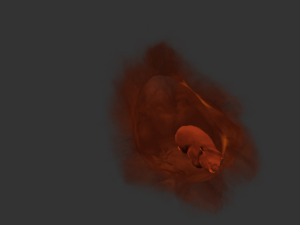
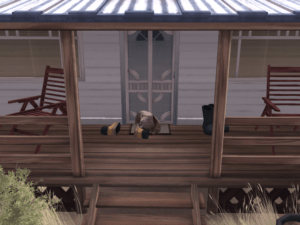
In the end, the wombat finds fresh grass and a comfortable front porch to nap at. With this happy ending, humans are gently reminded of their responsibilities. The narrative is intentional in the message it conveys. At the end of the game, players are left pondering their own influence towards the disasters that these animals must face – now a seasonal tragedy to brace for.
Unlike Fortnite, which mirrors violence rooted in military-industrial complex without a clear narrative, Paperbark avoids traditional depictions of weapons and kills. Instead, the game evokes fear and death through environmental artifacts like dead trees and ash. The creators’ success in building this claustrophobic and suffocating environment without using traditional elements of violence is perhaps the games’ strongest feature. A game created for younger players, it suggests subtleties of death and fear-inducing music rather than direct kills from first-person shooting. This quiet but immersive approach on the destruction of climate change makes the message more accessible to all.
Clark, Nicole. “A Brief History of the ‘Walking Simulator,’ Gaming’s Most Detested Genre.” Salon, 11 Nov. 2017, https://www.salon.com/2017/11/11/a-brief-history-of-the-walking-simulator-gamings-most-detested-genre/.
Hunicke, Robin, Marc LeBlanc, and Robert Zubek. MDA: A Formal Approach to Game Design and Game Research. Northwestern University, 2004. https://users.cs.northwestern.edu/~hunicke/MDA.pdf. Accessed 24 Apr. 2025.
Paper House Pty Ltd. Paperbark. Apple App Store, 2 Sept. 2018, https://apps.apple.com/au/app/paperbark/id1155399928.