I played Blood on the Clocktower, designed by Steven Medway and published by The Pandemonium Institute. It’s a tabletop game played in person and moderated by a narrator. The target audience is people who enjoy social deduction games (typically 5–20 players). The game’s open communication structure, asymmetric roles and emphasis on information revealed my preference for passive observation over active leadership in a group.
Unrestricted Communication
In Blood on the Clocktower, players can speak freely during the day, including having private sidebar conversations. This is different from games with structured turn-taking, such as Avalon or Secret Hitler‘s rotating presidency, or Werewolf‘s daily speaking rounds with only public discussion. During the game, I found myself mostly listen and observe, and never made accusations or 1-1 conversation. I prefer being quiet rather than directing conversations. In a way, the game amplified existing tendencies—quieter personalities can remain in the background, while more outspoken players dominate the discussion.
The emphasis on communication is also reflected in other mechanics. During voting, as long as another player receives more votes on the chopping block, you avoid execution. As a result, persuasion and accusation often become more valuable than consensus-building.
Communication happens even with eliminated players. In Werewolf, Mafia, or Secret Hitler, dead players simply wait until the game ends, which can become frustrating during long sessions. In Blood on the Clocktower, dead players remain engaged in discussion and have one final “ghost vote.” This allows them to continue contributing while still giving players an incentive to survive because their influence becomes limited after death.
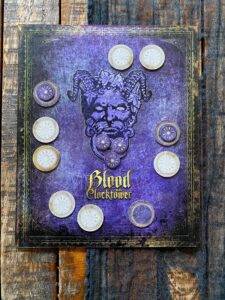
Together, these mechanics encourage players to form temporary alliances, debate, and test each other’s credibility. Through the MDA framework, these mechanics create dynamics of negotiation and information sharing, which ultimately produce aesthetics such as Fellowship through intense social interaction and Challenge through logic deduction under uncertainty.
Different Roles
I found myself relatively passive instead of leaning the group, but I wondered whether this reflected my own personality or was shaped by the roles I received. My first role was the Ravenkeeper, whose ability only activates after dying at night. My second role was the Baron, a Minion with limited information and no active ability. Both roles naturally encourage a more passive play style. I am curious how I would behave if I were assigned an information-rich role such as the Fortune Teller or Investigator.

Since the roles are both asymmetric and randomly assigned, the game encourages players to temporarily adopt identities different from their everyday personalities. This reminded me that games can function as learning environments, where players safely experiment with new behaviors with in the social simulation. It also reminded me of Vygotsky’s Zone of Proximal Development, where people learn by trying unfamiliar roles within a low-risk environment.
Information As Resource
Unlike many board games where resources include money, territory, or cards, the primary resource in Blood on the Clocktower is information. Every player possesses only a small fragment of the overall picture, making communication the mechanism through which information is exchanged, hidden, manipulated, or verified.
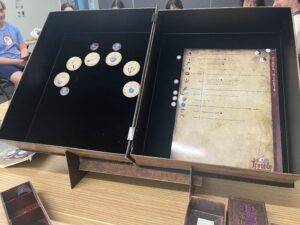
Because the game contains an enormous amount of characters and scripts, players cannot rely on familiar patterns or optimal strategies in the way experienced Avalon or Mafia players often can. Every session requires players to analyze a new combination of roles, which partially levels the playing field between experienced and new players. Although the amount of information can initially feel overwhelming, I actually think the game is quite beginner-friendly because the challenge shifts away from mastering rules toward mastering communication and integrating information. In the rounds we played, all beginners were able to engage and communicate. Plus, the game provides reference sheets explaining all roles and players have access to it at all times.

The huge possible permutations gives the game exceptional replayability. The mechanics of randomizing involved characters (up to the narrator) and scripts create the dynamics of people keeping discovering new strategic possibilities. This produce aesthetic experiences of Challenge, especially trying to make decisions under uncertainty and complexity. Instead of rewarding mastering established patterns, the design encourages curiosity and continuous learning. Personally, my enjoyment came not from winning but from observing social interactions and logical deduction. Even watching the narrator became enjoyable because balancing dozens of possible role combinations is a fascinating design challenge in itself.
The Ethics of Lying in Games
Entering the game is entering the magic circle—a temporary social space where participants voluntarily accept a different set of rules. Players understand that deception, bluffing, and role-playing are expected parts of the experience. Thus, lying is not unethical as in real life, since the social contract has changed.
Players are also acting their ‘roles’ rather than themselves. When I played, I saw that not only the ‘evil’ team lie. In one game, the Fortune Teller didn’t reveal himself and claimed to be another role, so that he can get more information and mislead evil players. In this context, lying actually strengthens the shared experience.
The ethics question I’m curious, is what if players learned manipulation and deception skills in the game, and bring it to real life? Does a game facilitate moral harm even if such behavior is acceptable within the game itself? Where does the boundary end? On the other hand, we can say that games provide a safe learning environment for recognizing manipulation and deceptions.