


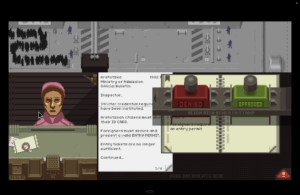
I had been playing Papers, Please long enough that I stopped seeing the people in line as people. Deep in rhythm, I’d check the photo, match the dates, verify the duration of stay, confirm the issuing city, stamp, and next. I had multiple documents open at once, flipping between them constantly, trying to move through the line as fast as possible. The game asked us to play as an immigration officer at the border of the fictional state of Arstotzka, where every mistake costs money, and every correct decision helps keep your family alive. It was strange how quickly the routine became normal. Early in the game, I noticed every story that people told me. I’d pause when someone begged to be let through or tried justifying issues with their paperwork. But after enough days at the checkpoint, dealing with warnings and deductions from my paycheck, I became more focused on catching mistakes than listening to explanations. My family in the game was sick, and money was thin. Thus, every citation cost me something at home.
There’s a moment I keep coming back to. A woman stepped up to the booth, and her paperwork had a small discrepancy, the kind of thing I might have missed earlier in the game before I had been worn into noticing everything. The correct move was obvious; I was to deny entry. So I did, and as she walked away, she said: “Curse you!” What surprised me wasn’t the decision, but that I still felt bad about it. She wasn’t real, the checkpoint wasn’t real, and the whole scenario had been engineered to make me choose procedure over compassion. I was aware of all of this, but I still felt like I had done something wrong.
It was a familiar feeling from other games – in BOKURA, players kept looking out for each other even as the game tried to introduce secrecy and hidden information to incentivise self-preservation over group work. In Slay the Princess, players hesitated to commit violent acts even when the game repeatedly steered them toward violence through looping structures. This raises the question of whether there is a “right” way to play games, especially those that allow multiple choices. Players seemed unable to fully detach themselves morally from actions they knew were fictional.
This is what makes video games a unique medium: players aren’t passively watching an ethical dilemma, but are inside of one. Jonathan Frome argues that games are more than simple interactivity. Players participate in situations where their own actions help determine what happens next. These actions become part of the experience itself, so games can generate emotions that are tied to personal responsibility in ways that non-interactive media may not be able to. As Frome mentions, players experience outcomes as consequences of actions they perform themselves. This distinction becomes important when thinking about why feelings like guilt and responsibility still remain even when players know a game is clearly fictional.
They make choices that a system responds to, with rewards, punishments, and pressures. But players don’t just follow the system’s logic. Rather, they drag their own instincts and priors into their play experiences. Even when the game is pushing for efficiency, violence, or cold self-interest, some of us still keep searching for something that feels morally livable.
Across these games, the systems seem to push players toward specific responses, assuming that players will try to optimize for the goals the games give them. Games seem to be built around rational models of human behaviour. Papers, Please assumes that survival incentives and repetition train players into bureaucratic thinking. BOKURA introduces asymmetrical information that should, in theory, encourage suspicion between players. Slay the Princess repeatedly loops violence until the shock factor no longer exists. But my experience of playing these games suggested something more complex: that players often resist the logic of the systems they inhabit. Players hesitate, cooperate, feel guilty, proud, and invent ethical boundaries that the game itself never formally requires.
With Papers, Please, we see that the power comes from implicitly transforming the players into part of a larger bureaucratic system. Bogost’s argument that games persuade through “procedural rhetoric” holds here, where systems and processes become the medium through which perspectives are communicated. Unlike a novel or a film, where a story could depict an overworked immigration officer losing sight of the people they process, Papers, Please asks the player to perform that work directly. The game’s argument comes through the repetitive actions the player must carry out in order to succeed.
At the beginning of the game, the work of the immigration officer seems explanatory. The player checks a few documents and has to confirm some pre-set details to decide whether someone should be allowed to enter. The green stamp and red stamp did not feel especially consequential, and I found myself paying attention to some of the stories people told me and trying to understand why they wanted to cross the border. As the game went on, however, the relationship between the player and the entrants progressed. The game introduces additional forms of identification, more rules and exceptions, and harsher consequences for mistakes. Every day, the player needs to process more information than the day before, introducing the idea of procedural accuracy in order to survive. Incorrect decisions lead to citations, which then lead to reduced pay, directly affecting the well-being of the player’s family. Personal survival starts to take priority over all else. I remember learning that my son was sick, had to deal with budgeting and prices, which gave me a sense of determination to not pick up any citations on the next day. The system created a powerful incentive structure where helping others may feel morally correct in the moment, but making mistakes carries a personal cost. The moral mathematics of evaluating every decision led to a greater sense of pressure and purpose.
As a player, my attention shifts. I started to focus solely on the documents rather than the people, and found myself narrowing in on identifying inconsistencies and avoiding penalties. I wanted to find every possible mistake, comparing the DOBs across documents, checking whether every photo matched, and verifying how long applicants wanted to stay versus how long they were allowed to stay. At my most efficient, I often had five things open at once, rapidly switching between documents, the rulebook, and regulations. What mattered was no longer understanding the person standing in front of me, but determining whether their paperwork was correct or not.
This transformation is what makes Bogost’s concept of procedural rhetoric so useful for understanding the game. Papers, Please does not explicitly argue that bureaucratic institutions encourage people to prioritize procedure over empathy. The game creates conditions where the player gradually begins behaving that way. In my own gameplay, the checkpoint interface made these people become collections of fields and data to validate. The game rewards speed and accuracy rather than compassion. In doing so, it encourages players to adopt the perspective of the system.
However, this transformation of mindset while playing Papers, Please never really feels complete. Even after adapting to the logic of the system, players continue to feel morally implicated in the actions they perform. When the woman whose paperwork contained a small discrepancy came through, denying her entry was the obvious choice. From a procedural perspective, there was no dilemma, but when she responded with “Curse You!” after being denied entry, I felt unexpectedly guilty. I knew I had followed the rules and understood that the interaction was fictional and the game had been designed to pressure me toward this outcome. And nevertheless, the feeling of responsibility remained.
Nagel’s argument about subjective experience helps explain this tension. Nagel argues that there are aspects of experience that can’t be fully reduced to objective systems or external descriptions. Papers, Please presents players with an objective framework, and from the perspective of the system, denying entry was correct. Yet players do not experience the game purely from the perspective of the system. They experience it as subjects performing actions, and the role of the immigration officer does not erase the player’s own moral intuitions. The game creates a conflict between institutional obligation and personal responsibility. The emotional power of the interaction comes from the fact that the player had to actively act rather than just observe it. The game can pressure players towards efficiency and train them into bureaucratic thinking and reward procedural correctness, but it can’t eliminate their sense of moral responsibility. Instead, Papers, Please reveals the central tension of moral play, where systems can shape behaviour, but they cannot fully determine how players feel about the actions they take.
While Papers, Please demonstrates how systems can pressure players into thinking procedurally, BOKURA explores how game conditions can risk trust altogether. The game repeatedly separates players through hidden information and different visual realities to create a situation where cooperation becomes increasingly fragile. Yet, my experience playing the game suggested that trust often persists even when the system provides reasons for suspicion. In theory, BOKURA resembles the conditions described by Axelrod and Hamilton’s work on the Prisoner’s Dilemma. When individuals have separate information and incentives that are still uncertain, cooperation becomes fragile because self-interested actors have reasons to defect. The game appears to be built around this possibility. Players receive different information and are even occasionally instructed to keep secrets from one another. Rather than produce a shared reality, the game creates two halves of a reality that somehow have to be reconciled.

However, this was not how the game felt while I was playing it. Although the game repeatedly introduced reasons to become suspicious, I rarely found myself thinking strategically about whether cooperation would benefit me in the long run. Helping my partner felt immediate and instinctive — when she needed help navigating a challenge, my response was not to calculate whether assisting her would maximize my own outcome but simply to help. Even moments where one player had to move beyond the visible limits of the screen and take on unknown risks never felt like opportunities for exploitation, but reinforced our sense of responsibility toward one another. Nagel argues that conscious experience possesses a fundamentally subjective character. No matter how much information one has, it is impossible to fully know what it is like to have and occupy another perspective. Communication becomes necessary because both players don’t have a complete understanding of reality. Nagel’s argument has some limitations, though, where even if complete understanding is impossible, cooperation remains possible. While I could not literally see what my partner saw, I could still respond to her frustration and her excitement. The gap between our perspectives didn’t mean that there was a lack of empathy between us.
What makes BOKURA interesting is that it challenges the assumption that players will always respond to incentives. The game repeatedly creates conditions under which suspicion would seem reasonable, but cooperation often emerges anyway. Even when players cannot fully understand one another and possess reasons to prioritize themselves, they continue acting as if the success of the other person matters. By making many of the challenges impossible to pass without working together as a team, while injecting conflicting incentives through the private information/tension created, there is a clear tension between self-preservation and team success. This suggests that moral play cannot be explained just through systems and rewards. Papers, Please showed that procedural systems cannot eliminate feelings of guilt, while BOKURA demonstrates that systems encouraging self-interest cannot fully suppress empathy. Players bring their own emotional commitments into games, often exceeding the behaviours that those systems seem to be designed to produce.
Trust and empathy aren’t the only emotions that persist beyond systems, as in Slay the Princess, the question becomes what happens when a game repeatedly asks players to commit violence. Rather than encouraging cooperation, the game attempts to normalize harm. However, even here, players continue searching for moral meaning inside actions that can feel increasingly inevitable.
When I first entered the cabin in Slay the Princess, killing the Princess felt significant. The game builds tension around the decision through the constant arguments between the Narrator, the hero, and the Princess herself. Even before any violence occurs, there is uncertainty about whom to trust and whether the player should follow the instructions they have been given. While the game technically presents multiple dialogue options, all of them seem to orbit the same central question about whether or not the player would kill her. The first time I acted, it felt uncomfortable. The violence was graphic and difficult to dismiss. The game achieved this effect through intense visuals, in which the blood contrasted sharply with the black-and-white art style, making the act feel shocking rather than routine. However, the structure of the game gradually changes the player’s relationship to this violent act. Regardless of how the player approaches the Princess, the game repeatedly loops back to similar situations. Each iteration introduces variations in dialogue and characterization, but the violence remains central to the experience. Quoting my reflections from the moment of gameplay, “killing the princess is no longer a singular decision but a recurring requirement that the game redirects me to, even when I try to avoid it”. What initially felt disturbing slowly becomes more and more expected, and I learned to anticipate violence in the same way that I learned to anticipate the paperwork discrepancies in Papers, Please, putting my guilt aside while repeating these acts.
Connecting to discussions about violence in games more broadly, in the New Yorker article, “How Evil Should a Video Game Allow You To Be,” Simon Parkin argues that video games have a unique ability to implicate their audiences because players are not just spectators but active participants. The question is not about whether players witness violence but what happens when they are forced to repeatedly perform it. In Slay the Princess, the player is not just observing a murder but selecting dialogue options and choosing actions to carry them out. The repetition borders on transforming violence from an ethical decision into a procedural action.
Sarah Stang argues that many games eventually do reveal the limits of player agency, showing how choices that may seem meaningful actually are quite heavily constrained by the system itself. It is similar to Slay the Princess, where the game initially presents violence as a choice; it gradually becomes clear that the system is redirecting the players towards certain outcomes. The player begins to realize that they are operating within a framework where certain events feel unavoidable. Stang argues that agency doesn’t disappear when narrative agency is constrained, that instead, “players create meaning within these possibility spaces”, reflecting on the actions they perform even when the available choices are limited. This realization creates tension, as the player is caught between two understandings of their actions. As a player, I was wondering whether there was another option or whether I was responsible for what was happening. The discomfort came from more than just the violence — it was from the relationship between personal responsibility and systemic constraint.
This same tension is in Papers, Please, and BOKURA. In Papers, Please, procedural systems still meant feeling guilty, while in BOKURA, incentives toward self-interest didn’t mean a loss of empathy. Similarly, in Slay the Princess, repeated exposure and constrained choices couldn’t eliminate moral reflection. Players continue looking for ethical meaning even when the system appears to make their actions feel routine, therefore demonstrating that moral play does not require complete freedom. Instead, it comes from the struggle between what the system encourages and what the player feels responsible for.
These games show that moral play goes beyond making choices, as there are other forms of media that ask their audiences and players to evaluate moral dilemmas. Books invite readers to judge characters, and films often ask viewers to empathize with difficult decisions. What distinguishes games is that players have to participate in these moral decisions. The player stamps the passport, chooses whether to trust their partner, or when to raise the knife against another character. Even when these actions seem constrained, the act of performing them creates a different relationship between the audience and the moral question being posed. This explains why moral meaning in games cannot be reduced to just systems with rewards and rules. As Sicart argues in Against Procedurality, ethical play comes through the player’s active engagement with a game rather than through mechanics alone. The games I played this quarter attempted to push me towards particular behaviours, but the most memorable moments were not when I followed those systems successfully. They came through the moments where I felt tension between what I thought was right and what the system wanted from me. Those feelings of guilt and regret all came from having to balance that tension.
I still grapple with guilt about that woman at the checkpoint in Papers, Please. The game rewarded my behaviour, but that feeling that I was doing something wrong lingered long after I had moved on to the next person in line. What interests me is not if that decision was morally right or wrong, but why it felt meaningful at all. Across the three games, players repeatedly exceeded the logic of the systems that they operated within. Repetitions and constrained choices attempted to shape behaviour, but players continued to bring their own emotional instincts and intuitions to their game experience.
This is why games are so uniquely powerful as a medium. Games can pressure players into efficiency, violence, cooperation, self-preservation, and betrayal, but still cannot fully determine how these actions are experienced. Ultimately, moral play emerges from the space between the player and the system. Games provide the incentives, but players bring their own interpretations. Because of this, players negotiate with the ethical logic of the systems they live within. The most memorable moments in games are the ones where the system works perfectly, but the players still look for what looks morally livable within it.
