Consumption Dressed Up as Commentary: DDLC & the Limits of Feminist Deconstruction
Doki Doki Literature Club (DDLC), by Team Salvato, is a free-to-play psychological horror visual novel disguised as a dating sim, aimed at teens and young adults already fluent in anime and internet culture. Released in 2017, it is single-player, roughly four to six hours on a first playthrough, and available on PC, Mac, Steam, and other platforms. I decided to play DDLC for my critical play this week and I came to it almost entirely ignorant of the visual novel genre. I had never played a dating sim, and had no particular relationship to anime aesthetics. After playing I came to the conclusion that DDLC never fully escapes its genre’s foundational problem – that its female characters exist to be consumed, not understood. Its visual novel mechanics (dialogue selection, intimacy mechanics, and the deliberate recycling of infantilized female archetypes) are not incidental to this problem; they are the problem.
Team Salvato gestures toward deconstruction by exposing these archetypes as hollow, but the mechanics underneath remain untouched. I believe critique of the male gaze delivered through the male gaze is not feminist design; it is consumption dressed up as commentary.
The Compliant, Docile Girl Archetype as Formal Procedure
As I played, I noticed that the game’s most important design decision was not the surprise horror – it was its opening scenes, and how carefully they were constructed to fit the four girls into clean, shallow archetypes. For example, Sayori is bubbly and self-deprecating and Monika is poised and perfect. I found these to feel less like characterizations and more like menu options. The affection system, in which the player writes poems by selecting words that appeal to individual characters, makes this visible as a formal procedure. I learned what each girl wanted and gave it to her, the first one being Sayori. The resulting reward was access; the girls opened up, they would lean closer when speaking and their sprite would tilt towards me. When I showed favoritism towards any girl in particular, there would be more intimate one-on-one scenes with them, such as the following:
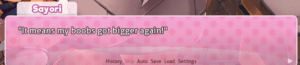
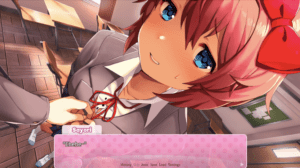
Sayori flirting with my character (in a manner that sexualized her characteristics, painted to seem helpless and innocent) as I helped her button up her shirt.
This is what Shira Chess, in “Play Like a Feminist”, identifies as the problem with “popular feminism” in consumable products. That the feminisms most easily commodified are those most structured around existing power arrangements, which in video games have historically meant a masculine audience and feminine characters designed for that audience’s viewing pleasure. Beyond how the girls are drawn with oversized eyes and hypersexualized bodies (for highschool girls), I noticed that the aesthetic language of both charm and distress are collapsed into each other. By intentionally rendering distress and cuteness in the same visual language, Team Salvato ensured the girls remained objects of aesthetic pleasure even throughout their suffering.
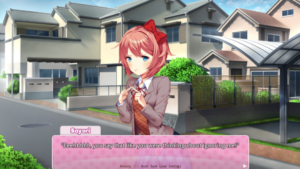
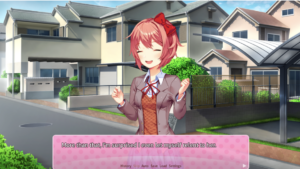
Sayori’s similar body posture when both anxious and when excited
The Deconstruction That Doesn’t Really Deconstruct
The game’s horror does not arrive through cutscenes or exposition. It arrives through the interface itself. Sprites begin to flicker and misalign. The screen splits, corrupts, and stutters. The game deliberately lags, menus freeze, and text renders wrong. Team Salvato uses the formal language of a broken program to signal each girls’ psychological collapse, and I found it very effective. When Sayori’s sprite glitches before her death, the horror lands not because of what is shown but because the game’s own visual grammar; the mechanism that had been making these girls legible and appealing for hours – had started to fail. This interface corruption produced a dynamic of helplessness as suddenly, my agency meant nothing and I was filled with dread. I found this interesting because the opening hours ran on narrative and fellowship types of fun, while the second act abruptly converts that into sensation fun without passing through genuine discovery or expression. The girls’ suffering was being used as a genre pivot rather than characterization.
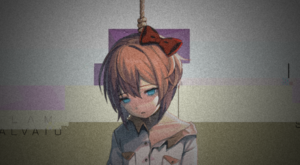
(Warning): After walking into Sayori’s bedroom and finding she had hung herself, the interface began to start glitching and cutting in and out.
Furthermore, when Monika becomes aware that she exists as an object inside a system to be consumed, she breaks the loop my character seems to be living in and deletes the other girls from the game- which initially reads as radical play.
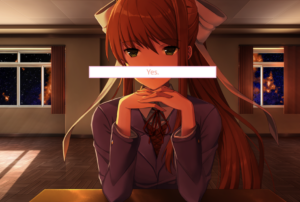
Her question was “Will you go out with me?” and the game dialogue mechanics enforce the narrative that Monika has complete control of my actions, because I’m in a program controlled by her. Therefore my only option to continue forth is “Yes.”
However, her arc reminded me of Chess’ warning- that the most insidious form of popular feminism is the kind that feels like resistance while leaving the infrastructure intact. Her resistance is expressed entirely as romantic fixation on the player and her disruption of the system leads not to liberation but to an intensified version of the same submission loop she was supposedly escaping. I realized here that her awareness of the male gaze does not free her from it; she simply maneuvers to become its sole object. This is where Chess’s framing of games as “affective systems” becomes most visible. I believe Monika’s arc doesn’t evoke solidarity or reckoning, but a more refined version of the same longing the game was always engineered to produce. Even in her revolt, Monika is designed to be consumed. The player is not asked to reckon with the system alongside her. They are asked to feel haunted by her, which is a different thing entirely, and a much safer one for the infrastructure that built her.
What Feminist Design Could Have Done
A feminist redesign of DDLC might refuse the affection optimization system entirely, replacing poem-word selection with something that rewards genuine attention to each character’s stated preferences, contradictions, and changes over time. It might develop the girls’ characters as ongoing, non-climactic experience rather than as reveal-and-destroy; giving Sayori’s depression a presence before the plot weaponizes it, or allowing Natsuki’s home situation to surface gradually through her own words rather than as a horror reveal. These are characters with enough texture to sustain real narrative development; the design simply never invests in that texture except to detonate it. Rather than using each girl’s backstory as payload delivered at the moment of maximum emotional damage, a feminist redesign might let those stories breathe. Unresolved, ongoing, and not organized around the protagonist’s reaction to them. Similar to Stardew Valley, the game could have combined structure with theme in a way that makes space for feminist narratives without instrumentalizing suffering as spectacle. Most critically, it would need to ask who it is building this world for, and answer with something other than the demographic the genre has always served. I believe the tragedy with DDLC is that the game designers understood the problem and pandered to it anyway because fixing it would have meant alienating the audience the game was marketed to.