Game—Poker: Texas Hold ‘Em
Platform—Tabletop
Audience— casual poker with friends (Historically Poker as a gambling game is 18+ or 21+)
I recently played analog poker with friends, no ante. For the first half I didn’t take notes. I was absorbed. After being reminded to take notes/pictures, I was neither attuned to the game nor to the notes. That split attention—the pull between documenting and playing—mirrors something Schüll describes in Addiction by Design: gambling machines demand your full presence, crowding out reflection until you’re already in too deep.
My central argument is that poker’s randomness becomes risky not because of the odds, but because of the social and environmental architecture surrounding them. Friendly poker is low-risk fun. But the same game in a casino—with free drinks, lavish tables, and Schüll’s “enchantment by design”—becomes an “undead” live service machine with no natural endpoint, designed to devour time.
After the end of our games I made a comment: “I’m never this lucky in poker!” to express that I had some “lucky” hands this game. I do believe I am luckier than most. Not in a gambler’s “I’m due for a win” way, but in a quieter sense: things tend to work out for me in the end. However, I don’t go looking for places to test my “luck” very often; games like poker aren’t mainly “luck” based. They have more room for other, stronger, factors to take over—skill, psychology, stamina. Luck doesn’t mean much without preparation. This statement aligns with my play style: I’m a very amateur player. I don’t like doing math. I play mostly vibes. This started during lockdown when my dad taught my family. I played statistically dogshit hands because just often enough, I’d win an unlikely straight or end up with two pairs. That pattern strongly stuck until I turned 18 and went to Legends Casino in Washington. After a disastrous game where I kept playing bad odds (plus a horrific poker face), my dad decided it was easier to teach me basic odds than to teach me to control my face. He was correct. I still cannot put up a poker face. Now I understand which cards are statistically worse, but I still play loose when cards just “feel right.” I was introduced to poker as a bonding activity, not a gambling vehicle. Even when I play for money with friends, I play for fun, not to “win.”
Also—and this is a slight side tangent that connects to Fullerton’s formal elements—I don’t love how poker gets styled as a single “game”. What is a game of poker? A hand? An evening? In casino poker, the answer is deliberately fuzzy. The chips are resources, the table has boundaries, but the outcome is always deferred. My intuition, because poker was introduced to me as a pastime rather than a gambling product, is that a “game” of poker ends when my chips run out. When a game resource hits zero, the game resets. But in a casino, chips are renweable (proportional to your funds). That small difference—the removal of a natural endpoint—is exactly what turns a game into an “undead” live service. Friendly poker can have an ending. Casino poker does not.
The rounds last week were no exception.
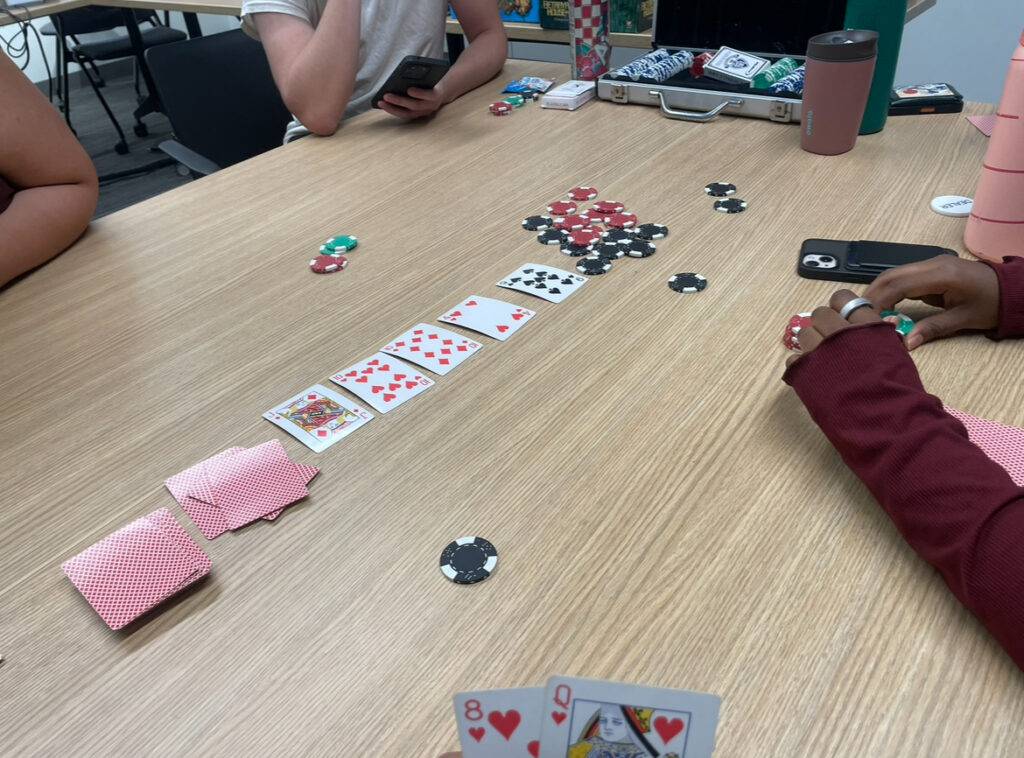
I photographed a hand that felt promising: 8 and Queen, suited hearts. No initial raise. After the flop—Jack of Hearts, 10 of Hearts, 10 of Diamonds— everyone had a guaranteed pair so everybody stayed in. After final betting, Marcarious revealed a Jack-high straight. I said, “I only had two pair and a high card,” and tossed out my 8. Butch interjected: “Show us your other card.” I ignored it. Internally: two pairs lose to a straight. Why show my high card? Butch got demanding. I relented. Queen on the table. Turns out I had a higher straight. I was confused until I realized: I had thought the 9 of Spades on the river was the 8 of Spades. Beyond rookie mistake. But the moment was funny and fun. Proper casino poker would not have allowed that. I would have lost practically all my money.
That’s the difference, and it brings me to Schüll. The randomness is identical in a living room or a casino. But the architecture around it changes everything. Schüll describes how slot machines use “virtual reel mapping” to create near misses—winning symbols just above or below the payline, tricking your brain into feeling you almost won. Casinos do the same with their environments. Free drinks lower inhibition. Lavish comfort removes the urge to leave. No clock, no windows. No endpoint. Evans-Thirlwell’s live service article calls this “undead” design—games that “want to live forever by devouring our time.” A casino poker table is a physical live service.
Legends Casino’s website makes this enchantment explicit: “a game where skill, strategy, and a little bit of luck come together.” They emphasize “inviting atmosphere” and “friendly competition” while downplaying that the house profits from the environment designed to keep you seated past your limits. Notice the framing: you’re not just gambling. You’re strategizing. You’re reading opponents. That’s Schüll’s illusion of control—the skill element is real, but it’s also bait.
Vegas, where I stopped during Spring Break, takes this further. Free soda becomes free alcohol. Tables digitized—chips and cards automated, removing even the friction of human error. My friends caught my silly slip because they were paying attention. In a casino? No one is looking out for you.
Chance becomes impermissible when it is manufactured to deceive—when designers create illusions of control, weighted odds, or near misses players cannot see. Friendly poker is permissible. The randomness is transparent. The social contract is honest—we’re here to have fun, not exploit cognitive biases. Casino poker tips toward impermissible. The odds are the same, but the environment is designed to keep you playing past your limits. Casino poker is fundamentally, purposefully, devoid of purpose or structure, because it is always bleeding away into the future. No catharsis. Just another hand, another drink, another “almost.”
I’ll stick to friendly poker. The randomness is the same. The addiction risk is not. And if you ever see me at a casino table, please remind me: I’m never this lucky.