This week, I chose to play Blood on the Clocktower, a social deduction game created by Steven Medway and published by The Pandemonium Institute. While the game can be played online, I played it in-person at office hours with ~6 other people (including the mod), with 2 joining in later in the game. The game is for teen to adult audiences and is a more complex twist on the folk game Mafia.
Clocktower is a unilateral social deduction game with multiple versions (I played “Trouble Brewing”), where the objective varies slightly depending on the team you’re on (Good = kill the imp, Bad = imp survives til the end) and the outcome is that only one team can win. Each version has around 20 different roles (or more, if Travelers are involved) compared to the much more simplistic game of Mafia, where there’s usually only 4. Mechanically, it seeks to expand and correct Mafia on its typical points of tension, such as dead players having no power or information being “he said she said”, but to also expand the folk game narratively as well.
While the game of Clocktower is primarily driven by the players’ decisions throughout the game, I argue that the setting and worldbuilding the game creates, while not CRUCIAL to its main types of fun challenge/fellowship, draws players in more deeply to the game’s sense of immersion.
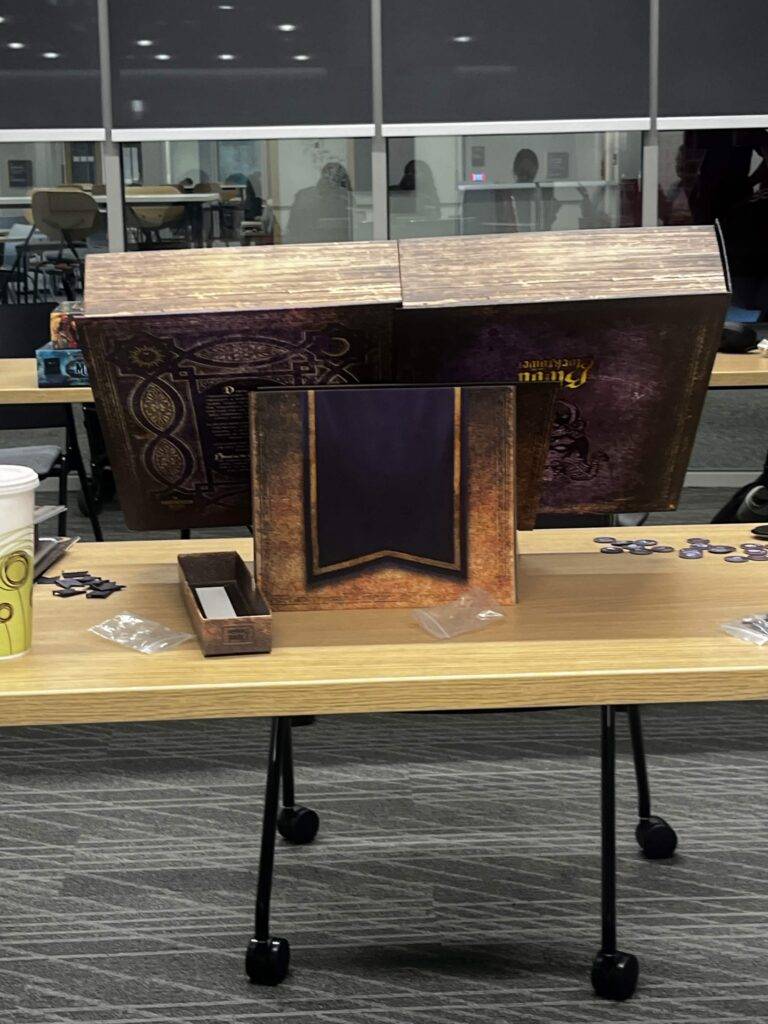
The props that come with Clocktower do a lot of the heavy lifting when it comes to its worldbuilding. Firstly are the non-text elements, such as the grimoire (fig. 1). These props increase the sense of game immersion, increasing the range of the magic circle by not only changing the real, physical setting that the players are in, but also implying things about the setting of the in-game narrative itself. A segment of text that typically the moderator or another player reads out before the game begins is about how the moderator themself is the first victim of the imp, impaled on the hand of the central clocktower. This evokes a particular “vibe” and setting of the game without needing to go into the nitty gritty details of things like currency or fictional religions, but instead paints in broad strokes what the energy of the game is supposed to feel like.
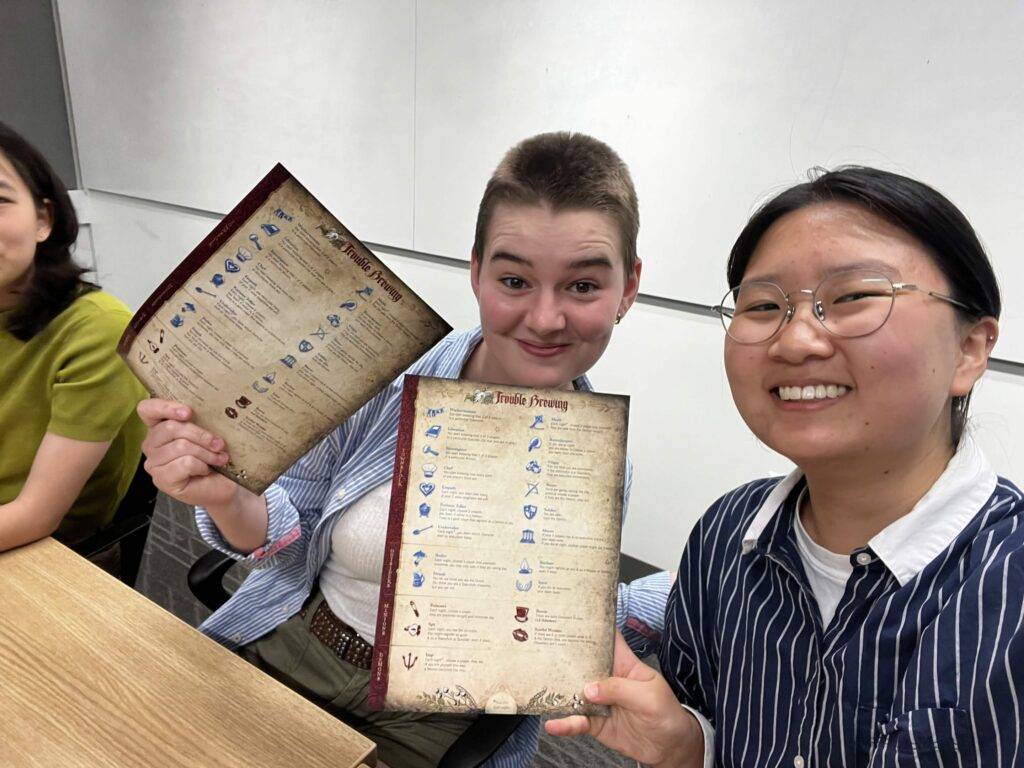
This broad-strokes approach actually supports the points made in The Psychology of World Building by Gabriela Pereira, who argues that “World building has less to do with your story’s environment and more to do with the characters you put in it.” Clocktower isn’t looking to make a super detailed world with intricate details about its economic system (and therefore waters down its social deduction focus), but is instead a sandbox for player/character agency that gives an understandable narrative context for player actions (see fig. 2).
An example of how the roles themselves play into the established worldbuilding while also meshing with the mechanics of the game are the Traveller roles. These are not typically available roles, but are instead reserved for people who may join later in the game. Mechanically, they’re very clever, as they can be EITHER good or evil, adding excitement to both the existing game as well as the role of the traveller themselves, but they definitely contribute narratively as well to the context of the world Clocktower has built. I actually had a pretty clear picture in my mind of the setting as some sort of gritty dark fantasy-ish setting (with pirates??), and the image of travelers who come around in the middle of a town crisis supported that image and didn’t break my immersion. Clocktower gives the players the pieces for the setting and for them to create their own narrative via the natural happenings of the game, which gives it a unique mixture of an enacting/emergent narrative feel (especially when an evil Traveller shot the imp, his own boss).

However, I think the true extent of Clocktower’s worldbuilding also depends on the moderator and the player group and how into roleplaying they are. I don’t think our group was super into dark fantasy roleplaying and so our story was that Butch was the anti-feminist who got killed by the SJW imp, which was interesting (fig. 3).
Ethics-wise, I remember jokingly mentioning some roles during my first play through of Clocktower, but I think it’s interesting how in a game where there are no explicit “characters” and are instead reliant on character archetypes to indicate the type of role people may have, in Trouble Brewing they made sure to relay some of the archetypes as specifically women: the Washerwoman and the Scarlet Woman. I understand that the Scarlet Woman may have some specific historical roots so that role is more understandable, but specifically choosing “washerwoman” and definitely stood out to me. This is definitely a small note in this type of game, but for games/movies/books in general I wonder if using misogynistic or gender-focused terms can be a shortcut to depict certain settings, especially ones that are historical or “gritty”. I personally would have not made that choice if I were making this game, and it makes me think about the artifacts of patriarchal culture slipping into these creations and how game designers have to be extra careful about their biases when designing.