
Dear Esther: Landmark Edition is a 2017 relaunch of a walking simulator originally released in 2012 by The Chinese Room and developer Robert Briscoe, published by Secret Mode. Available on Steam or ios, this is a single-player game designed for mature audiences who are interested in exploration. In Dear Esther, you play as a man haunted by the death of his wife. You are dropped on an isolated island to explore and uncover the narrator’s story as his voice fills your thoughts. This exploration reveals a nonlinear understanding of a broken psyche through space rather than explanation. Walking tells the story by structuring when and how narrative is revealed, turning movement through space into the primary storytelling mechanic.
From the beginning, Dear Esther immerses the player and provides an intrinsic understanding of its mechanics without tutorials or explicit instruction. The player is dropped into the world facing a cliff, seeing an electric tower in the distance, immediately marking its importance. Their only available action is to walk, and the first paths are made clear through the use of fences and beaten trails. When a player walks down a path that leading further into the game, they are “rewarded” with the voice of the narrator, revealing more about the world. Clear paths show the available areas to the player, while fences and cliffs act as edges, dividing available space for the unavailable, as shown by the fence and cliff restricting further movement in the following image.

The game is divided into different regions, such as the top of the cliff, the coastlines, and the caves, to mirror the emotions of the story as it progresses. Nodes anchor the otherwise fluid experience, with the wrecked ships, cave drawings, and candlelit objects giving moments of interpretive weight without traditional mechanics, as shown in the following image. Players pause at these nodes, giving the story weight.

Landmarks help the player position themself without a map, specifically the buildings and the electric tower. Dear Esther uses the Five Elements of Games to give players an intrinsic understanding of the world, allowing them to move through it effectively. This design promotes environmental storytelling and narrative pacing without additional mechanics.
Dear Esther utilizes an embedded narrative to encourage a player to explore the world and uncover the whole story through the simple mechanic of walking. The player almost immediately hears the voice of the narrator as they follow their first path, encouraging continued movement and learning. For example, early narration fragments describing Esther’s death are delivered only after progressing along specific paths, tying emotional revelation directly to movement. Whenever I felt ready to turn around, a narrative blurb reassured me to continue. Yet, the narrative is very unclear from the beginning; the player is only given pieces of the story as they go, motivating continued exploration and learning, as shown by this image describing a character that we do not know with unexplained metaphors.
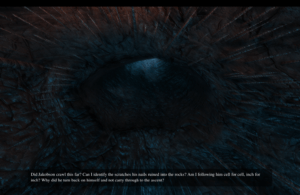
This embedded narrative embeds certain forms of foreshadowing, such as “Damascus” being visibly written on walls early on in the game, then referenced again in its final moments, or seagulls being heard if you go off a cliff, giving insight into the game’s ending. The mechanic of walking allows the player to uncover at their own pace through exploring different paths or regions of the world. This use of spatial storytelling in Dear Esther makes it a great game for Explorers, as the mechanic of walking promotes aesthetics of fun as exploration and discovery.
Spatial storytelling and exploration does have its downsides: it is easy to get lost and slightly frustrated in this game. The repetitive scenery creates a strong theme, but it also makes it easy to get lost and repeat your track. This happened to me frequently, particularly when discovering trails off of the beach of the wrecked ships. I became frustrated, feeling I was failing to uncover the narrative. Improvements could include clearer path differences, visual hints, or narrator cues to guide lost players. It is important to note that becoming lost is an important aspect of exploration and could lead to fun dynamics, but it is a balancing act. Compared to other walking simulators such as Gone Home and Firewatch, Dear Esther strips away interaction, relying on movement and environment rather than object manipulation or dialogue to convey narrative. This makes its use of spatial storytelling more abstract and interpretive, whereas other games in the genre provide clearer narrative scaffolding and player agency. This contrast highlights how Dear Esther uses walking not just as movement, but as the primary mechanism for delivering narrative through space.
Ethics: It should be noted that, while it does not utilize violence as a mechanic, Dear Esther tells a story involving difficult themes, such as death, drunk driving, and suicide. The narrative concludes with an acceptance and forgiveness of the narrator’s loss and its cause. He finds freedom in what is an implied suicide, which could have detrimental affects on a young audience and their perception of suicide as a viable solution to their problems. This game may be normalizing or aestheticizing self-harm by placing the player in a position of identification with the narrator, potentially blurring the line between representation and endorsement. Additionally, the lack of explicit consequences or alternative resolutions risks presenting suicide as narratively meaningful closure rather than a preventable harm. Dear Esther did not engage in direct violence, the exclusion of which allowed for a heightened focus on the embedded narrative, but it also shifts ethical responsibility onto how sensitive themes are framed and interpreted by the player. Unlike violent games that externalize conflict through action, Dear Esther internalizes conflict, using the absence of violence to foreground emotional interpretation.