

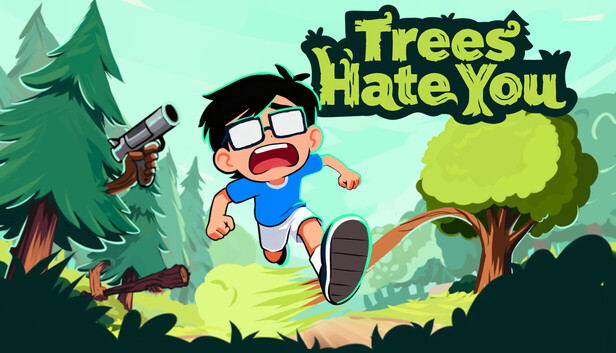
Trees Hate You (the demo) is a fantastic and simple single-player walking simulator rage game created by Tykenn. The game invites people who enjoy humor and being challenged by unpredictable, unfair systems rather than traditional skill-based gameplay. On first glance, Trees Hate You seems similar to other simulators like Firewatch or Dear Esther because you are simply moving through an environment. However, while traditional walking simulators focus on calm exploration and narrative discovery, Trees Hate You focuses on deception and hostility! This distinction leads to a fundamentally different player experience where the game uses walking as a system of spatial storytelling through distrust and the player’s movements becomes the narrative.
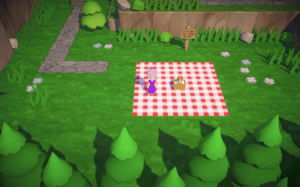
In class, we learned that not all games tell stories and some are more abstract and experiential. Trees Hate You begins in this abstract space. Even though this was the first walking simulator I have ever played, I was surprised by how quickly I understood what to do given that at my spawn point, there were zero instructions and objectives. Any exploration was entirely in my control and the mechanics only consisted of simple forward movement and interaction with space. I came in expecting walking to feel neutral and safe, but this was an intentional setup. The lack of instruction allows the game to make you feel in control just to later subvert those expectations with deception.
As I continued playing, the environment quickly shifted the dynamics where I felt like I didn’t call any of the shots. The trees did!! Some trees bent over to block my path completely, forcing me to find a new direction. Others had distinct behaviors like dropping down suddenly to kill me. Some even shot at me with a gun! Over time, I learned the patterns to survive, like which trees would try to kill me in what way and where I should walk with what speed. This created a dynamic of constant interpretation and adaptation even though the mechanics are minimal.
As frustrating as it was getting killed over and over by trees, I truly enjoyed forming my own expectations about how the environment should behave. There were core aesthetics in discovery and sensation, and I began to characterize trees’ actions as their personalities I had to adapt to. I ran in circles around some trees, moved in tiny footsteps around others, and even danced in zig zag. Each pattern of movement reveals how I felt about each tree.
There’s no pre-written story in this game, and instead the player learns through repeated interaction with a hostile environment. It reflects that idea that the experience of playing games can never be simply reduced to the experience of a story. The meaning comes from how I walk around each tree and what emotional relationship I formed with them (crazy, I know), because they all had different quirks to different extremes.
Trees would shoot roots to trip me, steal items away from me (rip I miss my top hat), or gang up on me with nearby trees. What emerged was my own narrative (emergent narrative) of dying, learning, and adapting arose from my interaction with the forest system. In that sense, the player can have the components to craft their own underlying message of the game. For example, that even something as familiar as nature can have unpredictable personalities. The only way to move forward is to adapt, learn patterns, and slowly overcome what once felt impossible.
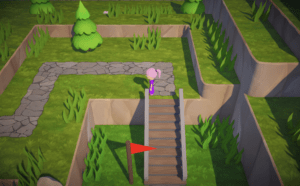
Another core mechanic were the checkpoints. They signal relief because it meant leaving behind the last level, yet I would then become extremely anxious of going near any of the trees around it. That contrast was both stressful and funny. Trees usually represent peace and nature, but here they are dangerous. This uses the concept of an evocative space, since the game relies on pre-existing associations and then subverts them. Everything kept you on the edge but you find that it’s only because you are moving within the forest. Without the player, these trees may never move or express their personality. The meanings lied in exactly how we walked.
Looking at some risks, I think that the unpredictability of the trees’ actions creates strong challenge and discovery. However, after a while, the same tricks can feel repetitive. The moment I expected deception, the surprise element of the game weakened. One improvement would be to introduce surprisingly longer moments of safety within the game to rebuild that trust (perhaps a path of kind trees), just to create the unexpected again.
On the ethical layer, Trees Hate You presents violence in a very different way compared to traditional games. In most games, violence is direct and controlled by the player, but here violence is completely environmental. The trees attack, trip, and manipulate the player, but the player cannot fight back, which creates a feeling of powerlessness. I also think the violence is more psychological than physical. The game constantly sets expectations and breaks them, creating a sense of mockery. However, because the overall tone of the game is comedic, it doesn’t feel harmful, instead it was delightful. The lack of direct combat shifts the focus from domination to adaptation. If I was able to attack the trees, the message of the game might be anti-environmental.
Aside from the amazing soundtrack, I was so pleased by walking through Trees Hate You because it was so simple yet I had learned so much about each tree through spatial interaction. The narrative was embedded right in where I walked and how I walked throughout the game, and I came out of the forest feeling like all expectations have been broken, yet I triumphed through the humor and uncertainty of it all.